

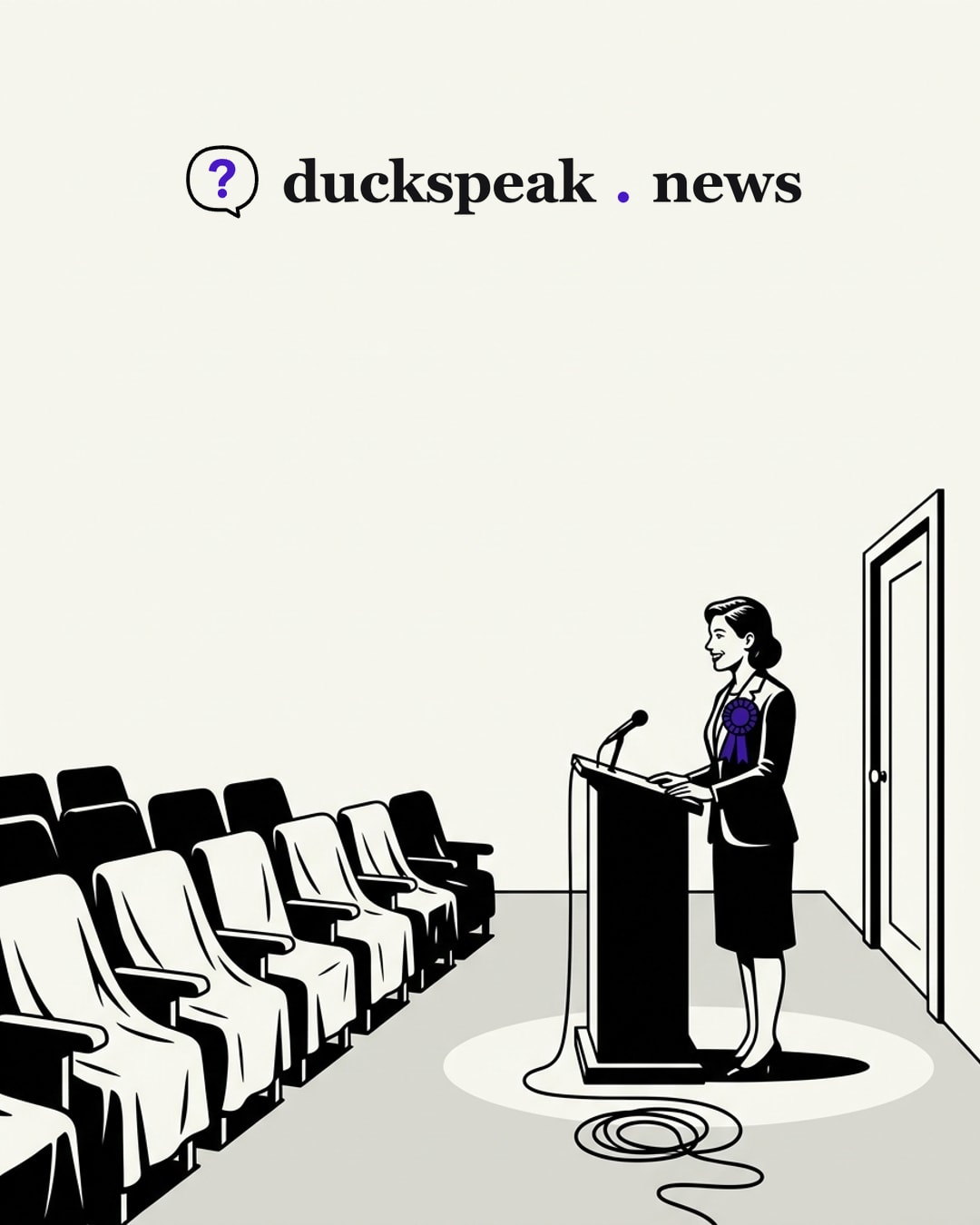
On Friday the president announced his sixth press secretary on Truth Social, and by evening six outlets on two continents had written it up [1][2][3][4][5][6]. Every version is built from the same raw material: the president’s own post, in which the stated qualification for the job is that Katie Zacharia has “an unblemished record of support” and is “a devoted fan and member of MAGA” [1][3][5]. What almost no version leads with is the fact sitting in its own copy: the briefing room has been dark for more than a month.
The credential that replaced all others
In the BBC’s write-up, CBS’s lead, and the Post’s story, the phrase “unblemished record of support” travels intact from Truth Social into print [1][3][5], always in quotation marks, never in question. It reads like a character reference. It is the job criteria. Notice what the sentence around it does not contain: nothing about informing the public, nothing about accuracy, nothing about answering to citizens rather than to the president. In the appointing authority’s own words, the new secretary “will deliver strong results for our Country” and “will work fantastically with, the Media, the American People, and my Administration” [1][3][5]. The media appears in that list as a partner to be worked with, one constituency among three, not as the institution the office exists to answer.
This is Newspeak by subtraction. The vocabulary of appointment has been reduced to a single approved attribute, support. When the only credential on offer is loyalty, the concept of a credential distinct from loyalty gets harder to say, and eventually harder to think. CBS put “loyal” in its headline [3] as a description of the person. No outlet put it anywhere as a description of the job having been redefined.
The job description versus the job
The Post tells readers the press secretary’s job is “one of the more visible positions in any White House, requiring regular on-camera briefings with reporters” [5]. The BBC describes “the complex job of press secretary” that “goes beyond the briefing room podium” [1]. Both are written as though the podium still functions. In the same news cycle, Fox News reports that “since Leavitt’s departure there have been only two formal White House press briefings” [2], and CBS notes the Brady room “hasn’t hosted a briefing for the press since Sept. 3” [3]. The institution is described in the present tense; its core function is reported in the past. No article lets those two facts collide. Nobody asks the incoming secretary whether she will resume briefings, at what frequency, or on what terms. The one comment the BBC sought from Zacharia was about her own appointment [1].
The hedging is even inverted. Fox, the outlet closest to the building, reports “it is not clear if she has accepted the role” [2], while the BBC states the president “has chosen” her and CBS that she “will be” the secretary [1][3]. The further the outlet, the more certain the casting.
The closed circuit
Follow the pipes. The announcement was made on Truth Social, a platform run by Trump Media & Technology Group [1][2][3][4][5][6], the company where Zacharia serves as senior communications adviser [1][2][3][4]. Her predecessor, Karoline Leavitt, has been hired by Fox News as an on-air contributor [1][4], a move Fox’s own story promotes in capital letters [2]; the BBC still calls it “reportedly” [1], though Fox has announced it itself [2][4]. The new secretary is, by her competitors’ description, “a frequent fixture on conservative Newsmax and Fox News” [1] and “a regular presence on conservative media, including appearances on Fox News, Fox Business and Newsmax” [4]; the Post discloses she “has also contributed op-eds to The Post” [5]. Fox’s own article, reporting on the hiring of a Fox regular, describes her only as “an attorney and frequent television commentator” [2]. The one outlet that could have disclosed her history on its own air declines to. None of this requires a conspiracy theory; the structure is visible entirely within the six articles’ own text. The pipeline runs from the green room to the podium and back, and the press covers the casting of its own future interlocutor as a personnel item.
The softeners
Leavitt left “to spend more time with her family” [1][5]. Zacharia left the Department of Homeland Security, per the BBC, because of “the strain of travel between California and Washington on her family” [1]. The Post alone adds the palace version: she departed after Markwayne Mullin took over at DHS, was “reported to be close to then-Secretary Kristi Noem and her special adviser Corey Lewandowski,” and her arrival “could upend the dynamics of Trump’s inner circle” because of Grenell and Lewandowski’s “long-standing distaste” for chief of staff Susie Wiles [5]. Both readings may be true; only one traveled. Four outlets ran the family explanation, one ran the factional account, and none ran both. Flagging uncertainty plainly: the factional account rests on unnamed sources in one outlet [5], not established fact, but it is the only version that treats the appointment as power politics rather than biography.
Then there is the résumé problem. Three outlets source her government service to “her LinkedIn profile” [1][3][4], and the three accounts of the DHS stint disagree: “February to March” [1], “about three months” [5], and February to April 2026 [6]. A tenure at a cabinet agency, reported three incompatible ways, all apparently from a self-reported page. The press is covering a press appointment by transcribing a CV.
The Huxley half
What fills the space where the institutional questions should be: a UFC quote (“I think there’s no better summation of the American ethos than a good UFC fight” [1]), an op-ed about wearing a MAGA hat to the gym [3], a husband’s filmography including The Irishman and Roofman [2], red carpet captions [2], four children [1][2][4][5], two years clerking at a Beijing law firm [1][6]. This is casting-call coverage. The reader learns what the new spokesperson is like, not what the office has become. The one flicker of pushback in the entire corpus is a single CBS clause noting that “the First Amendment protects against government censorship of speech, not private businesses” [3]. One sentence of correction, in six articles, and it is about a gym.
The sharpest doublethink also goes unremarked. NBC quotes the president blaming “the fake news” for his message problem and vowing better “promotion” [4]; the same news cycle carries his prediction that Zacharia “will work fantastically with, the Media” [1][3][5]. No outlet sets the two statements side by side. The man doing the hiring says the press is fake; the coverage prints the job description anyway, then frames the hire as the president’s promotion problem and its staffing solution, which is his frame, adopted.
What a reader would need instead
- Whether the briefings resume, and on what terms. This is the single most consequential fact about the hire, and in six articles it appears only as an aside, never as a question put to anyone [2][3].
- The White House Correspondents’ Association, which exists to represent the press corps on exactly this, access and briefing practice, is quoted in none of the six pieces. A reader would need its account, or any account from the reporters who staff that room.
- The count, up front: two briefings since August, none since Sept. 3 [2][3], belongs in the lead, not buried mid-story.
- The president’s own theory of the office, stated plainly in NBC’s quotes [4], placed next to the “fake news” line, so the reader can see what the new secretary is actually being hired to do.
- One question, asked of Zacharia or the White House, on the record: will you hold regular briefings? The BBC sought comment from her [1]; the subject of that request was herself.
A press corps that covers the casting call while the stage goes dark has already accepted the smaller role being offered to it.