

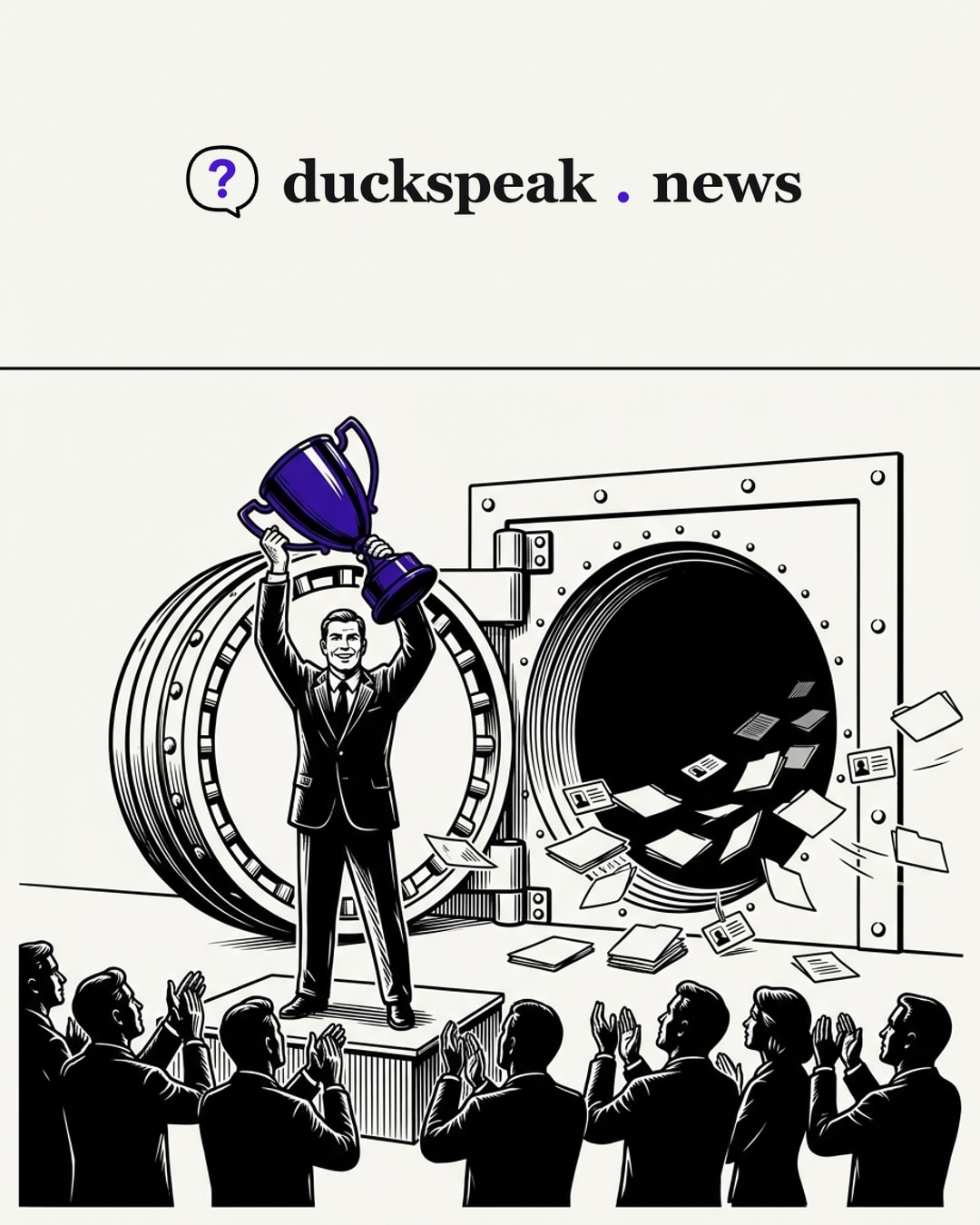
On Friday, FBI Director Kash Patel announced an arrest, and two major outlets showed their readers what the story was. Fox News headlined it “Kash Patel announces arrest of suspected ShinyHunters co-conspirator after FBI jobs portal breach” [1]: the subject is the Director, the verb is “announces,” and the breach, the thing that actually happened to the institution, is compressed into a trailing clause. CBS News made the bureau itself the actor: “FBI arrests suspected member of ShinyHunters in connection with jobs site hack” [2]. In both, the enforcement action is the news and the breach is the occasion. The failure is the setup; the arrest is the story.
The phrase that relocates the victim
Both outlets print the Director’s statement intact: “This arrest demonstrates the strength and reach of our efforts to protect Americans from cybercrime” [1][2]. The sentence travels between outlets untouched, and neither asks the question it invites. If the arrests demonstrate strength and reach, what does the breach demonstrate?
Consider “protect Americans.” The Americans whose data was taken, by both outlets’ own material, are FBI employees and applicants: a sample containing “agents’ names, home addresses, Social Security numbers, assignments and, in some cases, names of family members” [1], belonging to “nearly all FBI agents and people who applied to work for the bureau” [1]. The sentence doesn’t lie; it relocates. The specific harmed population, the bureau’s own workforce, is swapped for an abstract national beneficiary, and the arrest is attached to the abstraction. This is the Orwellian move worth naming: not a falsehood but a redirection of the object, printed twice without examination.
One outlet soothes
Fox’s summary line leads with reassurance: “no evidence hackers accessed classified FBI systems” [1]. The voice delivering the reassurance is Jason Pack, introduced by Fox as “a retired FBI supervisory special agent turned CEO of Media Rep Global Strategies” [1], a former bureau official who now runs a communications firm. His line: “There is a meaningful difference between somebody obtaining personnel information and somebody gaining access to classified investigative systems,” and “there is no indication they have the keys to the kingdom” [1].
The kingdom metaphor is doing anesthetic work. It converts a question of harm to identifiable people, whose home addresses and family members’ names are reportedly in an extortion group’s hands, into a fairy-tale image of castles and keys. Whether the distinction is “meaningful” to an agent whose household is in the sample is not explored. This is Huxley’s mechanism rather than Orwell’s: the soothing insider voice, the vivid image, the fear raised in one crosshead (“FBI HACK CLAIM RAISES FEARS OVER SENSITIVE PERSONAL DATA” [1]) and dissolved in the next paragraph. The story consumes its own alarm. To Fox’s credit, it notes “The extent of the alleged breach has not been independently confirmed” [1]; but the caveat arrives after the kingdom, a footnote to the reassurance rather than a challenge to it.
The other outlet subordinates
CBS has the accountability detail and buries it. Deep in the story, past the arrest, the anonymous sourcing, and the Director’s statement, we learn that the FBI’s Cyber Division Assistant Director Brett Leatherman announced “that a contractor failed to implement a security patch to the system that was targeted,” and that “The FBI has removed the contractor and taken all necessary steps to both mitigate any further risk and protect our workforce” [2]. Reuters, CBS notes, first reported the removal and identified the contractor’s employer as Accenture [2].
“All necessary steps” is unfalsifiable boilerplate, printed with no steps enumerated. The remedy on the record is action against an external party; the question of who inside the bureau supervised that vendor’s patching goes unasked. Fox, meanwhile, carries only Patel’s placement of the incident “on a platform managed by a third-party vendor” [1]. The failed patch, the removal, and Accenture do not appear in its story at all. The institutional failure is memory-holed in one outlet and demoted in the other, while the identical victory quote runs in both.
A timeline the story doesn’t flag
Both outlets frame the arrests as rapid response: “the latest in a series of FBI actions against the hacking network in recent days” [1]; “the latest arrest this FBI has made in a matter of days” [2]. But CBS’s own reporting contains a wrinkle it declines to comment on. Suspected member Pepijn van der Stap “was taken into custody on Sept. 15, meaning he was already in custody days before ShinyHunters announced it had hacked the FBI jobs website,” an intrusion “first reported on Sept. 22 by 404 Media” [2]. At least one arrest in the “string” predates public knowledge of the breach.
This point is speculative as criticism: van der Stap may have been detained for the group’s other activity, and these articles doesn’t say. But a story that builds an impression of swift, reactive enforcement owes readers the timeline that complicates it. CBS has that timeline in hand. It just doesn’t flag it.
Note also what is on the record versus off it. “The FBI did not provide any additional details on the individual’s identity or the location of the arrest” [2]; the specifics (Pennsylvania, a Canadian citizen) come from “a U.S. official and another source briefed on the matter,” granted anonymity “to speak about law enforcement details that have not been made public” [2]. The verifiable, on-record content is the bureau’s self-praise. The accountability reporting is anonymous, or, at Fox, absent.
What a reader would need instead
The scale, first, not ninth. CBS’s own material says “some veteran agents” consider this possibly “the worst breach of a federal government system since the infamous hack of the Office of Personnel Management system in 2015, when more than 22 million government records were stolen” [2]. That benchmark appears after the Director’s victory statement; it belongs above it.
The vendor relationship spelled out: who was responsible for the patch, who inside the bureau supervised them, and what “removed” actually means. Reuters’s Accenture identification [2] is already in the record; Fox’s readers never see it.
The count of affected people, in numbers rather than “2 to 3 terabytes” [2], which measures the theft’s weight, not its reach into households.
The arrest timeline set against the disclosure timeline, so “a matter of days” can be checked rather than felt.
And the inverse question, asked once, out loud: if the arrest demonstrates strength and reach, what does the unpatched system demonstrate? Both outlets had the material to ask it. Both ran the quote instead.