

On Tuesday, Nottingham Crown Court heard the opening of a murder trial. Duane Anthony, 40, denies murdering Tyler Fairman, a 26-year-old footballer with non-league side Woodthorpe Park Rangers, who died in hospital on May 12, three days after a red Vauxhall Astra mounted a kerb in Arnold, near Nottingham, and struck a group of pedestrians; Anthony’s girlfriend Destiny Carrier, 29, denies assisting an offender [1][2]. The Mirror covered it [1]. The Independent covered it [2]. And the two reports are, to a remarkable degree, the same article.
The same syllables, twice
Set the pieces side by side and the overlap is close to total. Both open on the prosecution’s phrase that a driver “deliberately drove into a crowd of people intending to kill them” [1][2]. Both carry, in the same order, the same extracts from prosecution counsel Gareth Weetman KC: the argument outside Sasha’s Bar, the man who “was seen to walk away”, the onlooker who “would have been wrong”, the CCTV, the man who “managed to ‘miraculously’ jump out of the way” [1][2]. Both include the same connective sentences in the same neutral voice, among them “The moment the car ploughed into the group was captured on CCTV that was played to the jury in front of a packed courtroom” and “There was an audible gasp” [1][2]. Both close on the same detail, the pair leaving Bulwell at around 5.50am in a vehicle with trade registration plates [1][2].
The differences are marginal. The Independent adds a street name, Gedling Road, and the detail that doctors noted “there were no signs of brain activity” [2]. The Mirror adds photographs and a plug for itself on Google News [1]. Otherwise the words match because they were, almost certainly, written once.
I cannot prove the upstream text from the material here; no wire slug is visible. The Mirror’s picture credit to “Jacob King/PA Wire” [1], and its second credit to Nottinghamshire Live / BPM Media, a Reach sibling title [1], make a single syndicated source the likeliest explanation, but that is inference, not established fact. What is established is the duplication itself. Duplication is not corroboration. A reader who sees the same account under two mastheads reasonably concludes it has been checked twice; it has merely been published twice. This is the mechanism this site is named for: duckspeak, Orwell’s term for orthodox speech emitted from the larynx while the higher brain sits idle. Two outlets quacking in unison is not a conspiracy; it is a distribution system doing what distribution systems do. The reader just should not mistake it for verification.
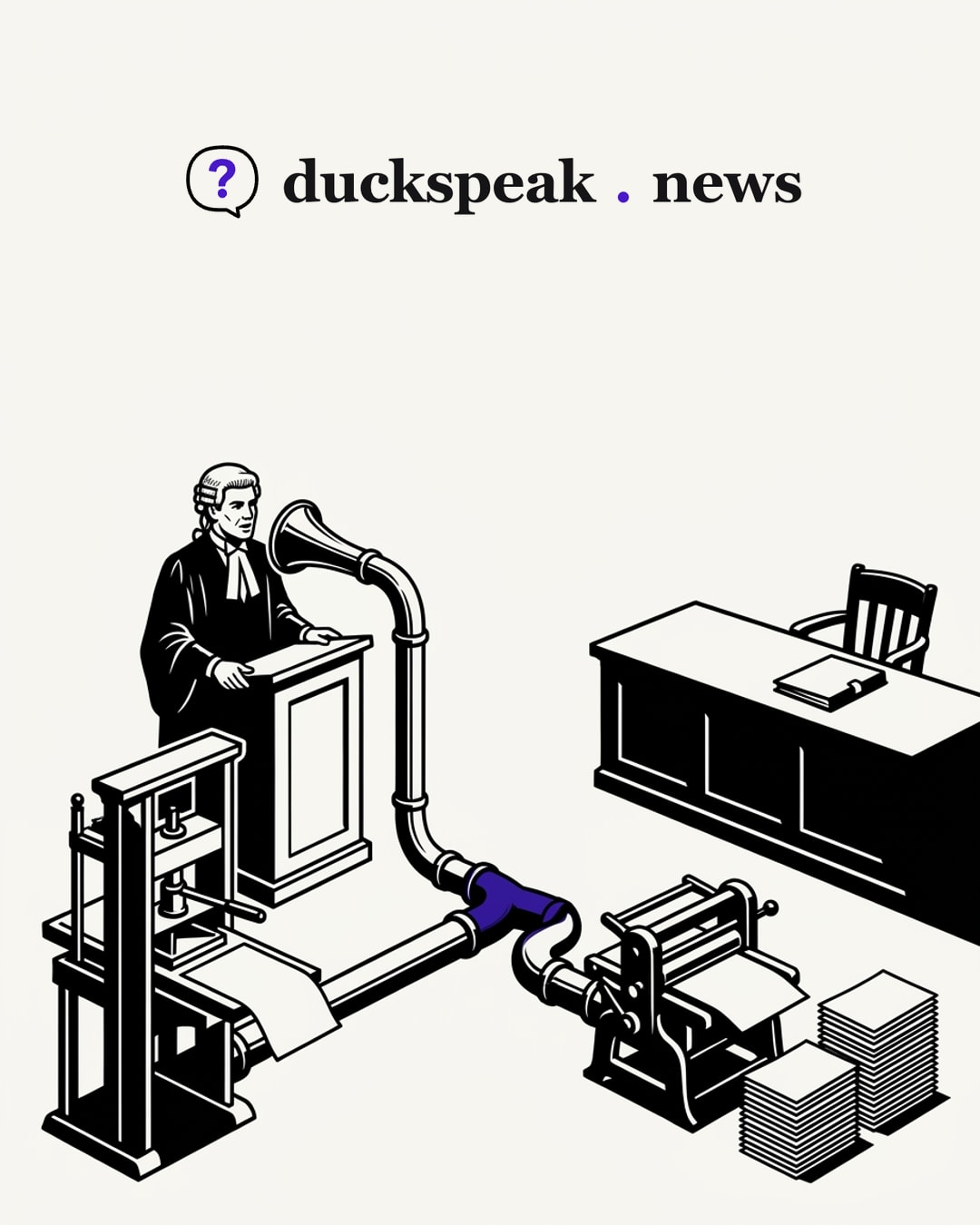
The advocate’s script, printed as scene
To be fair to both pieces, the attribution is technically present. Intent claims are framed as what “Mr Weetman alleged” [1][2], and the contested adverb in the Mirror’s headline, “deliberately”, sits inside quote marks [1]. The Independent tags its headline “murder trial told” [2]. This is not fabrication.
It is something subtler. The architecture of both articles is the architecture of the prosecution’s speech. The story has a protagonist (the driver described as “cold, calculated and violent” [1][2]), a reveal (“That onlooker would have been wrong” [1][2]), a moral (“his first thought was about himself” [1][2]), and a climax played to a gasping, packed courtroom [1][2]. The reader is seated as a second jury and shown exactly one advocate. The defence appears once, as a plea: Anthony “has pleaded not guilty” [1]; the Independent notes the pleas were entered “at an earlier court hearing” [2]. Two words, and then silence.
Part of the one-sidedness is structural: on day one of a trial the defence may not yet have spoken. The critique is that neither piece says so. Not one sentence in either article reminds the reader that an opening statement is assertion, not evidence, and that the jury has so far heard one side of it. That sentence costs nothing, and neither outlet spent it.
“Collision” and “motorist”: the default nouns
Here is the strangest tension in the copy, and the most speculative point in this critique. The Crown’s case is that the car was aimed at people; both articles transcribe “intending to kill them” [1][2]. Yet when the same articles need a noun for the event, they reach for “the collision”: “His life support was withdrawn in hospital three days after the collision” [1], a sentence the Independent extends with the brain-activity detail [2]. The Mirror’s headline noun for the accused is “Motorist” [1]. The vocabulary of the insurance claim keeps surfacing inside the vocabulary of the murder charge. This may be nothing more than routine shorthand; “collision” is a standard term and no editor visibly sat down and chose it. That is rather the point. When the nouns are pre-selected by reflex, nobody has to decide anything, and the frame arrives without an author.
What a reader would need instead
First, provenance. Identical wording across outlets is the signature of a single upstream text, and until outlets label syndicated copy, a reader should treat matching articles as one source, not two. The check takes two minutes: open both, compare.
Second, status. An opening statement is the Crown’s narrative, untested by cross-examination. The only defence information in either piece is the not-guilty pleas [1][2]. One sentence, “these are allegations the jury has yet to test”, would have done the work; neither piece carries it.
Third, the record. The ground truth is the court itself: Nottingham Crown Court’s proceedings, and in time the verdict, are what this copy should be checked against. The rules already exist; the Contempt of Court Act 1981 governs what may be published while proceedings are active, and IPSO’s Editors’ Code governs accuracy in reporting crime. Neither obliges an outlet to tell readers that a trial opening is advocacy, which is the gap this piece sits in.
Fourth, symmetry. When the defence opens, it deserves the same verbatim energy the prosecution received here, and if the verdict diverges from the Crown’s script, the follow-up deserves the same prominence as the gasp.