

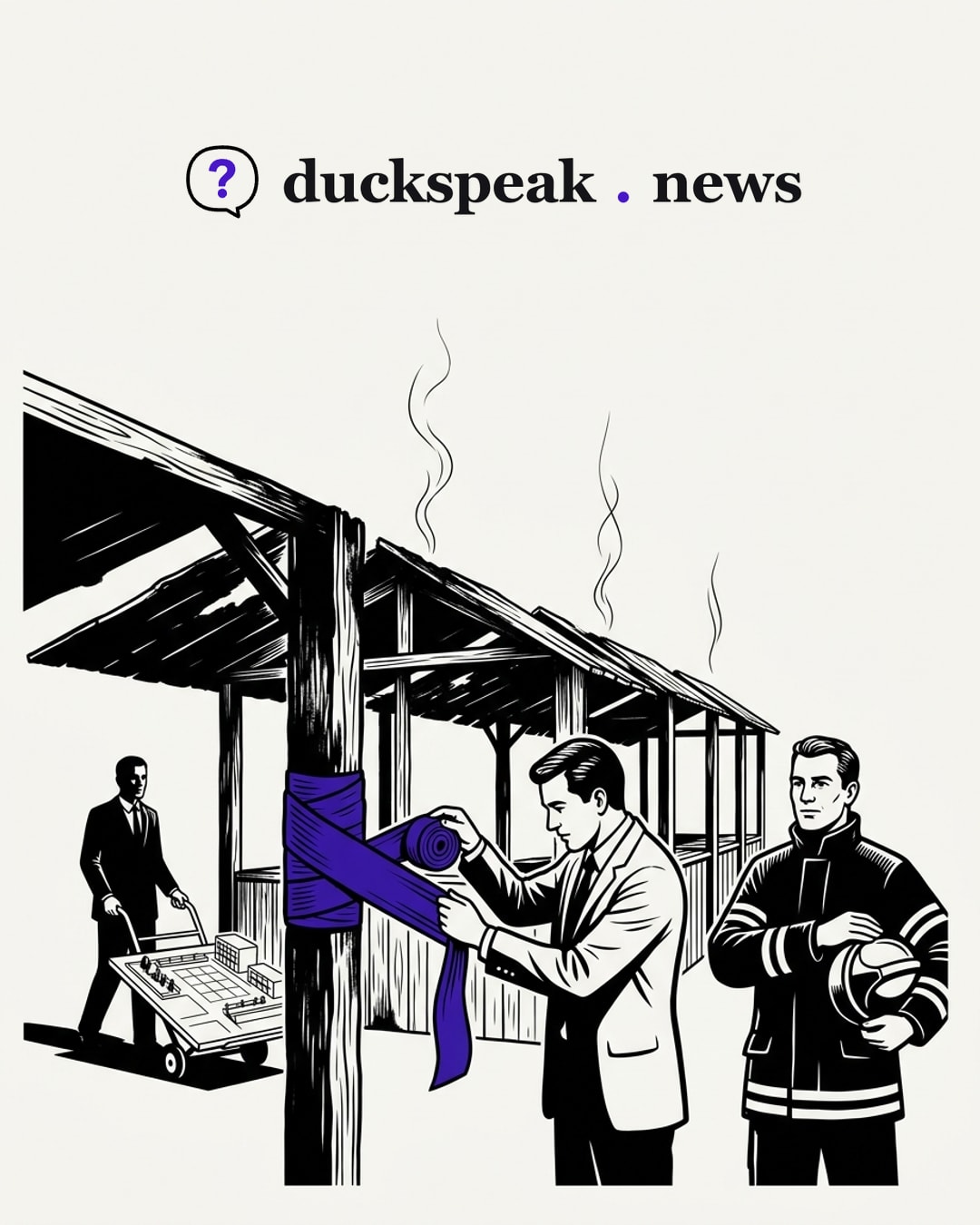
A fire took hold in Kingston’s Ancient Market at around 4.30am; four fire engines and around 25 firefighters attended, eight people were evacuated, and the Metropolitan Police said the blaze was not being treated as suspicious while the London Fire Brigade described it as accidental [1]. Both outlets covering the story relay that official line without embellishment, which is to their credit. The packaging around the facts is another matter.
The quotation marks are not punctuation; they are a liability shield
GB News’s headline reads “Fire rips through historic 800-year-old London market leaving locals ‘wounded’” [1]. The word wounded appears in quotation marks because a barista, whose coffee shop suffered cracked windows, told reporters: “We are really sad, all the community is wounded by this” [1]. It is a metaphor, and a fair one. Printed at headline scale it becomes something else: a casualty word, a battlefield word, attached to an event in which, a few paragraphs into the same article, “no injuries have been reported” [1].
The quotation marks are not punctuation; they are a liability shield. This is Orwell’s doublethink in miniature: the article holds two statements at once, locals are “wounded” and no one is injured, and both are technically true because one is a quotation and the other is a fact. Each does a different job. One word sells the click; the other keeps the record clean. The scare quotes are the mechanism that lets both coexist, so the outlet can print an impression its own reporting contradicts and then point, if challenged, at the barista.
The verbs get the same inflation: the fire “ripped through” the market [1], or “tore through” it [2]. Standard fire-genre adrenaline, and minor next to the noun.
“Fearless journalism,” assembled from other people’s quotations
The GB News piece is framed by a pitch: “Join the fight for free speech and fearless journalism” [1]. Look at what the fearless journalism consists of. Its strongest human material is credited elsewhere: the fishmonger who estimates £2,000 of fish was lost “told the BBC” [1]; the barista “told reporters” [1], unspecified. The loss itself is real, and a trader of 42 years says “It’s taken everything away from me” [1]. But the article is competent aggregation wearing a counter-establishment brand. This is the Huxleyan half of the problem: news as identity product, in which a market fire is the vehicle and the brand is the payload. The Independent wraps its version in the same kind of funnel (“Join thought-provoking conversations”) [2]. The funnels are universal now; they are still worth naming when a story’s emotional packaging and its commercial packaging turn out to be the same packaging.
“Regeneration,” undoubtably
Here is the genuinely open question, and only one of the two outlets surfaces it. In January the market operator, Between the Bridges, submitted plans for “replacement stalls, a central piazza, a restaurant, bar and roof terrace,” still undecided by Kingston Council [1]. The fire destroyed the stalls. What now happens to a pending proposal to replace them is the story. GB News closes the question with an adverb: “the fire would have undoubtably been a major setback in the regeneration of the area” [1] (sic). No operator, councillor, or planner is quoted saying “setback.” The certainty word substitutes for the sourcing.
The frame is borrowed, too. “Regeneration” is planning-world Newspeak: a word that sounds like healing while describing replacement, here the replacement of trading stalls with a piazza, a restaurant, a bar, and a roof terrace [1]. Whether the fire is a setback to that plan or simply a changed context for it is precisely the question a reporter might put to the council. The article answers it, undoubtably, in the vocabulary of the party that filed the application.
Two cautions, stated plainly. The cause is settled as far as the quoted officials are concerned (accidental, not suspicious [1]), and nothing in either article suggests otherwise; nothing here should either. And the “setback” line may reflect off-record conversations; nothing in the text says so, which is the point.
The Independent, the sober version, omits the redevelopment entirely. Its only mention of the operator is factual: Between The Bridges was “appointed by Kingston Council to run Kingston Ancient Market from 1 April last year” [2]. So a reader either gets the planning question smothered in developer vocabulary, or does not get it at all. The plain fact, that the future of the burned stalls is already the subject of a live planning application, appears nowhere as a plain fact.
Heritage as transferable gloss
Both headlines lean on antiquity: “800-year-old” [1], and The Independent’s more careful “Records show Kingston-upon-Thames had a market as far back as the early 1200s” [2]. The heritage is real. Note what it is attached to: an operating arrangement in place since 1 April last year [2]. The glow of eight centuries transfers, in both headlines, onto an eighteen-month-old commercial contract, and neither outlet marks the seam. Sentiment does the work that scrutiny would otherwise do. “This market is the heart of Kingston” [1] is a fair quotation, and it is also the last thing a reader feels instead of the first question they ask.
One discrepancy worth flagging
GB News reports the brigade “described it as accidental” [1]. The Independent reports “The fire brigade and the Metropolitan Police are investigating the cause of the blaze” [2]. Possibly a timing difference between the two publications; neither article dates its status, so a reader holding both cannot tell whether the cause is settled or open. The mismatch is a textual fact; the explanation is speculation, and is flagged as such.
What a reader would need instead
- The planning application itself. Kingston Council’s planning register is the public record, and “replacement stalls, a central piazza, a restaurant, bar and roof terrace” [1] is a proposal a reader can read. Its fate now interacts with a fire that destroyed the thing it proposes to replace.
- What “support” costs. The council leader is quoted as “shocked and saddened” and offering support to traders [1]; no figure, premises, or scheme is named in either article. The insurance status of the stalls and the operator’s reinstatement obligations are the obvious follow-ups.
- A consistent account of the cause. The London Fire Brigade’s own incident record is the institution that settles it; one outlet says accidental [1], the other says under investigation [2].
- The seam between the institution and the arrangement: a market dating to the early 1200s [2] and an operator appointed in April of last year [2] are two different facts, and both bear on who rebuilds what.
Credit where due: The Independent’s timeline is precise (first call at 4.33am, out by 6.08am [2]), and both outlets print the official cause without dressing it up. The critique here is about packaging: a casualty word the copy contradicts, a certainty adverb doing the work of a source, and a live planning question wrapped in the vocabulary of the applicant.