

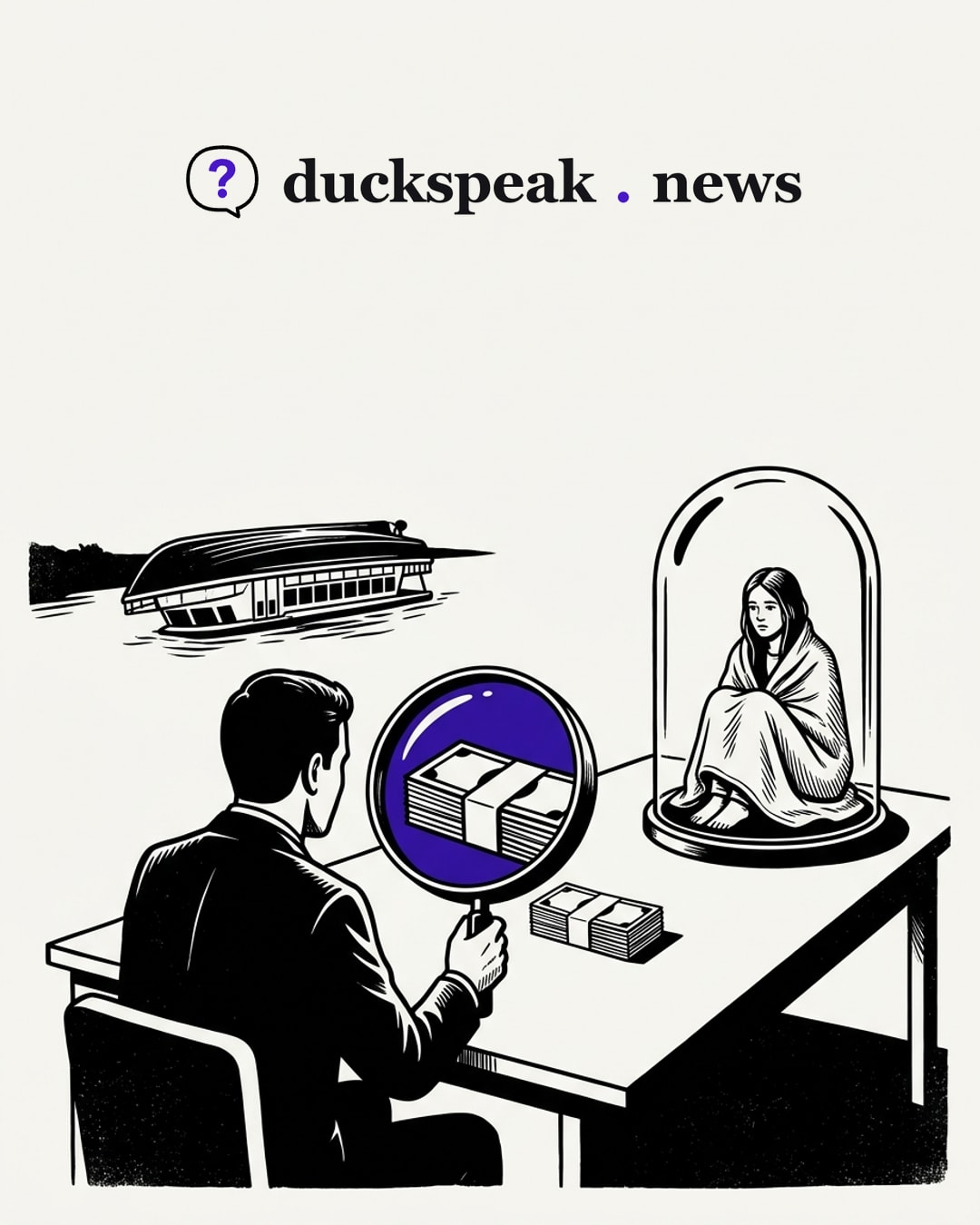
This is a milder case than the ones we usually dissect, and it is worth saying so up front. The Independent’s report on the £12m lawsuit against Transforma Travel Group, trading as The Dragon Trip, is mostly routine High Court coverage: documents quoted, both sides given, next hearing date noted [1]. Our first read of it, like the automated one, finds no systematic distortion. What it finds instead is a set of small typographic and grammatical choices that, taken together, allocate doubt in one direction. That direction is worth naming.
The punctuation of doubt
The headline calls her the “Woman who ‘drowned’” [1]. The drowning is in quotation marks. There is a charitable reading: in common usage “drowned” means died, and she survived, so the quotes may mark a lexical problem rather than a skeptical one. But the quotes do not stop at the headline. In the body she suffers “‘drowning’ injuries” [1]; the accident leads to “‘multiple casualties’”, a phrase quoted and then never explained; her injuries are described only inside quotation from her court papers [1]. The paper’s own voice never once asserts her harm without punctuation around it.
Meanwhile, the one fact that needs no hedging, because the defendant has conceded it, is liability: the tour operator “made a full admission of liability for the boat accident in June 2024” [1]. The typography runs backwards. Admitted facts get scare quotes; the contested number gets the confident adjective.
The only adjective the outlet spends is on the money
“Massive” appears twice: she sues “for a massive £12m”, and the defendant disputes “the massive amount of damages claimed” [1]. Both times the word modifies the sum. Her injuries, by contrast, arrive only as quotation: “severe and traumatic injuries” is the court papers’ phrase, not the reporter’s [1]. This is the asymmetry that matters. In a dispute where the defence states that “the alleged injuries are disputed and causation of the alleged, if any, injuries is not admitted” [1], the outlet has chosen where to place its only unquoted evaluative word. The harm is treated as evidence to be attributed; the money is treated as a fact to be characterized. A reader absorbs the shape of the argument, that the claim is outsized, without ever being told it.
The accident nobody caused
Here is the capsizing in the reporter’s own sentences: the boat “shipped water and overbalanced whilst passengers were climbing on the roof”, and separately, “water entered the boat causing it to capsize” [1]. Water enters. Boats overbalance. The “near-fatal accident took place” [1]. Things occur; nobody does anything. Every agent in the story, the crew who “instructed passengers to stay on the right-hand side”, the second floor that “appeared to have been added to the boat post-manufacture”, the passenger numbers “over an acceptable capacity”, the furniture “not fixed down”, arrives via the claimant’s solicitors’ press release, quoted at length [1]. The paper’s own narration is agentless. This is the Orwellian note in the piece, and it is a quiet one: not euphemism, but the passive grammar of an event without an author. It does not lie about causation; it declines to narrate it, outsourcing the entire causal account to one side’s press release while sounding neutral.
Five sentences of brochure, zero sentences of boat
The article reproduces the company’s marketing copy in full: “diving into new adventures with an open mind”, “experiencing life to the fullest”, “memories that last a lifetime” [1]. This is the Huxley half of the critique. Adventure travel sells the deliberate suspension of the safety instinct, “off-the-beaten-track”, “life like a local” [1], and the report recirculates the copy for free, as color, in a story about what the product did to a customer. The juxtaposition is clearly deliberate; “memories that last a lifetime” sitting a few paragraphs from a PTSD therapy that “retraumatised” her because “focusing on breathing, for example, reminded her of drowning” [1] is a bitter edit. But irony by juxtaposition is not accountability by inquiry. What the piece never asks: who operated the boat locally, who employed the crew, what inspection regime (if any) governs a post-manufacture two-storey conversion on the River Kampot, how large this company is, and whether its tours have prior incidents. All absent [1]. The founder, meanwhile, gets a romantic origin story told twice, the “British backpacker” “inspired during his gap year” [1]; the claimant gets “German government worker” [1]. One speculative flag: in a story about quantum, pairing “government worker” with the detail that she “has been awarded a full disability pension” [1] quietly invites the reader to subtract the pension from the claim. That may be innocent biographical detail. The text alone cannot tell us, so we will not claim it as more than a possibility.
What a reader would need instead
To judge whether £12m is “massive”, a reader would need a scale, and the piece provides none. Specifically:
- The casualty count. “Multiple casualties” is quoted and never unpacked [1]. Did anyone die? The severity of the event is the single most relevant fact for judging the size of the claim, and it is the one fact the report leaves in quotation marks.
- The named local operator and crew, and the regulatory context for converted passenger boats in Cambodia. The claim’s own account makes these central [1]; the report makes them invisible.
- A comparative benchmark. The Judicial College publishes guidelines for personal injury awards in England and Wales; a reference figure next to £12m would let readers assess the number rather than take an adjective’s word for it.
- The company’s size, safety record, and what a “full admission of liability” [1] actually concedes, stated in the paper’s own voice rather than the defendant’s.
- The posture of the case stated plainly: liability admitted, quantum disputed. A headline that puts “drowned” in quotes while the £12m stands unquoted has the emphasis inverted from the court’s own.
None of this required the outlet to take a side. It took one anyway, in punctuation. The quotes are doing the doubting so the prose doesn’t have to.