

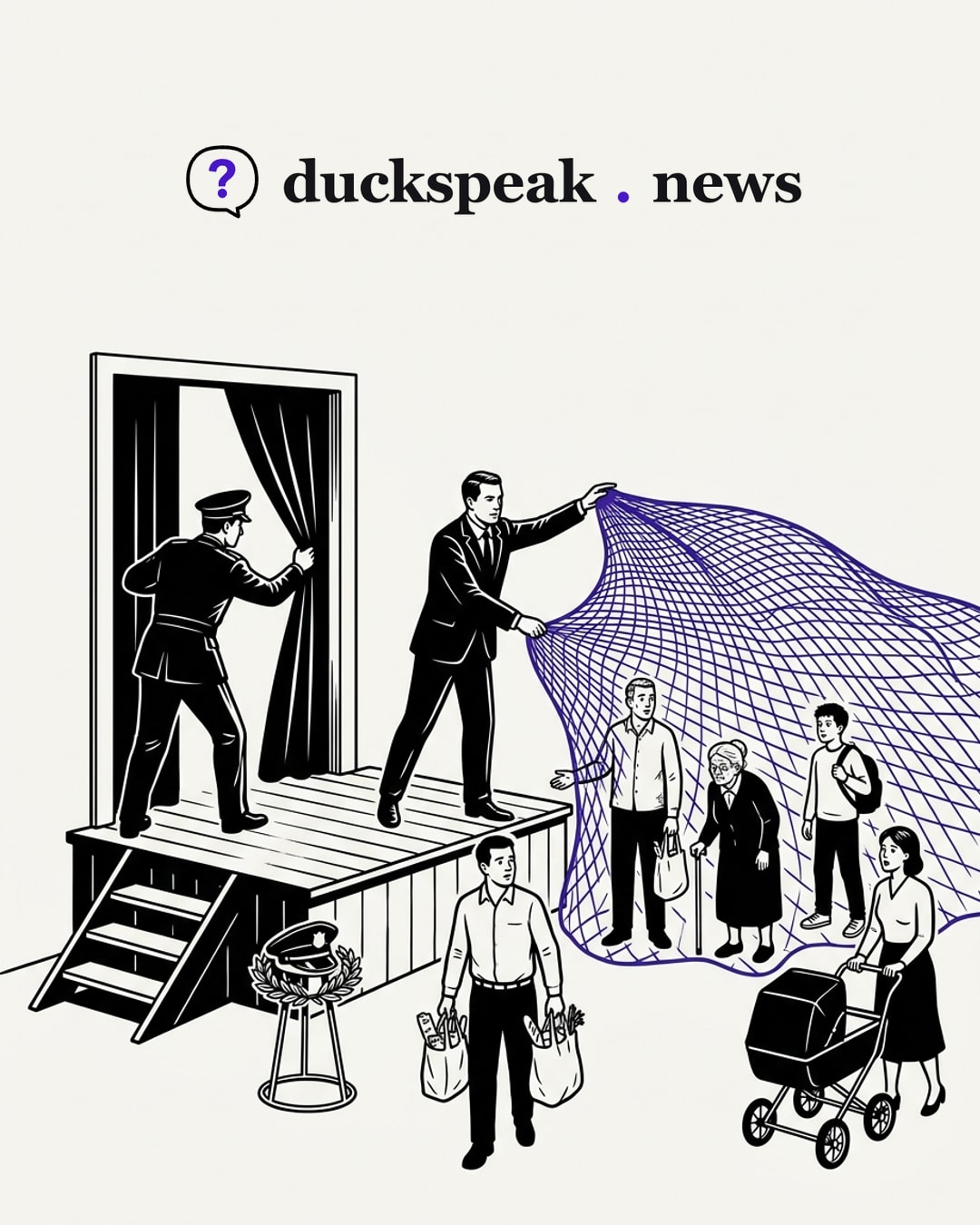
Two outlets covered the killing of Philadelphia police officer Shane Seiber on Saturday: CBS News [1] and the New York Post [2]. Both built the story from Police Commissioner Kevin Bethel’s press-conference language, and the most consequential word in that language appears in only one of them. The Post carries Bethel’s full adjective stack, “a brutal, senseless, horrific killing” [2]. CBS carries his elegy: “He fought valiantly, but he lost his life today” [1][2]. Between the two, the question of why a 35-year-old Water Department employee opened fire on approaching officers is closed twice, once by adjective and once by omission.
The word that ends the question
“Senseless” looks like grief and functions as a verdict. A senseless act is one with no meaning available to recover; the word instructs the reader that asking why would be a category error. The Post runs it without examination [2]. CBS never uses it, and never asks the question either [1]. Same closure, different mechanism.
Then, later in the CBS report, meaning arrives anyway, supplied not by evidence but by policy. Mayor Cherelle Parker, the outlet reports, “called upon Pennsylvania state leaders to consider bills to address mental health and substance abuse” [1], specifically “legislation that will expand involuntary commitment laws to cover not only severe mental illness, but substance use disorder and any kind of mental and/or behavioral challenge that could interfere with Philadelphia’s ability to keep itself safe” [1].
Inventory what the coverage has established about the accused, Eric Lewis, at that point: his age, his Water Department job, his union local, an “extensive criminal record” relayed by a state representative who lives nearby [1], and an alleged statement, also via that representative, that “he wished he had killed more officers” [1]. Nothing in either article reports that Lewis has a mental illness or a substance use disorder. The premise of the mayor’s remedy is absent from the reporting that transmits the remedy. The word “senseless” closes the question of motive; the bill answers a question the coverage never opened. The cause is supplied by the remedy.
Seiber, by contrast, receives a full biography: a 10-year veteran, a father of two, fresh from SWAT training, his wife at his bedside [1][2]. The coverage supplies everything needed to grieve him and nothing needed to understand the event.
This is Newspeak running in two directions at once. “Senseless” shrinks the permissible question, a small machine with the same direction of travel as 1984’s vocabulary reduction: make the inquiry unsayable and it goes unasked. Parker’s category expands instead, and the expansion is the trick. “Any kind of mental and/or behavioral challenge” is not a diagnosis, and the commitment criterion she floats is not danger to self or others; it is interference with “Philadelphia’s ability to keep itself safe.” A legal category whose boundary is the city’s own assessment of its safety has no boundary. Who counts interference, and how, is precisely what the phrase’s breadth lets everyone postpone specifying.
‘Ambush’
The Post’s headline calls it a weekend “ambush” [2], and its body attributes the word: “in what police described as an ‘ambush’” [2]. CBS never uses it, and its own factual sequence shows why it might not: “Police initially received a call about a man with a gun on the porch at the West Philly home. When officers arrived, they approached and came under heavy gunfire” [1]. An ambush is planned; it is lying in wait; it targets police as police. The reported facts describe officers approaching an armed man and being fired upon. Planning, waiting, targeting: none of the three appears in either article. The word is police-supplied, and the Post repeats it at headline size, where the quotation marks do the legal work while the noun does the framing work.
The rest of the register is battle grammar: “heavy gunfire,” officers who “closed in on Lewis,” a SWAT team, a suspect pulled from a tree [1]. Battle grammar pre-selects battle remedies, so it is worth noticing the tension: the remedy actually proposed was clinical, and clinical in the loosest sense available.
The reminder genre
Two elected officials, same noun. Parker: the incident “is a reminder of the dangers police officers face on the job” [1]. Sen. John Fetterman: “a stark reminder of the dangerous job our law enforcement has in keeping us all safe — and why we should always be grateful for their service” [1]. Gov. Josh Shapiro completes the arc: officers “are the very best of us” [1]. A reminder refreshes something already known. It defines the event’s function in advance: not to teach anything, but to re-trigger an existing affect, gratitude on schedule. This is the Huxley half of the coverage, the incident consumed as conditioning stimulus rather than information.
Councilmember Curtis Jones performs the complementary move, rejecting condolence in favor of action, where action means charges: “Thoughts and prayers — I hate when people say that — thoughts and prayers. My thoughts and prayers, but our deeds with these charges are what I’m looking forward to” [1]. The deed-space on display contains exactly one item, prosecution. The same day’s coverage also has Parker urging “the public to pray for the officers” [1]. Prayers are disdained and solicited within a single news cycle, and neither posture leaves room for the question the mayor’s own bill raises.
The condensed dose
The Post item is the CBS piece reduced to its triggers: the adjectives, “a daughter, 3, and a son, 7” [2], a partner “shot 12 times” [2], “roughly 80 separate charges” [2]. Roughly two hundred words, no mayor, no policy, no question of any kind. It is the feeling with the connective tissue removed. One smoothing is worth flagging, tentatively: the Post reports the wounded officer “is now in stable condition, said Bethel” [2], while CBS quotes Bethel saying “he’s not out of the woods yet” [1]. The two can coexist; a patient can be stable and still at risk. But the Post converts a guarded prognosis into reassurance, and smoothing runs in that direction far more often than the other.
What a reader would need instead
- The basis for “ambush”: whether police have evidence of planning or of targeting, or whether the word describes outcome rather than intent. Attribution in the body does not neutralize a headline.
- Whatever is actually known about Lewis’s mental health or substance use, since the mayor’s legislative ask presumes a connection the reporting never establishes. If nothing is known, that absence belongs in the story, adjacent to the bill it is meant to justify.
- The current text of Pennsylvania’s involuntary commitment statute, and what “any kind of mental and/or behavioral challenge that could interfere with Philadelphia’s ability to keep itself safe” would add to it, plus who would decide what counts as interference. The Treatment Advocacy Center publishes state-by-state analyses of civil commitment law; the ACLU of Pennsylvania is the institutional counterweight whose position on such an expansion a reader would need before forming one.
- The sourcing level of the suspect’s record and alleged statement: both travel through a state representative’s account [1], not through charging documents as quoted.
- A translation of “roughly 80 separate charges” [2] into charging practice, so the number reads as a gravity meter with a known function rather than as a fact about the event.
A killing can be brutal and horrific and still have causes worth knowing. “Senseless” is the one adjective in the stack that forbids the knowing, and it is the one the coverage kept.