

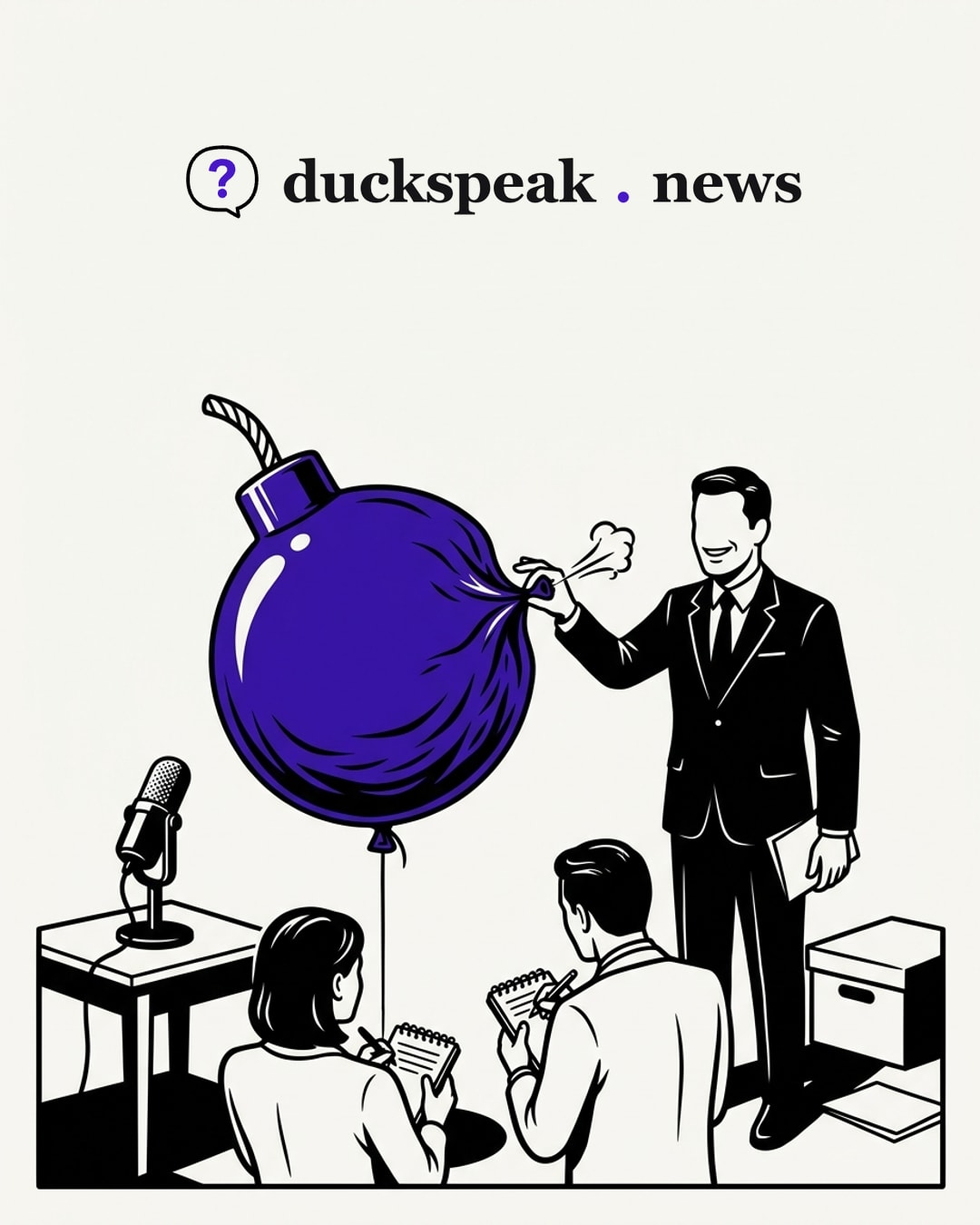
Here is the sequence, assembled from the articles’ own contents. Over the weekend the prime minister relayed a private exchange on The Rest Is Politics: asked “was there interference in the 2016 referendum from Russia?”, he said “I’ve had the clear answer that yes, there was” [1][2]. On Monday his Foreign Office minister, Stephen Doughty, told Times Radio the PM “has been very clear that he’s talking about attempts to interfere” [1], and told LBC “I don’t think they’ve succeeded in their efforts” [1]. The Independent’s headline still sells the original claim as a “bombshell” [1], and its body still states as fact that “Mr Burnham became the first prime minister to confirm Russia had interfered with the referendum” [1]. The walkback is in the article. The contradiction is not.
The walkback in plain sight
Put the quotes side by side. The prime minister’s words, as both outlets print them: “yes, there was” interference [1][2]. The minister’s gloss on those words: the PM was only “talking about attempts to interfere” [1]. Those are different claims. “There was” asserts an event; “attempts” asserts an effort, whose failure the same minister asserts twice in one day: “I don’t think they’ve succeeded in their efforts to undermine our elections,” and “The security minister’s been very clear that they’ve attempted but not succeeded, in his evidence that he gave previously on this” [1]. That last clause is the tell. The government’s record position, per its own security minister’s published evidence, is attempted but not succeeded. The podcast remark went beyond the record; Monday’s job was to pull it back; and the outlets headlined the beyond-record version. The Independent’s headline promises “Here’s what we know” [1], and its reporting supplies the answer: the PM says interference occurred, his government says attempts failed. That is the story. It is not the story the frame tells.
“The result is the result”
Asked whether interference could have changed the 2016 result, Doughty answered: “The result is the result” [1]. The sentence contains no information, and that is its function. It is a tautology in the costume of hard-headed realism, and it works the way Party slogans work in Orwell: it ends thought by grammar rather than evidence. The question was whether the outcome was affected; the answer declares the outcome beyond the reach of the question. Note the asymmetry this creates inside one government position: interference is asserted, and the result is simultaneously sacrosanct, mentionable but unquestionable. The Independent transcribes the tautology without labeling it a non-answer, in the same article that reports the minister “declined to provide details of what form Russian interference took in 2016 and whether it had been successful” [1]. Two non-answers, printed as news. A third rides along: Russia “was spending £1.5 billion on disinformation this year,” relayed without source, beside a call for a “whole of society effort” [1], mobilization vocabulary resting on a number the article never verifies.
Clear, four times
When this story broke we tracked the adjective “clear” migrating from the manner of an answer to the truth of a fact in two headlines. A day later the word is a government mantra, and each repetition is transcribed without anyone noticing that nothing has become clearer. The PM had “the clear answer” [1][2]. Doughty: “what is clear is that Russia is attempting to interfere” [1]. Doughty again: the PM “has been very clear” [1]. Doughty a third time: “The security minister’s been very clear” [1]. Four clears in one cycle, each certifying an assertion that arrives with no evidence attached. The strangest instance: the PM was “very clear that he’s talking about attempts,” says the minister, of a man whose quoted words were “yes, there was.” Clarity is claimed loudest exactly where the words stop matching. ABC carries the same vocabulary into the Berlin account: the AfD are “clearly linked to Russia, funded I believe” [2]. “Clearly” and “I believe” in one clause, the adverb of demonstration bolted to a verb of guessing, unremarked.
Tampering, and a story built on a trailer
ABC’s headline attributes honestly, with “says” and scare quotes around “clear” [2], but its body upgrades in the outlet’s own voice: it was important “to put Moscow’s tampering on the record” [2]. The PM said interference; ABC says tampering, a word that puts hands on the mechanism and presumes alteration. In our earlier piece we watched “attempts to influence” become “meddling” inside one Independent sentence; the gradient has climbed another step. ABC also builds the milestone with the hidden-agent passive: “The intervention is believed to be the first time a British prime minister has publicly acknowledged Russian interference” [2]. Believed by whom, the sentence never says; the Independent runs the same construction (“became the first prime minister to confirm”) as flat fact [1]. Note what the story is made of: “In excerpts from ‘The Rest is Politics’ podcast released Sunday,” ABC reports, with the full episode scheduled “to drop on Monday” [2]. The whole cycle ran on a trailer for a commercial podcast, and “bombshell claim” [1] is promotion vocabulary. The Huxleyan mechanism in miniature: revelation as content marketing, the reader sold the drama of confirmation rather than its substance. That reading is ours; the excerpts and the timing are ABC’s reporting. The balance ritual is one sentence, “Russia has long said it does not meddle” [2], leaving the reader holding an assurance, a denial, and no disclosed evidence from either.
The sentence that travels
Both outlets carry one identical sentence: the Intelligence and Security Committee “found in 2020 that the government failed to fully assess the impact Russian state-run media and ‘troll’ accounts could have had on the EU referendum” [1][2]. Word for word, on two continents. Whether that is inherited wire copy we cannot tell from the material; what is observable is that the only institutional finding in either article arrives prepackaged, and it is the most hedged sentence in both. It is also, per the reporting we cited when this story broke, a softened version of the committee’s finding, which was that no post-referendum assessment had been provided at all. “Failed to fully assess the impact” quietly implies an impact existed, waiting to be measured. Both articles deploy the finding as a pillar under the interference claim; it documents the absence of the assessment that would support one.
The loop at the end
The Independent closes with campaigners who receive the statement as “this public confirmation of those suspicions” [1]. The suspicions’ stated origin: “We have suspected for years that the 2016 referendum could have been subjected to interference because of how its result helped destabilise a united Europe” [1]. Read that twice. The suspicion was inferred from the character of the result; the confirmation is a statement with no disclosed evidence; the loop closes, printed alongside “Disinformation played a role at the time” [1], asserted as fact by the same speaker. None of this makes the Kremlin innocent; the ISC’s subject, per both articles, is state media and troll accounts whose impact was never assessed [1][2], and the government’s own record says attempted. It makes the press product incoherent: a “bombshell” whose own article records the government shrinking it to failed attempts, sealed with “the result is the result,” and headlined as what we know.
What a reader would need instead
- The security minister’s evidence itself, named and dated, since per Doughty it is the government’s record position: attempted, not succeeded [1].
- The collision printed as a collision: “yes, there was” [1][2] beside “he’s talking about attempts to interfere” [1], and the question of which is the government’s actual assessment.
- The ISC’s 2020 report itself rather than the traveling sentence; its finding concerns what was never assessed [1][2].
- The £1.5 billion figure sourced, or labeled as a minister’s unsourced claim [1].
- The attempt, effect, and result questions kept separate, rather than fused into a tautology [1].
- The full podcast transcript, since the story ran on excerpts [2], and the name of whoever supplied the “clear answer,” which neither article provides.
More on Russian interference in the Brexit referendum on this site:
- 12 October 2026 A Clear Answer Is Not a Fact
- 13 October 2026 ‘Legitimate’: the word that ends the question
- 14 October 2026 Not Yet Realised, Already Headlined
- 14 October 2026 Inconceivable, Therefore It Happened