

On Monday at Southwark Crown Court, a judge asked 50 prospective jurors whether they remembered a 2023 Channel 4 documentary, or a long article in the Times, making allegations of sexual misconduct against Russell Brand. Six raised their hands and were dismissed from the panel [2]. That exchange is the most consequential thing that happened at the court all day: the one moment when the press’s own past coverage became a measured variable inside the trial.
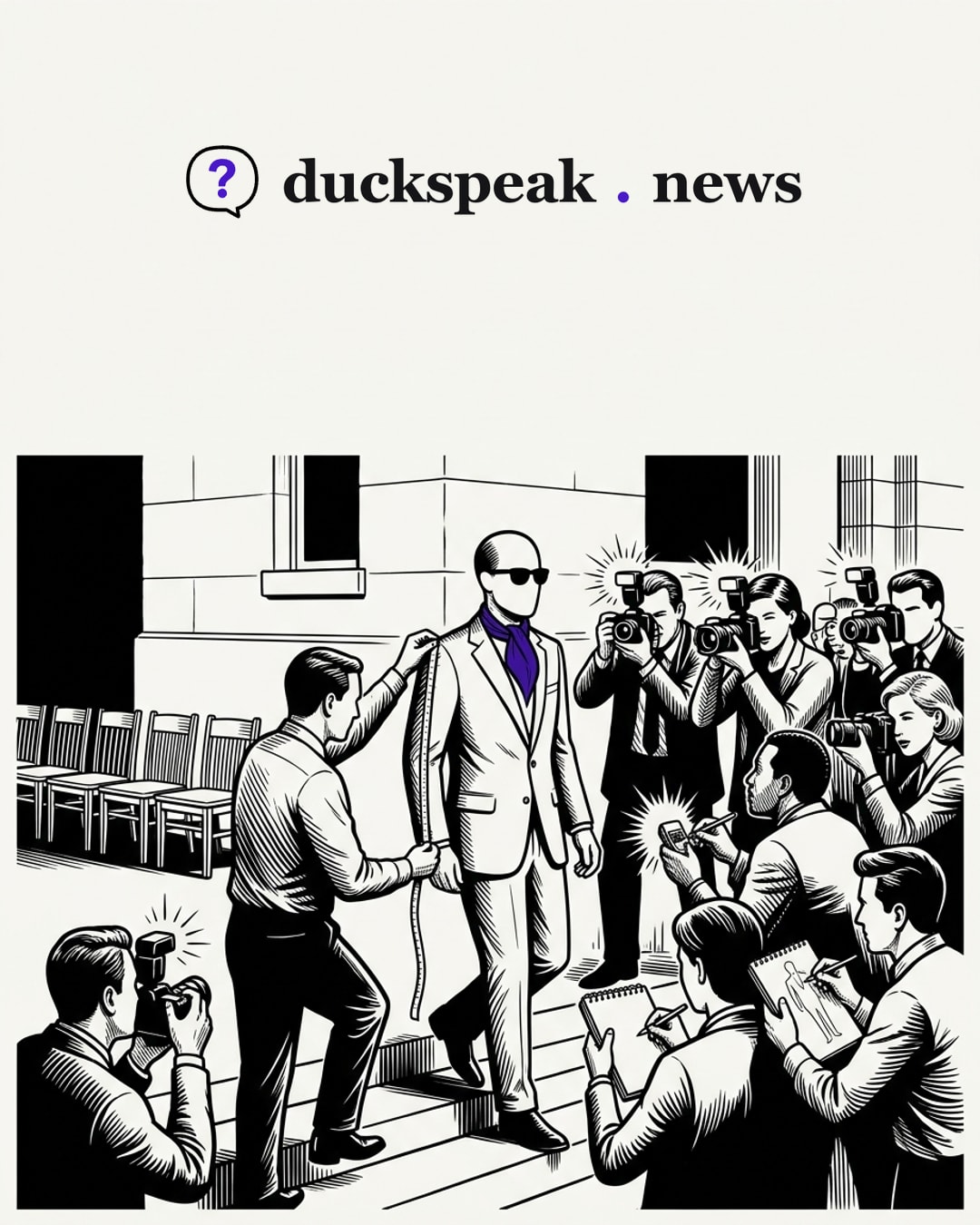
The BBC’s report of the same morning opens: “Russell Brand arrived at court on Monday for the start of his trial wearing a navy suit and sunglasses” [1].
The distance between those two sentences is the story of this coverage.
The fitting-room lede
The Independent itemizes the full kit, “a grey suit, a white unbuttoned shirt with a brown neckerchief underneath, brown boots and sunglasses,” and logs the “black Mercedes” he arrived in [2]. Two outlets independently recorded the eyewear [1][2]. The Independent also files theater criticism from the dock, noting Brand “remained seated and displayed little emotion” [2], and reports a non-event as an event: “He said nothing to members of the press as he walked into the courthouse, and did not respond to shouted questions” [2]. Part of Monday’s news was that nothing happened.
The wardrobe reporting cannot even agree with itself: the BBC logged a navy suit [1], the Independent a grey one [2], same man, same morning. Perhaps lighting, perhaps an error, perhaps a change of clothes; the deeper point survives all three, which is that sartorial detail is texture rather than evidence, and even the texture does not reconcile. Meanwhile the BBC, exact about the sunglasses, misspells the venue, “Southward Crown Court” [1]. Precision was allocated to the neckerchief and withheld from the court’s name.
The wife is a recurring beat in all three files: “accompanied by his wife Laura” [1]; “taking Ms Gallacher by the hand” [2]; “holding hands with his wife” [3]. It is tableau, not evidence, and no outlet claims otherwise; the critique is not her presence but the editorial instinct that files it three times as though it were information about the case.
The travelling résumé
All three outlets, on two continents, run a near-identical biography block: stand-up origins, the Big Brother spin-off shows, BBC Radio 2, the Hollywood films (Forgetting Sarah Marshall appears in all three [1][2][3]), the pivot to podcasting [1][2][3]. CBS, filing from the United States, repeats the paragraph whole [3], the same biography quacked identically on two continents. No coordination is needed when everyone owns the same boilerplate; this is Orwell’s “long strips of words which have already been set in order by someone else,” travelling intact between newsrooms. And in Monday’s files the résumé outweighed the case: the BBC states the counts [1] but omits the specific allegations that both the Independent and CBS carry from previous hearings, among them the alleged rape in a hotel room at the Labour Party conference and the alleged assault of a TV worker in a toilet [2][3].
The BBC piece then closes by promoting its own product, “Fame Under Fire: Russell Brand on Trial podcast” [1]. The outlet reporting the trial is also selling a podcast about it, and the title is the frame in miniature: what is under fire, in the BBC’s packaging, is Fame. Not six women. Fame. That is Huxley’s mechanism rather than Orwell’s: nothing is hidden, no one is deceived; the trial is simply offered as content, a celebrity saga in which the accused is the protagonist and the allegations are the plot. The BBC even files the size of its own scrum as news, noting “a large media presence at the court” [1], the media reporting on the media’s presence at the story.
The women as arithmetic
Across three outlets the charges are counted with precision, three counts of rape, three of sexual assault, one indecent assault [1][2][3], and the complainants are counted too: “six women” [1][2][3], or job categories, “a TV worker,” “a radio station worker” [2][3]. The named human beings in Monday’s coverage are Brand, his wife, and the judge. The women are quantities and occupations.
The passive voice finishes the job, and Orwell named the habit precisely: it is “wherever possible used in preference to the active,” his own example of degraded political prose. At the BBC, offenses “are alleged to have occurred between 1999 and 2009” [1]; things occur, and no one does them. At CBS, “the charges involve six women” [3], the women appearing as grammatical furniture. All three outlets print the word “rape,” then arrange the sentence so the agent evaporates.
One fairness note, and it matters: British law protects complainants’ identities for life, as CBS alone pauses to explain [3]. Outlets cannot name these women and should not. The critique is not that they go unnamed; it is that the entire budget of humanizing, individuating detail went to the accused. The suit has a color; the women have a count.
The number that got skipped
The most newsworthy figure of the morning, six of fifty jurors dismissed for prior exposure to the 2023 coverage [2], appears in one of three outlets. The BBC does not mention the screening; CBS records only “a morning of jury selection” [3]. Yet it is the one datum measuring how far the 2023 reporting reached, and the one place where the press’s own prior work is a fact in the case. Two of three outlets declined to file it.
The era nobody connects
The alleged offenses span 1999 to 2009 [1][2][3], overlapping the years of Brand’s Channel 4 and BBC employment, the same years the résumé block celebrates. CBS notes he “has moved away from mainstream media” [3] without noting that the allegations date from his mainstream years. The BBC lists “his own radio programmes on stations including BBC Radio 2 and 6 Music” [1] as career highlights, with no acknowledgment that the institution doing the listing once employed him. This is an observation about framing, not an accusation; no source here draws the connection, and this critique goes no further than noting that nobody did.
What a reader would need instead
- The judge’s words to the jury panel and the six dismissals [2], which quantify the reach of the 2023 coverage and the court’s answer to it.
- An attributed trial length. Jurors were told “around six weeks” [2]; the BBC and CBS repeat “up to 10 weeks” [1][3], the BBC twice in a short piece, with no attribution. A reader deserves to know which figure came from the courtroom.
- The specific allegations as they will be tested, not just the counts; the prosecution opens its case on Wednesday [2], and until then nearly everything filed on Monday was texture.
- The legal context that shapes the copy: lifetime anonymity for sexual offence complainants, mentioned only by CBS [3], and contempt-of-court restrictions on reporting active proceedings, which explain, without excusing, the caution. For charge detail, CPS statements; for standards regimes, IPSO (print) and Ofcom (broadcast).
- The recognition that when red-carpet vocabulary is applied to the dock, the softening happens in structure, not in words. All three outlets say “rape.” None of them let it be the story.
The suit was navy or grey. The women were six. Only one of those facts got a paragraph.