

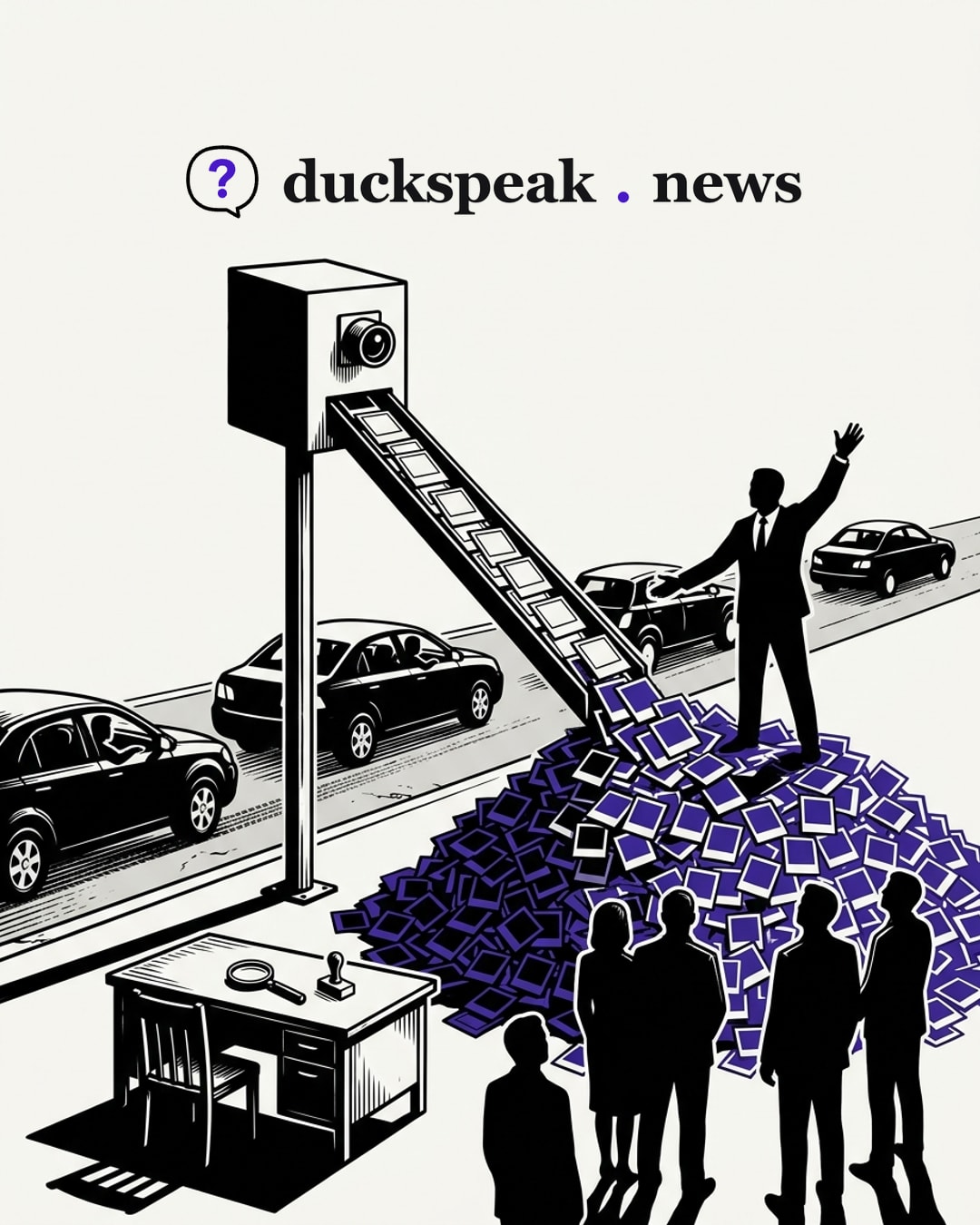
Two outlets, one number, and a word quietly deleted on the way to the headline. The BBC reports that “AI spots nearly 19,000 ‘shocking’ road offences” [1]; GB News reports that the cameras “detect 19,000 offences in just two weeks” [2]. Both are describing machine classifications that were never tested. “No enforcement is planned as a result of the trial” [1]; “follow-up enforcement of violations did not take place” [2]. The word “potential” is attached to nearly every count in both articles, and it is the only honest word in the sentence. It is also the first casualty.
The qualifier that vanished
BBC body copy is careful, in the way body copy is careful when headlines are not: the trial “identified almost 19,000 potential driving offences” [1], including “11,045 potential seatbelt offences” at Ladywood and “6,030” at Fallings Park [1]. GB News opens with the qualifier already gone: “Almost 19,000 traffic offences have been identified” [2]. Its cameras “captured just under 19,000 images of people using their phones at the wheel or not wearing their seat belts” [2], a flat assertion of fact. Only later does the hedge return, in “11,144 potential non-use of seat belt offences” [2]. The pattern is mechanical. The qualifier lives in the paragraph nobody reads and dies in the sentence everybody shares.
What “potential” is doing matters. GB News describes the product’s ordinary workflow, in which “Images are then checked by human operators, who have the power to issue a fine” [2], while also reporting that in this trial no enforcement followed [1][2]. Whether any of the 19,000 flags was ever confirmed by a person is therefore left ambiguous by both articles, and neither treats that ambiguity as newsworthy. What is certain is that not one of them will be adjudicated, because no enforcement is planned [1]. A count that will never face a test is being reported, in two headlines, as fact.
Orwell’s Newspeak shrank the space available for thought; headline-writing shrinks the space available for doubt. “Spots” [1] and “detect” [2] are verbs of confirmed perception, and “offences” is a legal finding. Neither describes what happened, and both outlets know it, because both wrote “potential” themselves. BBC’s scare quotes around “shocking” perform a related sleight: the adjective belongs to Mayor Richard Parker, but the headline’s grammar welds his affect to the number, so the count arrives pre-shocked.
The shock was scripted
BBC states the trial’s purpose plainly: it “was intended to establish the potential scale of mobile phone use and failures to use child restraints” [1]. The trial was designed to produce a number, and the number was presented as a surprise. Parker’s quote, printed whole by both outlets, supplies the affect: “frankly shocking and far higher than we expected” [1][2]. Expected by whom? By the authority that funded the trial and ran it “working with the police and fire service” [1], and by the region’s police and crime commissioner, who is now “closely evaluating these trial results to consider how this advanced AI technology can be deployed for future police enforcement” [1][2]. The shock and the rollout pitch arrive in the same package of pre-written quotes, and neither outlet notices they are the same document.
Then the children. BBC opens on “a front-seat passenger holding a small child with no seatbelt on” [1]; GB News reports “a toddler was not properly restrained in their own seat” [2]. This is Huxley’s mechanism rather than Orwell’s: the emotive image is soma, a payload that makes deliberation feel unnecessary. Nobody scrolls past an unrestrained toddler to ask about the camera’s error rate. And the gallery was curated: “dozens” of images showed children travelling without proper restraints [1][2]. The pictures are the argument.
Duckspeak, delivered whole
Simon Foster’s paragraph appears in both outlets nearly word for word: the region is “closely evaluating these trial results to consider how this advanced AI technology can be deployed for future police enforcement,” and “we will use every effective tool at our disposal to ensure our roads are safer” [1][2]. Look at the adjectives. “Advanced” contains its own rebuttal, since questioning the deployment becomes opposing advancement. “Effective” is asserted, never shown: neither article contains an accuracy rate, a false-positive figure, or any independent evaluation of the system. “Every effective tool at our disposal” is a phrase that means “whatever we choose,” dressed as necessity; Parker’s “every resource available” [1][2] performs the same trick. This is duckspeak in Orwell’s exact sense, quacking from two beaks having passed through no brain on the way.
The sourcing is the tell. Every quoted human in the two articles, Parker, Foster, and road safety commissioner Mat MacDonald [1], funds, chairs, or runs the partnership that conducted the trial [1][2]. GB News names the vendor, “AECOM/Acusensus, whose products are already used by local authorities across the UK” [2], as though a commercial footprint were a credential rather than an interest. No cost figure appears in either piece. No civil-liberties voice appears in either piece. GB News’s headline contains the most candid phrase in the coverage, “cameras that can see inside vehicles” [2], and the article never returns to it. The same page’s furniture asks readers to “Champion free speech and independent journalism” [2]; that is boilerplate, not editorial, but the juxtaposition is the story: an outlet branding itself on skepticism ran a surveillance product’s field test as a crime bulletin.
Neither outlet did the addition
Here is the fingerprint of stenography. BBC’s site-by-site figures sum to 18,995 (11,045 + 1,163 + 6,030 + 757) [1], which matches its “almost 19,000.” GB News’s sum to 19,145 (11,144 + 1,163 + 6,081 + 757) [2], which contradicts its own “just under 19,000” [2]. The mobile-phone counts agree exactly; the seatbelt counts differ by 99 and by 51. At least one outlet mis-transcribed the source figures, unless the figures were revised between publications, which neither indicates, and nothing in either article suggests anyone did the arithmetic.
The death figures drift the same way. BBC: “The WMCA said road safety data for last year showed mobile phone use was linked to 32 deaths” [1]. GB News: “Department for Transport figures show that mobile phone use was linked to 32 deaths in 2025” [2]. WMCA or DfT; last year or 2025. The outlets do not agree on the source or the year, and neither flags it. GB News then upgrades the verb mid-sentence: phone use is “linked to” deaths, but unbuckled belts “contributed to” 133 fatalities [2]. “Linked” is a correlation word; “contributed” is a causal one. The drift happens inside a single sentence, unremarked.
BBC’s own related links point to more of the same frame: “AI sensors aim to boost road safety and cut deaths,” “AI cameras help reduce junction near misses,” “AI cameras catch thousands not wearing seat belts” [1]. Three links, one direction. That is a pattern, not proof of policy; we flag it as suggestive. But the pattern in this pair of articles is already clear enough: a trial built to generate a number generated a number, the number was called a surprise, the surprise was called news, and the qualifier that made it honest was left on the cutting-room floor. In Orwell’s terms, the memory hole is now a headline slot.
What a reader would need instead
- A denominator. How many vehicles passed those two camera sites in two weeks? Without it, “shocking” is uninterpretable; a rate of one in a thousand reads differently from one in ten. Neither article provides it [1][2]. A shock figure without a denominator is not a statistic; it is a feeling.
- An accuracy figure. What proportion of Acusensus flags are confirmed on human review? GB News describes human checking as part of the product workflow [2] while reporting that none occurred here [1][2]; that gap is the story, and both outlets walked past it.
- The money. What the trial cost, who paid the vendor, and what a wider rollout is worth to AECOM/Acusensus. GB News even appends a business forecast to the news: fines “could increase dramatically if AI cameras receive a wider rollout” [2]. That sentence belongs in a disclosure paragraph, not a kicker.
- The enforcement baseline. “About 2,000 drivers a year in the West Midlands are fined and given penalty points for using a phone while driving” [1]; against nearly 19,000 potential offences in two weeks at two sites, the gap is the actual story, and it is a story about scale-up, which is precisely what Foster is evaluating [1][2].
- A regulator’s view. Cameras that photograph the inside of private vehicles process personal data; the Information Commissioner’s Office is the UK body that oversees exactly this, and neither article contains its position, or any voice outside the partnership [1][2].
- Reconciled numbers. Which seatbelt count is real, 11,045 [1] or 11,144 [2], and whether the 32 and 133 deaths are DfT 2025 figures [2] or WMCA’s “last year” [1]. Until someone checks, “nearly 19,000” is a rumor with a logo.