

On Monday the Royal Swedish Academy of Sciences awarded the 2026 economics prize to Robert E. Hall and Michael Woodford “for microeconomic foundations of macroeconomic stabilisation” [2]. Six outlets covered it: NPR, CBS News, PBS NewsHour, RFI, France 24 and franceinfo. Read together, the six stories amount to roughly two texts. One is an Associated Press wire story, carried by PBS under AP bylines [5] and by CBS in near-verbatim paragraphs [2]. The other is the prize committee’s own communiqué, carried into French [3][4][6]. Six bylines, two texts. The job here is not reporting on economics; it is relaying an institution’s account of its own importance, in its preferred vocabulary.
A Nobel that isn’t, headlined as one
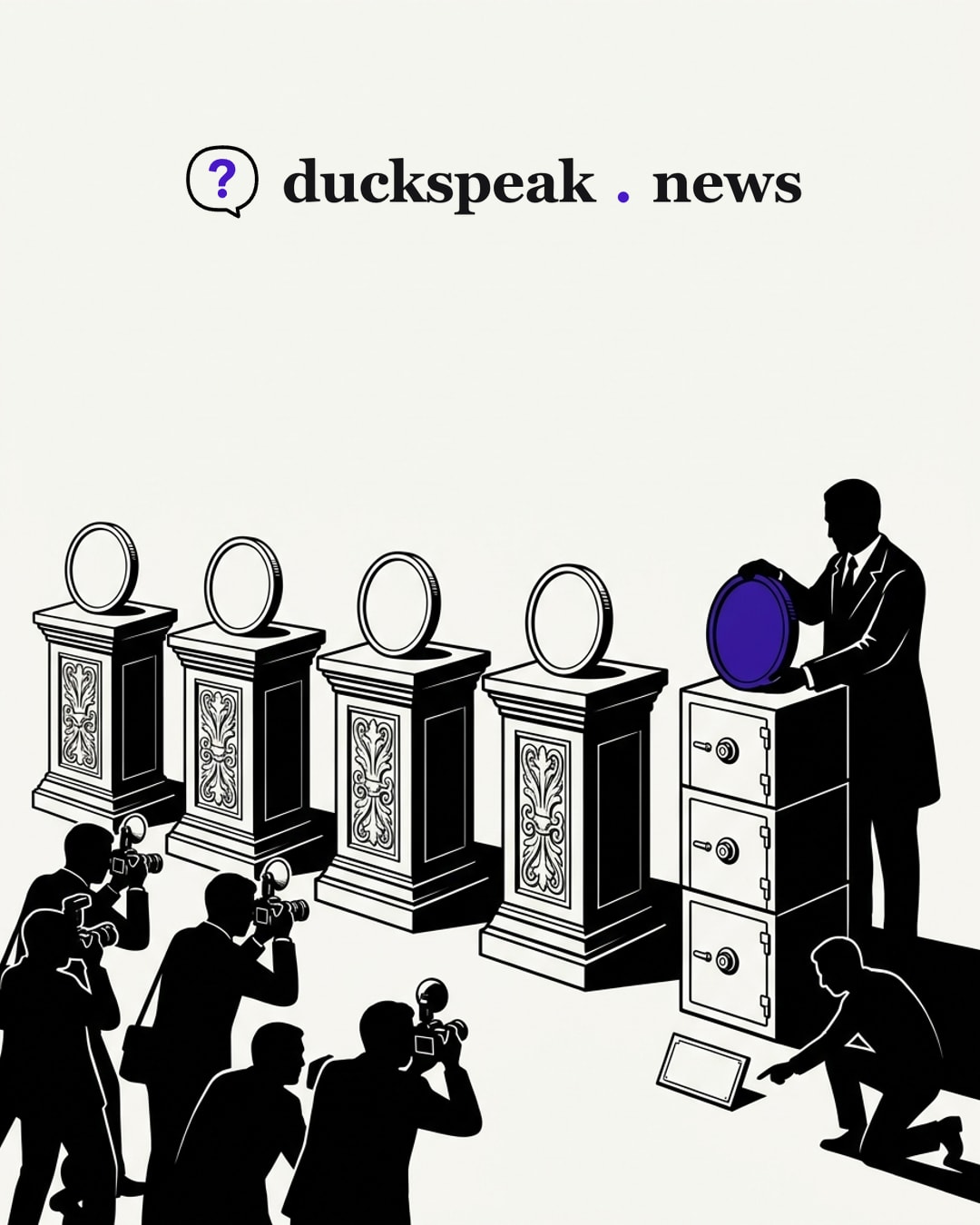
Start with the name, because the coverage half-knows and half-concedes. The prize’s actual name, as RFI points out, is the Bank of Sweden Prize in Economic Sciences in Memory of Alfred Nobel, and RFI flags this as the exact name [3]. Sweden’s central bank established it in 1968, alongside the five prizes Nobel himself created [2][5]. The headlines nonetheless read “Nobel Prize in economics” [1][2] and “Le prix Nobel d’économie” (The Nobel Prize in economics) [3][4][6]. The pattern is consistent: outlets that print the correction still headline the euphemism. NPR’s body concedes the award “is not one of the original five, but a ‘memorial’ prize” [1], beneath a headline that says Nobel Prize. CBS and the AP wire carry the bluntest version: “Nobel purists stress that the economics prize is technically not a Nobel Prize” [2][5]. Notice the machinery in that sentence. The fact is conceded, and the people who insist on it are pre-labeled “purists,” fussy pedants. The correction arrives pre-defused. France 24 runs the story with the caveat appearing nowhere at all [4]. franceinfo embeds the official tweet naming the “Sveriges Riksbank Prize in Economic Sciences in Memory of Alfred Nobel” [6], the true name sitting untranslated on the page while the headline says “Le Nobel d’économie” (The economics Nobel).
This is Newspeak in its plainest form: the long, institutional, accurate name steadily replaced by the short, prestigious one. No one decided this in a meeting; each outlet individually reaches for the word that carries more authority, which is how euphemism actually spreads. The stakes are not pedantic, because the borrowed name is the whole argument. “Nobel” says this field ranks with physics and medicine. The coverage takes the prestige without examining the loan.
The vocabulary of smoothing
The committee’s preferred verb is “smooth.” The laureates “have helped us smooth out the economy’s peaks and troughs” [2]; well-timed policy can “atténuer les hauts et les bas de l’activité économique” (smooth out the ups and downs of economic activity) [3][4]; the committee chair wants to “reduce the amplitude of these swings” [1]; policymakers are now “better equipped to deal with shocks” [2]. Peaks, troughs, amplitude, equipment: the economy as machine, policy as engineering, turbulence as something the right instruments dampen.
The strange part is that a laureate rejects this frame on the record. “Government authorities shouldn’t view stabilization of the economy as an exercise that is simply conducted by people pulling levers to control the economy, independent of what people in the economy understand,” Woodford told reporters [1]. NPR quotes him, then returns to describing the prize as work on “how to smooth boom-and-bust cycles” [1]. The caveat is quoted and metabolized; the lever-and-smoothing vocabulary survives untouched. No story invites the reader to notice that the honored theory’s own author considers the coverage’s central metaphor a misunderstanding of his work.
The parable, told by the winners
Every version carries the same miniature history of the discipline. The Keynesian recipe “worked well until it didn’t” [1], a line that travels intact through the wire copy to two more outlets [2][5]; 1970s stagflation “proved the formula was simplistic” [2][5]; NPR has Boppart declaring “The Keynesian recipe was shattered” [1]; Hall and Woodford rebuilt it on microeconomic foundations, producing what the committee calls a “paradigm shift” [5]. It is a redemption arc, arriving in every outlet with the same beats because it is the awarding body’s own script. What is absent is any voice from outside the ceremony. Across six stories, the quoted sources are the committee chair [1][2][3][4], a committee member [1][2][5], the laureate [1][2][5][6], and one MIT economist, quoted in praise of research that pushes macroeconomics “from the bottom up” [5]. The history of a field is told entirely by the institution currently honoring it, and its superlatives are relayed as fact.
The strongest claim gets the same treatment. The laureates’ research “has been hugely beneficial during the pandemic and the energy crises of recent years” and made it “possible to manage major macroeconomic crises far more effectively than before” [5], a claim franceinfo repeats in translation [6]. No outlet offers evidence, and NPR’s framing quietly strains under its own weight: the work’s importance “has been underscored in recent years by the pandemic, which pushed millions of people out of work, and the supply shocks that followed, driving up the cost of living” [1]. Read that slowly. A mass joblessness event and a cost-of-living surge are presented as evidence of a stabilization framework’s importance. Whether the post-pandemic years support or embarrass these models is a fair question; I cannot answer it from this material, and no story asks it.
Words are the instrument
The most Orwellian thread is the one the coverage treats as least interesting. The honored insight, repeated everywhere, is that households and firms are forward-looking, so policy works through what people expect, so central banks should provide “clear and credible communication about how they reason and what they plan to do” [5], and Woodford urges policymakers to explain “why the things that are being done are being done” [1]. The AP story closes the loop approvingly: “Central banks have responded to this insight by working harder to explain what they are doing” [5].
In this theory, communication is not commentary on policy; it is the policy. A tool that operates by shaping what millions of people expect is powerful, and power of that kind is double-edged by construction: the same insight that recommends honesty recommends managing perception, since expectations, not levers, are the mechanism. This requires no suspicion of anyone’s motives; it is a structural feature of the framework being honored, stated by the laureate himself. But the coverage can see only one edge. “Clear communication” appears as unambiguously virtuous, transparency as technique, and the story moves on to the prize money [2][5].
The Huxleyan reading needs no help, because NPR supplies the genre’s honest slogan in its own sidebar: “Sign up for the Planet Money newsletter. The world is confusing. Economics can help” [1]. That is the annual function of this coverage, reassurance delivery: the experts are equipped, the peaks are being smoothed, medal-winning people are at the machine. CBS, citing Reuters, notes most previous winners have been American and only three women have won [2], a fact about the discipline’s geography offered as trivia. Every headline leads with the national scoreboard: “2 Americans” [1][2], “aux Américains” (to Americans) [3][4][6].
One more absence. The only time poverty appears in six stories it appears as a modeling friction: “some households are so poor they can’t borrow or tap savings in response to economic changes,” and in Hall’s 1982 work with Mishkin about 80 percent of households planned spending on expected future income “while the rest lived hand to mouth” [5]. One in five households enters the coverage as a technical detail inside a model for smoothing aggregates. Who gets smoothed, and who doesn’t, is a question none of the six stories asks.
What a reader would need instead
- The prize’s real name and origin, stated up front rather than buried or omitted: a prize created by Sweden’s central bank in 1968 [2][3][5], not one of Nobel’s five, however often it is headline-edited into one.
- The provenance of each claim: which sentences come from the committee’s communiqué and which from independent reporting. On this evidence, nearly all of the former.
- At least one voice from outside the ceremony, ideally asking whether the pandemic and energy-crisis years [1][5][6] actually demonstrate the “far more effectively than before” claim [5].
- The distributional question the models themselves raise: what stabilization means for the hand-to-mouth fifth of households [5].
- The double edge of expectation management. If words are the instrument, the press should be where that instrument is examined, not merely relayed.