

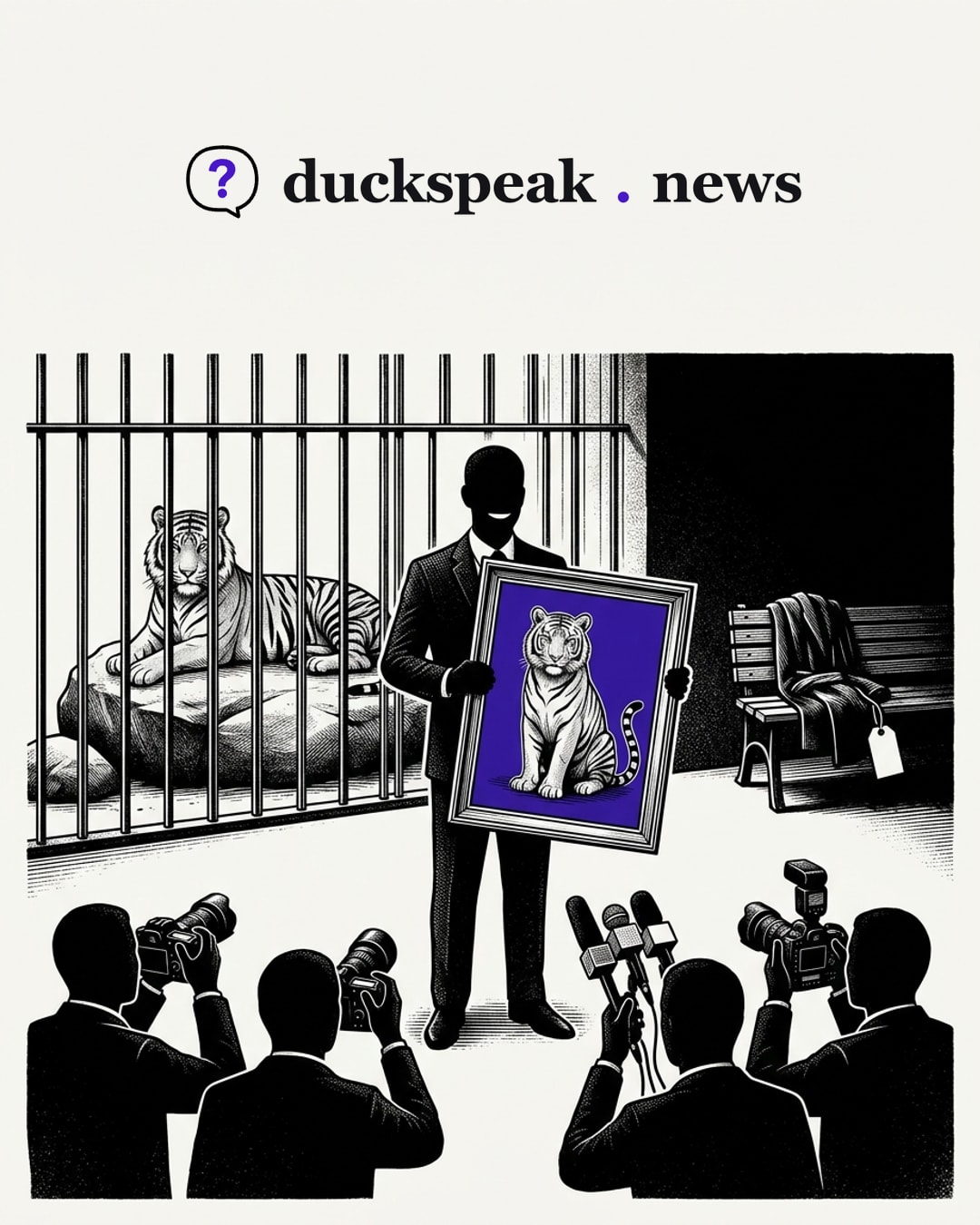
On Saturday afternoon a man died at Yorkshire Wildlife Park after entering the tiger enclosure. By Sunday, the question parts of the British press treated as urgent was not who he was, or what state he was in, but whether a tiger named Altai would be put down. The Mirror’s headline set the hierarchy in its own word order: ‘Yorkshire Wildlife Park confirms fate of Altai after man mauled to death’ [3]. The animal’s fate is the news. The man’s death is the timestamp.
The reassurance package
The park’s Sunday statement is the emotional centre of the coverage: ‘Many, many people have contacted us about Altai, the tiger. We can reassure everyone that he is safe and well and will not be euthanised as a result of this incident’ [3][7][8]. The Mirror stamped that reassurance as a photo caption three separate times down its liveblog, twice as ‘Altai will not be euthanised’ and once as ‘The tiger will not be put down’ [3], the way a watermark repeats. The BBC confirms in its opening paragraphs that the tiger ‘would not be euthanised’ [2], and illustrates the story with an eyewitness photograph of the tiger taken ‘minutes before the incident’ [2]. A witness quoted by The Independent closes her account with ‘Thankfully the tiger survived’ [1][5]. ABC’s dispatch is little more than the reassurance itself: ‘The tigers remained inside the enclosure and there was no danger to the public’ [6].
Then comes the celebrity comment. The Mirror gives generous space to Carole Baskin of Tiger King, via the New York Post: ‘The tiger was not doing anything wrong by being a tiger’ [3]. No mental-health charity, safeguarding expert or bereavement organisation appears anywhere in the eight articles collected here. A reality-television star does.
And the police line, repeated across outlets: ‘no wider risk to the public’ [1][3][4][5]. Technically it is a statement about containment. Rhetorically it completes the package: park safe, tiger safe, public safe. The dead man, it quietly follows, was the public.
A mystery the copy already answers
‘It is not yet clear why he entered the enclosure,’ the Mirror reports [3]. The same liveblog prints a witness unsure ‘if he was with a carer or family member’ [3]; a witness reached via The Telegraph and republished by The Independent, describing a man ‘in a trance, not in reality at all’ with ‘arms wide open ready for the tiger to attack him’ [7][8]; a woman who ‘desperately tried to pull back’ the victim as he climbed [7][8], and another who ‘wasn’t strong enough’ to hold him [3]; and the man’s age, relayed as rumour with a disclaimer bolted on (‘We heard other people say he was 22, although I can’t confirm his age’) [3].
In the eight articles collected here, the words ‘mental health’, ‘crisis’ and ‘suicide’ do not appear once. That is a checkable absence, and I have checked it; the corpus is small and later coverage may differ, but in this collection the vocabulary is entirely absent. What fills the space instead is whimsy. ‘I honestly do think he just wanted to play with the tiger,’ one woman’s guess, recurs across four articles and two outlets, unchanged in wording, always attributed, never examined [1][3][5][8]. ‘Probably the last photo on his phone’ [1][3][5][8] is the detail The Independent chose to headline [1][5].
Whether this was a suicide, an acute mental-health episode or something else is genuinely unknown, and establishing it is the coroner’s job, not a bystander’s. The critique is not that the outlets declined to declare a cause. It is that they held, in their own copy, the signature of a crisis (a man alone, dancing, possibly attended by a carer, ‘not in reality at all’, pulled at by strangers) and chose as the working explanation ‘he just wanted to play with the tiger.’
The grammar of agency
Notice who acts in which sentence. When the tiger’s innocence is at stake, the man acts: he was ‘climbing down into the enclosure’ [2], he ‘jumped in’ [3]. When the death is at stake, the tiger acts: the BBC headlines a ‘fatal tiger attack’ [2]; the Mirror has a man ‘mauled to death’ [3]; ABC has a man ‘attacked by tiger’ [6]. Both framings are accurate, and both are endlessly available, because neither requires the third sentence, the one the whole story bends to avoid: a man died in a place built to keep him out, in circumstances his own witnesses describe as a break with reality.
Around this sits a chain of euphemism. A death is ‘a serious incident’ that ‘occurred today at the tiger enclosure’ [1][5]. Staff are ‘deeply affected by events’ [2][3][7][8]. The foreign secretary mourns ‘the individual who died’ [2][3][4]. The park’s line, ‘working closely with the authorities to ascertain exactly what happened’, is carried by six of the eight articles here, including ABC’s, where it is essentially the whole story [1][2][4][5][6][8]. ‘The safety and wellbeing of our visitors, staff and animals remain our highest priority’ [1][4][5][8] travels nearly as far, and no outlet points readers to any record that could test it.
Orwell’s unperson, Huxley’s feed
Orwell first. Altai has a name, a nationality and a biography: he arrived from a Norwegian zoo in March 2025, a journey of ‘1,135 miles’ [8]; he is a ‘nice and calm tiger’ who ‘loves his training, eating and especially enjoys playing in the water outside’ [3]. The man has no name, no confirmed age, no occupation, no family voice in the copy. He has AirPods and a dance. In 1984 the erased become unpersons; here the erasure begins procedurally, pending formal identification, but the coverage’s choices make it total, filling the vacancy with trivia and speculation rather than restraint.
Then Huxley. The Mirror runs the death as a liveblog (‘Good morning and welcome to the blog if you are just joining us’ [3]), relays the police request not to share the distressing footage and then narrates what it contains: ’He was heard shouting: ‘Stop, stop, stop, stop, stop!’’ [3]. It notes twice that tickets remain on sale for Monday [3], and twice garbles ‘AirPods’, once as ‘EarPods’ and once as ‘earpods’, in its haste [3]. The Independent’s explainer, titled ‘What happened in the Yorkshire tiger attack?’ [7], includes a video that ‘appears to have the voice of the as-yet-unidentified man asking people to take a photo of him’ [7]. The dead man’s voice is content. His name is withheld. His crisis, if it was one, is unprintable; his ‘playfulness’ is not.
Underneath it all runs the repetition machine this site exists to watch: one small pool of witnesses, solicited by the Sun, the Mail on Sunday, the Telegraph, the Sheffield Star and the BBC [2][3][4][7][8], syndicated from outlet to outlet until a single woman’s guess reads as settled fact. ‘Say witnesses’ in a headline is not attribution. It is a liability shield that lets speculation lead.
What a reader would need instead
- The Samaritans’ media guidelines exist for precisely this ambiguity: they counsel against speculating on motive, against dwelling on method, and for printing helpline details (Samaritans, 116 123). None of the eight articles here includes helpline information.
- An honest sentence about process: the ‘why’ will be established by a coroner’s inquest, and ‘not yet clear’ should be followed by that fact rather than by a stranger’s theory.
- The ‘highest priority’ claim is testable. Zoos in England operate under the Zoo Licensing Act 1981, with local-authority inspection reports on the public record. No outlet consulted them.
- The man’s name, when formally released, and his family’s account of who he was. Eight articles found room for a Tiger King quote; none found room for a bereavement charity.
- A label separating witness speculation from established fact. ‘Say witnesses’ is not that label.
Follow-up: a later piece on this site (13 October 2026) covers days three and four of the story, when the man was named.