

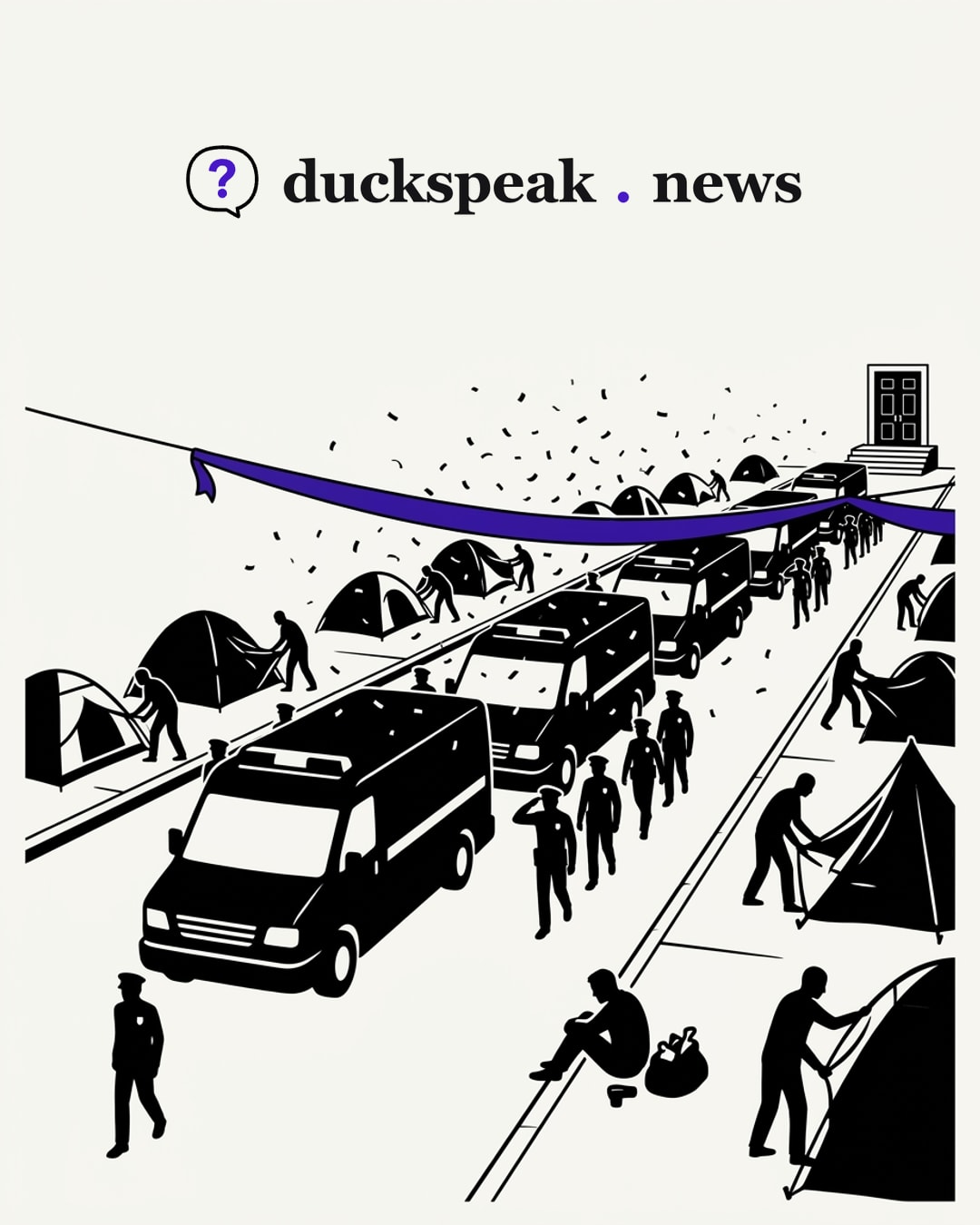
Before the reader encounters a single fact about evidence, charges, or law, the New York Post teaches them the event’s brand name: “Operation Free Skid Row” [1]. The name does the moral work in advance. A raid on a neighborhood where, by the article’s own count, as many as 6,000 homeless people live [1], carried out with flash-bang grenades and a convoy of roughly 100 law enforcement vehicles [1], is packaged as liberation, and the coverage never steps outside the packaging. Orwell’s point about political naming was that the label precedes and replaces the thought; here the label is supplied by the state and reprinted as journalism.
A war in search of a grammar
LA’s top federal prosecutor, Bill Essayli, supplies the vocabulary and the paper builds with it. The operation is “the first shot in a war to clean up the blighted neighborhood once and for all”; “This is just the first salvo” [1]. The headline adds its own military verb: a “100-strong convoy storms” the neighborhood [1]. Notice what the war metaphor converts. If this is a war, the 28 “suspected drug dealers” [1] are not defendants with charges and counsel but enemy personnel, and the neighborhood is not a place but terrain. The hunting verbs work at smaller scale: the sweep “netted a number of street pushers,” agents went “trapping dealers” [1]. People become quarry. The article even grants the neighborhood itself agency as an opponent, its “filthy blocks long resisting cleanup by authorities” [1]. Blocks do not resist; people do, and the sentence has chosen its side without saying so.
The promise of finality, “once and for all,” sits in the same story as the note that “federal agents and police conducted similar operations targeting downtown’s MacArthur Park” [1]. What those operations achieved goes unmentioned. The reader is handed a promise of ending and, a few paragraphs away, evidence of repetition, and the story never lets the two sentences meet.
Filth as fact
The headline calls Skid Row “America’s filthiest neighborhood” [1]. No metric, no comparison, no source; a superlative doing editorial work on a news deck. The body echoes it: “filthy Skid Row,” “filthy blocks,” “blighted,” “a locus of crime and misery” [1]. The operative metaphor is cleanup, and cleanup has a logic: a thing is cleaned by removing what is dirty. The article never distinguishes the residents from the dirt, and the one voice it permits from the policed population is chosen for its agreement. “Skid Row’s drug users watched the action warily, but even they said that the areas should be better policed” [1]. The “even they” construction does the argument’s work: if the users themselves want this, who could object? One quote is a sample of one, and inferring a selection effect is speculative; but the construction is on the page, and so is the absence of any advocate, service provider, defense attorney, or family member of an arrested person anywhere in the piece.
Officials as anonymous economists
The story’s most consequential claims are attached to no one. “Addicts got money for drugs from government programs, begging and thefts, they said, with the cash going to fund drug pushers’ lavish lifestyles” [1]. Who is “they”? Investigators, unnamed. On what record? None cited. A claim that public benefits feed drug markets is exactly the kind of assertion that travels from raid coverage into common sense, and it enters print with no name and no data behind it. The same sourcing carries the geopolitics (“The drugs in the area come from Mexico, Central America and Columbia” [1]; the country is Colombia, the misspelling is the outlet’s) and the claim that some dealers “posed as social workers or homeless services providers” [1]. That one seeds suspicion of the very people doing outreach on those blocks, on the word of prosecutors who are not named. Whether the paper pressed for named sources and was refused cannot be known from the page; what the page shows is assertion with the assertion marks removed, which is the outlet’s contribution, not the officials’.
The dragnet that did not target users
“Investigators said the effort did not target users, but rather dealers” [1]. Paragraphs later, the same story describes agents taping off “four multiblock sections of the neighborhood,” where “People caught in those areas were questioned by cops and, in some cases, searched and arrested” [1]. Both sentences appear with the tension between them unacknowledged. A cordon that sweeps everyone inside it is a dragnet by any plain description; the “did not target users” line is the officials’ framing, printed as the story’s conclusion. The same gap opens between headline and body. The headline asserts a “massive Skid Row criminal network” as established fact [1]; the body says “suspected drug dealers,” “alleged dealers,” “alleged distributors” [1]. The certainty is placed where everyone reads; the hedging where almost no one does.
Spectacle as anesthesia
This is the Huxley half. The story is engineered to be enjoyed rather than questioned: flash-bang grenades clearing a Pasadena home, “gleaming low-riders” in the driveway, a helicopter “circling overhead,” officers who “engulfed Skid Row in the gigantic bust,” a dealer who “purchased a Bently” [1] (sic), and, as garnish, the death of an actress, Daveigh Chase, invoked as proof of the neighborhood’s character [1]. The cinematic inventory displaces every boring question: what are the 28 people actually charged with, in which court, on what evidence? The arrest scene even lets the reader ride along in the agent’s voice; a suspect asks “What’s your problem?” and the reply, “Your mom’s selling drugs,” is printed as color [1]. None of this requires a conspiracy. It requires only a copy desk that finds a convoy more vivid than a docket number, which is Huxley’s mechanism precisely: distraction does not need to be planned to be total.
What a reader would need instead
- The charges. Forty-four search warrants and “at least 14 suspects taken into custody by 9 a.m.” [1] is an inventory, not a case. Which counts were filed, against whom, and what the court papers allege.
- The track record of the “similar operations” at MacArthur Park that the article itself references [1]: did enforcement there reduce overdoses, or move the market? Los Angeles County’s public health department tracks overdose deaths, and the LAPD keeps its own incident records; neither dataset appears.
- The legal basis for cordoning four multiblock sections and searching “people caught in those areas” [1]. The story quotes no authority on it.
- A named source or document for the claim that government benefits fund dealers’ lifestyles [1].
- Residents, advocates, and defense counsel beyond a single anonymous quote selected for its agreement [1].
- The word “suspected,” restored to the headline where “criminal network” sits as fact.
A war named freedom, a cleanup that never names what is being cleaned, and an economics sourced to “they said”: the story asks only to be watched. Reading it back means asking, each time a sentence begins with “they said,” who exactly is speaking.