

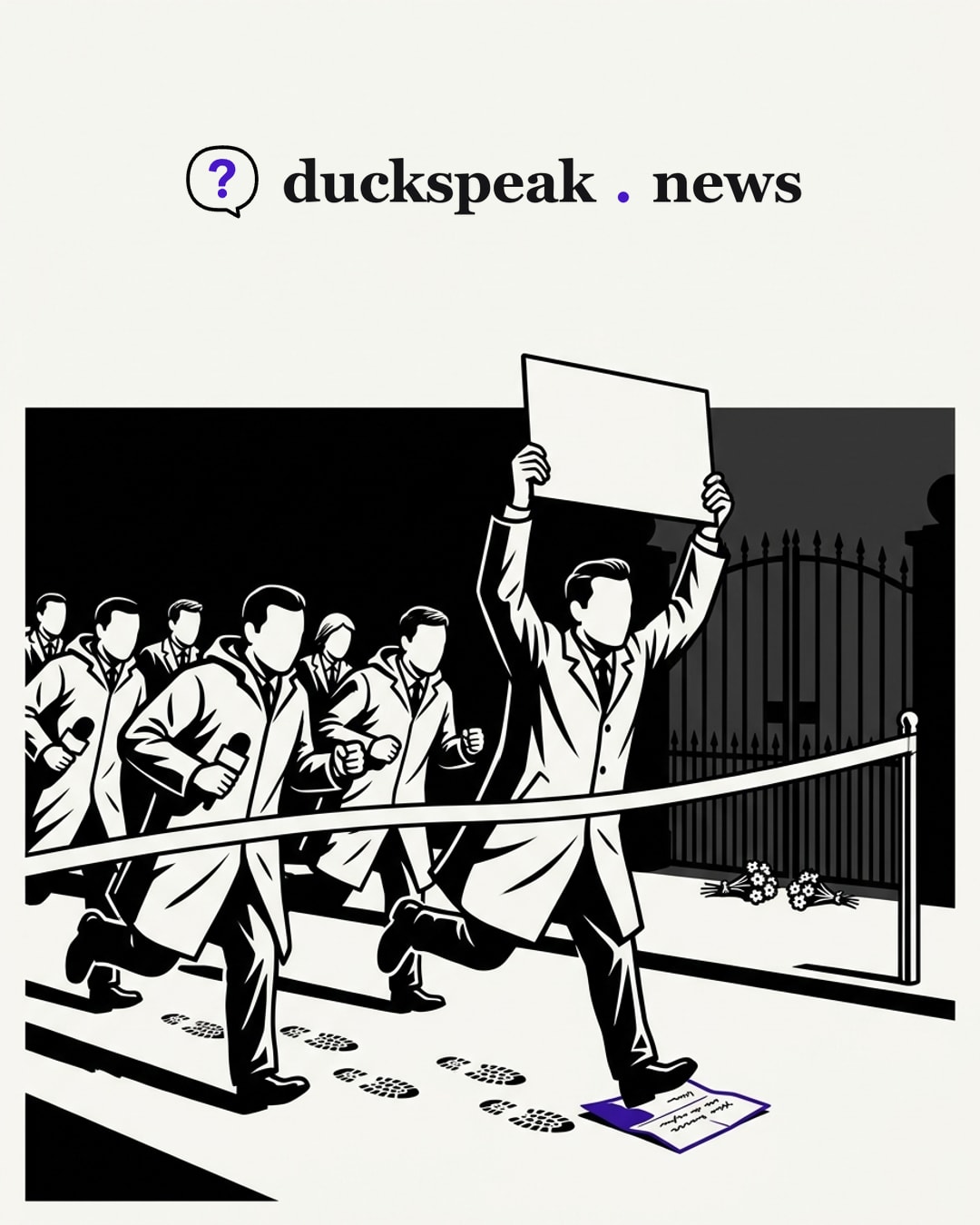
On Saturday a man died after entering the tiger enclosure at Yorkshire Wildlife Park. An earlier piece on this site (13 October 2026) watched the first days of coverage confirm the tiger’s welfare before the man’s name; this batch, drawn from days three and four of the story, adds three things. The man has a name now. His own final footage is in the copy. And an expert consensus has arrived to say the death was unlikely to have been preventable. Each addition came by a mechanism worth dissecting.
The request that was printed and passed
The Independent’s rolling file carries both facts at once. “South Yorkshire police will not be naming the victim,” it reports, adding: “It is understood that the family have requested the man is not named” [2][5]. The same outlet’s headline for the same story: “Man killed in zoo enclosure named as William Chapman” [2]. The BBC: “has been identified as William Chapman, the BBC understands” [7]. The Guardian: “named locally as William Chapman,” while noting he “has not been officially named by police” [8]. GB News, in the same batch, still has “an unnamed individual” [1]; the collection spans the exact moment the name broke.
Look at the attribution grammar. Not “police said.” Not a family confirmation, an employer, a friend. “The Independent understands,” “the BBC understands,” “named locally.” Each phrase points at nothing a reader can check; each is an outlet citing its own clairvoyance. This is the Orwellian move, the passive voice with the actor removed: the naming happened, and who did it is not on record. The family’s request is never refuted. It is printed, and then printed past, a hurdle cleared rather than a decision weighed.
To be fair, naming a dead person is ordinary journalism, and this site’s earlier piece criticized the namelessness that made the man an unperson. The critique here is not the naming. It is that the name arrived as competitive scoop while the family’s one stated wish sat in the same article, unengaged, and that no piece in this corpus weighs the two against each other.
And what does the name come attached to? Not a life. Across the three outlets that named him, William Chapman receives no occupation, no home town, no family voice [2][7][8]. He is “described by eyewitnesses as in his 20s” [7] and “believed to have been in his 20s” [8]. The tiger still has the fuller obituary: born at Dyreparken in 2021, moved to Doncaster in February 2025, a former keeper recalling that he “loves his training, eating and especially enjoys playing in the water outside” [3][6]. The unperson has been issued a name; the vacancy around it is unchanged.
The last minutes as content
The Independent’s update on the name is also an update on the footage: “Mr Chapman posted footage on his now-deleted Instagram account, minutes before he was killed, of him approaching the tiger,” with audio of heavy breathing and distant voices shouting “Oh my God” and “seriously” [2]. The BBC describes the video in detail, the inside of the enclosure, the tiger “perched on a wooden platform,” “shouts of concern, urging him to get out,” and then: “The video ends, and the account has now been removed” [7].
Meanwhile, South Yorkshire Police “said it is aware of the footage and asked people not to share it on social media” [1], and “urged people not to share distressing footage” [5]. The press’s compliance is selective: do not host the file, but narrate its contents, sourced to an account that has been removed. And the Guardian carries, in a subordinate clause, the detail that might have led: the real videos were shared online “as well as a number of AI-generated fakes” [8]. Synthetic footage of a real death is already circulating, and the coverage it earns is a clause. That is Huxley’s condition in miniature: the event and its counterfeits arrive together, and both are simply feed.
A verdict before the inquiry
City of Doncaster Council launched its health and safety investigation on Monday [2][4][6][8]. One more institutional fact, which took the Mirror to surface: “The Health and Safety Executive earlier said it would not investigate the incident, confirming that the council would be responsible” [6]. The national safety regulator is out. The licensing authority is in.
Into that vacuum, an expert consensus arrives pre-formed. Dr Campbell Murn’s analogy runs across three outlets in near-verbatim form: a “determined thief” will get into your house “despite the best security systems and enclosures” [6][7]; “If a determined thief wants to get in your house, they’re going to get in your house” [8]. The Guardian frames its expert section with a verdict sentence: “Wildlife and zoo experts told the Guardian it was unlikely the wildlife park would have been able to prevent the incident” [8], backed by Amy Dickman’s “virtually impossible for zoos to stop people who are very determined to breach safety measures” [8]. Two experts, one analogy, three outlets, and a conclusion about an investigation that opened the day before. This is duckspeak: a judgment delivered in the passive voice, before the body charged with judging has reported.
The dissent exists and is easy to find. The Born Free Foundation called for an “urgent review” into “how the man managed to enter the enclosure and what happened next” [7][8]. The Guardian gives it the final sentence of the piece [8]; the BBC, one line [7]. The Mirror, to its credit, gave Will Travers room to make the structural point: “the fence is there to contain the animal. But I think we should be looking at whether the fence is preventing people getting in” [6]. Only one outlet in this batch carried the question at all; the Guardian and the BBC carried the consensus.
What persists
The reassurance package documented in the earlier piece travelled intact into every article here: “many, many people” contacted the park about Altai, who is “safe and well and will not be euthanised” [1][2][3][5][6][7][8]. The crisis vocabulary is still absent. In these eight articles the words “mental health” do not appear, even though the corpus now holds police confirmation that Chapman was “visiting the park on his own” [2][7], a witness describing a man “in a trance, not in reality at all” [5], and the Mirror, relaying Sky News, reporting that onlookers shouted “play dead” and “he did not understand,” that he told the tiger to “stop being naughty” [6]. The signature accumulates. The vocabulary does not.
A local resident named the gap herself. Angela Seivewright, laying flowers at the gate, said “people seem to care more about the tiger”; she was bullied online for hoping the man survived, told “he deserved to die” [3][6]. The Mirror printed her words twice, once in each of its two pieces here, in blocks repeated verbatim [3][6] (possibly a liveblog artifact, but the duplication is in the record). No outlet connected her observation to its own copy.
One more instability, small but telling: the Mirror reports Altai as “now three years old” [3][6]; the BBC says “now five years old” [4]; the Mirror elsewhere notes he was born in 2021 [6]. The tiger’s biography is repeated with confidence and without agreement. The dead man’s age remains “believed.”
What a reader would need instead
- The naming dilemma stated, not smoothed: the family requested no naming, police declined to name, and three outlets named him anyway. One paragraph on the Editors’ Code’s clauses on intrusion into grief would cover it.
- The investigation’s actual shape: the council is investigating, the HSE is not [6], and findings will come in due course. A pre-emptive expert verdict is not a substitute for that sentence.
- The Born Free call for an “urgent review” [7][8] given equal prominence to the expert consensus that answers it.
- The Samaritans’ media guidance point from the earlier piece still stands: no helpline information appears in any of these eight articles either.
- The AI-generated fakes [8] treated as a story of their own, not a clause: readers sharing “footage” of this death need to know some of it was never filmed.