

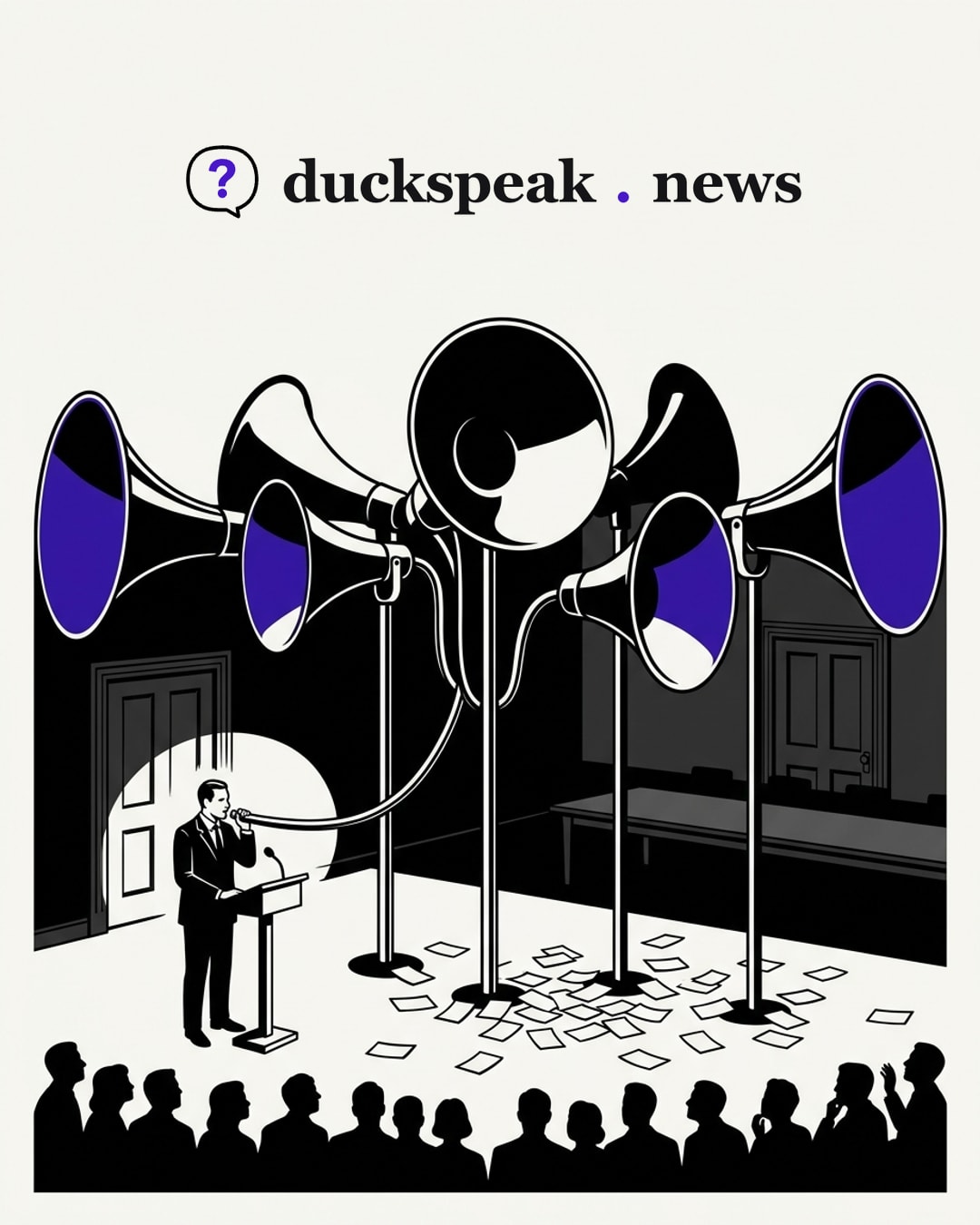
On Tuesday the director general of MI5, Sir Ken McCallum, gave his annual threat speech at Thames House. Seven pieces of copy followed from five outlets: two Independent reports, two Mirror pieces (one news, one leader column), and one each from the BBC, GB News and the Guardian. The spread is the story. The phrase “a new era of national security” surfaced in both Independent reports [2][3] and the Mirror’s news piece [4]; the Mirror’s leader column supplied the mood music, opening “The chilling warning from the head of MI5 should shake every one of us” [7]. What follows is a dissection of how a hedged official speech became a siren.
The hedges were in the quotes
The speech, as quoted, hedged itself at every turn. The bioweapons worry, the item that fronted three of the five outlets’ coverage [2][3][5], was “not yet realised” [1][4]; in the question session it was “not yet manifest” [2][3]. McCallum told his audience “My adrenaline thresholds are set pretty high. I am not easy to alarm and neither is my organisation” [4], and offered the quiet reassurance that “Their trolls aren’t geniuses by the way; they only get a foothold if we give them one” [2].
The headlines mostly kept the conditionals: “AI could give terrorists access to bioweapons if guardrails fail” [2], a scare-quoted “may” at GB News [5]. The adjectives did not. The Mirror’s leader column drops the conditional grammar entirely: “artificial intelligence threatens to put ever more deadly weapons within reach of terrorists” [7]. Present tense, no guardrails, no “not yet”. The week’s sharpest irony: the only outlet to quote “I am not easy to alarm” [4] is the one whose leader column ran “chilling” the same day [7]. Its copy desk, meanwhile, printed “manipulate how we fell” and “scrambling fats jets” [4]; the machine was running fast.
Notice the inversion across the coverage: the more speculative the threat, the higher it was placed; the more checkable the case, the softer the treatment.
“We’re there again”: an analogy nobody audited
The Mirror’s report carries the speech’s own 9/11 comparison: 9/11 was “demanding radical transformation as we took on a radically different form of threat. We’re there again. We have entered a new era of national security” [4]. The Mirror frames it as a “seismic” change on the scale of the “post 9/11 nightmare” [4].
No report audited the analogy. The sentence’s own logic says the last shock demanded a radical transformation of the security state; the obvious journalistic question is what that transformation entailed and whether this moment resembles it. Seven pieces, zero asks. Instead the register escalated: “seismic” [4], “stark” [5], “chilling” [4][7].
And the era has no exit. “Our planning assumption is not that this is a temporary blip” [3]; “We are planning on the basis that these risks will endure” [3]. Orwell’s permanent emergency, delivered as a planning assumption and printed as weather. Around it travel the Newspeak fixtures: “aggressor number one” [1][3][4][5], a ranking label doing the work of an argument, and a new MI5 mission named “Protect” [4], expansion dressed as hygiene.
The front line in your teenager’s bedroom
The speech reached past submarines and cables to the domestic mundane: “Think of a flicker in the power grid supplying your home” and “Think perhaps of what online algorithms are feeding your teenagers in their bedrooms” [2][4]. Every blown fuse becomes a possible enemy action; every teenager’s feed a front line. The Mirror’s leader column made the conversion explicit: “An attack could begin with a blackout, a poisoned online lie or a threat against a neighbour because of their faith” [7]. The speech said “flicker”; the leader said “attack”.
Then the loop closes. The same column calls for “properly funded police, intelligence services and public institutions” [7]. Official says be afraid; paper says be afraid and pay; the only evidence in between is the speech itself.
The Huxleyan half is quieter. That leader column bundles the “chilling warning” between a rugby player’s bodybuilding transformation and a water-safety campaign [7]: fear as one more carousel item, consumed between celebrity and grief. Even the Guardian, the one adversarial report, reached for “as if it was episode one of a TV thriller” [6]. And one emotional exhibit travels word for word across four reports, the “radicalised extreme right-wing 13-year-old” [1][3][5][6], offered as proof of trend without a single outlet asking what it means, in either direction, that MI5 is investigating children.
What one outlet managed, and the Brexit split
The Guardian proves the material supported scrutiny. It noted that MI5 and counter-terror police “may have to do a little better to explain” the RAF Fairford episode, given that “nothing of significance was found in the vans and nobody has been charged” [6]. It observed that McCallum was “too polite to mention” that US voices led by Elon Musk also sow division in the UK [6]. And it flagged the omission no other report touched: “AI is also an extraordinary and potentially intrusive tool for MI5 to seek out threats” [6].
Then there is the Brexit split. The Mirror reports the prime minister’s claim of Russian interference in the referendum: “I’ve had the clear answer that, yes, there was” [4]. GB News reports that McCallum “would not be drawn on whether Russia had directly interfered in the result of the Brexit referendum” [5]. The Guardian does not mention it [6]. Three outlets, three pictures, no reconciliation.
The numbers nobody can check
The caseload has “quadrupled” [1][3][5]; fifty arrests in a year of Iran-linked operations [1][3][5]; “almost 1,000 expulsions since the invasion” [1]; MI5 “devoting more resource to countering state threats than during the Cold War” [1][3]. Every figure is self-reported by the agency whose resourcing the speech itself puts on the table, and every report prints them as flat fact. The BBC, the most restrained of the news reports, which led with Russia rather than AI and kept the “not yet realised” hedge [1], still gives the numbers no epistemic label. This is not an accusation of falsehood. It is a note about status: a claim from the institution that benefits from the claim deserves a sentence saying so.
What a reader would need instead
- The full speech text. In this coverage, readers were given excerpts, never the document; the primary source is one speech, and every claim above is a selection from it.
- The evidentiary record on RAF Fairford: charges, evidence, and what “almost certainly” actually rests on. The Guardian shows the questions exist [6]; the others show they can be skipped.
- The post-9/11 audit: what “radical transformation” produced last time, so that “We’re there again” [4] can be judged as an analogy rather than absorbed as a mood.
- An institution that checks MI5’s claims rather than repeating them: Parliament’s Intelligence and Security Committee exists for exactly this, and its published reviews are the reader’s substitute for “trust us”. For the AI claims, the AI Security Institute, praised in the speech itself as “globally respected” [1][3], publishes the work behind the conditional headlines.
- One reconciled answer on Russian interference in the Brexit vote, instead of three incompatible ones [4][5].
McCallum announced a new AI Threat Assessment Centre whose job, he said, is to “separate the bluster from the realities” [1]. On this showing, the centre has its work cut out. So do the papers.
Caveat: this critique is built from the outlets’ excerpts; no transcript was available to check quotations against, so the claims about hedge-stripping rest on what each outlet chose to print.
More on Russian interference in the Brexit referendum on this site:
- 12 October 2026 A Clear Answer Is Not a Fact
- 12 October 2026 ‘The result is the result’: the bombshell that shrank to ‘attempts’ by Monday
- 13 October 2026 ‘Legitimate’: the word that ends the question
- 14 October 2026 Inconceivable, Therefore It Happened