

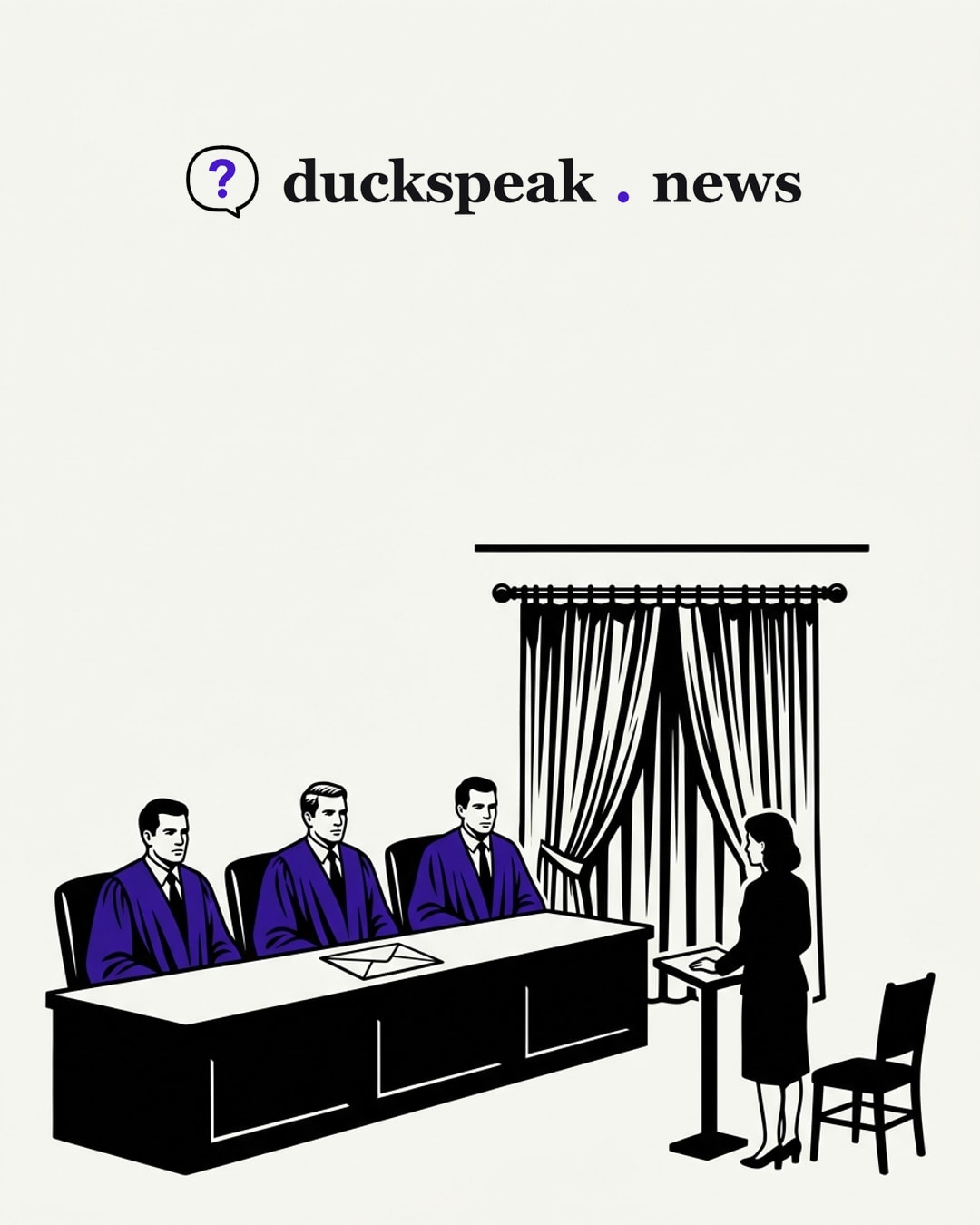
When a president who has already tried and failed to fire a Federal Reserve governor convenes a panel to decide whether that governor should be fired, and staffs it with his own top economic adviser and two of his appointees, the obvious question is who is judging whom. Read the two stories on Friday’s memo and the question barely surfaces. Both outlets open with machinery: a signed memo, a “committee of inquiry,” a Nov. 5 hearing at the White House, a transcript to be published later [1][2]. The vocabulary is judicial. The wiring is not.
The name does the work
“Committee of inquiry” is the administration’s coinage. Both outlets quote it once, in quotation marks, and then let it harden into a neutral category of government thing [1][2]. ABC’s headline is the memo’s self-description almost verbatim: “Trump announces committee to investigate Federal Reserve’s Lisa Cook” [1]. AP at least appends a clause of candor, “in latest effort to fire her” [2]. Inside both stories, the committee simply exists and will now do inquiry-shaped work.
What the stories print but never assemble: the panel consists of Kevin Hassett, the president’s top economic adviser, who “has frequently echoed Trump’s criticisms of the Fed” [2]; Andrea Lucas, whom Trump appointed to chair the EEOC [2]; and Keith Sonderling, acting director of the Office of Government Ethics, whom the president “has also appointed to lead the Labor Department” [2]. Its “written findings of fact and conclusions of law” are delivered to the president himself [1], the same official who signed the memo, who already attempted the firing once, and who was stopped by the Supreme Court [1][2]. In Orwell’s vocabulary, this is naming as conjuring. Call it an inquiry and it performs inquiry, whatever its wiring.
The verdict inside the warrant
The sharpest piece of evidence in either story is quoted and left unexamined. Trump’s memo, as carried by AP: “As President, it is my job to ensure the laws are faithfully executed, including by firing subordinates who cannot be trusted to tell the truth and follow the law” [2]. The document that establishes an inquiry into whether Cook can be trusted declares, in the same breath, that subordinates who cannot be trusted should be fired. The verdict is printed inside the warrant that orders the trial. That is doublethink in a single sentence, and it runs as color quote, not as the circularity it is.
“Extraordinary,” repeated until it soothes
Both outlets reach for the same adjective. ABC: “an extraordinary ramping-up of his ongoing efforts” [1]. AP: “Trump’s extraordinary demand” [2]. The word performs alarm while the surrounding structure, all dates and rosters and balanced quotes, reassures. This is the Huxleyan half of the mechanism: crisis vocabulary delivered in the rhythm of routine coverage, so that the tenth unprecedented event reads like weather.
AP then slides into the passive: the demand “will likely renew concerns about threats to the Federal Reserve’s independence” [2]. Concerns renew themselves. No one in the sentence does anything; the president’s act becomes an atmospheric condition that merely affects the ambient level of concern.
The motive, printed in pieces
The rate story is fully present in the sources and fully disassembled. AP reports that Trump “has repeatedly called for the central bank to cut its key interest rate,” that the Fed raised it anyway on Sept. 16 in a unanimous vote led by Chairman Kevin Warsh, “whom Trump appointed earlier this year” [2]. AP also reports that Trump and his advisers blamed the rate-setting committee for the hike, and that Cook is one of that committee’s 12 voting members [2]. ABC carries the other half: Cook’s attorneys say the original ouster attempt “was based on her refusal to lower rates” [1].
Every piece of the motive puzzle is in print. Neither story assembles it in one paragraph. To be clear about the status of this claim: the connection between the firing effort and the rate fight is alleged by Cook’s lawyers [1], not established by either outlet, and this critique is inference from facts both outlets printed. But printing the facts while withholding the relation is itself a framing choice.
A standard the process is built to miss
The law permits removal “for cause,” a term “not defined in the statute” [1]. The Supreme Court, per AP, required “an alleged offense that was serious and related to an official’s job” [2]. The allegation here concerns private mortgage paperwork from 2021 [2], not Cook’s conduct as a governor. Scott Alvarez, formerly the Fed’s chief counsel, says the allegations “don’t appear to meet the ‘for cause’ standard” [2]. So the machinery exists to manufacture a “cause” that, on the coverage’s own expert testimony, the record does not contain.
The lawyers’ phrase for it is the sharpest line in either story: a “box checking exercise” [1][2]. TD Cowen’s Jaret Seiberg is blunter: “We do not see why the White House would start this process if it were not trying to create a way to justify removing Cook from her job” [2]. Note where all the analysis lives. It lives in quoted parties. The outlets’ own framing stays procedural throughout, borrowing judgment from sources so the house voice can remain neutral about a structure that is not.
Omissions, small and large
The hearing will be closed to the public, though transcribed [1][2]. Both mention this in passing, without noting the tension: a process built to satisfy a Court-ordered “opportunity to respond” [1], conducted in secret, before the accuser’s own staff. ABC omits what AP includes, that Cook is the first Black woman on the Fed’s board and that the attacks on her “followed other efforts to oust or indict Black officials, such as New York Attorney General Letitia James and Gen. Charles Q. Brown” [2]. Pattern context is the first casualty of process framing.
The memo’s own grammar goes unremarked: Cook “shall appear at the hearing and be examined by the Committee, its representatives, and her legal counsel, if any” [1]. If any. The order presumes a defendant without counsel. And the factoids drift: ABC says no president attempted this in the Fed’s “112-year history” [1]; AP says “113-year” [2]. The timelines wobble too, with ABC dating the first firing attempt to “last year” [1] while AP dates it to August 2025 [2]. Small things, repeated without checking. This is how repetition starts.
What a reader would need instead
- The panel’s composition and reporting line in the first paragraph, not deep in the story: three presidential appointees, one of them the president’s own economic adviser, delivering “findings of fact” to the president who ordered the firing [1][2].
- The motive assembled in one place: the rate demands, the unanimous Sept. 16 hike under Trump’s own chairman, Cook’s vote on the committee, and the attorneys’ allegation about her refusal to lower rates [1][2].
- The Supreme Court’s actual standard, “serious and related to an official’s job” [2], set directly against the 2021 mortgage paperwork [2], with Alvarez’s assessment that the allegations do not meet it [2].
- The June ruling’s footnote, which said nothing prevented Trump from “trying again” so long as Cook received notice and an opportunity to respond [2]. The hearing is engineered to the letter of that footnote, and a reader deserves to see the engineering.
- The Taft-era precedent Alvarez raises, a similar commission in 1912, and AP’s own note that Trump’s panel “goes beyond the type of process the Supreme Court said was needed” [2].
- The transcript the memo promises [1][2], read against the memo itself, which already contains the conclusion.
Cook’s lawyers say they have “grave doubts” the hearing will prove legitimate [1]. The doubt worth adding is about the coverage: once a newsroom adopts the vocabulary of inquiry, quotation marks and all, the marks come off fast, and what remains is the administration’s description of its own device, printed as the news.