

On 12 October 2026, NATO’s Supreme Allied Commander Europe, General Alexus Grynkewich, delivered a keynote at the Warsaw Security Forum carrying his own branding: a “Theory of Victory” [4]. The full transcript of the address and Q&A is public [4]. Three press accounts of those same minutes map the market by headline alone: “NATO commander warns of bloody retaliation if Russia attacks” [2]; “NATO commander says alliance does not want war but is ‘ready to fight tonight’” [3]; and RFI’s calmer «l’Otan est prête», assure le commandant [1]. Gore, readiness, reassurance. Read against the record, all three wrappers share one feature: the violence survives the packaging, and the speaker’s own limits do not.
The words that weren’t in the speech
Neither “bloody” nor “retaliation” appears anywhere in the transcript [4]. The closest the general came was “we will break the warfighting system engaged against us” [4], and the Mirror’s body text correctly attaches its quotation marks only to “break” [2]. The blood is the headline’s contribution. So are “stern warning,” “grim warning,” and an “overwhelming reaction” [2], none of them his words.
“Retaliation” is the more serious invention, because it reverses the argument. The general devoted a full section of the speech to escalation management: “we are not seeking to impose a strategic defeat on our adversary, nor do we need to do so,” only “the tactical and operational defeat of the forces being employed against us. But no more,” because “we have no need and no incentive to escalate” and “the burden of escalation would rest squarely upon the aggressor” [4]. That is a denial defense with deliberately capped aims. Retaliation is punitive payback, the thing he explicitly disclaimed. The Mirror cut the entire escalation chapter and printed the mirror image, widening him into a commander who would “break” the military “of any country behind such an assault” [2].
Also cut, completely: “I do not assess that conflict is imminent or inevitable. It isn’t.” [4]. That sentence appears nowhere in the Mirror piece [2]. We cannot know the headline writer’s intent, and that part of this critique is inference; the absences, though, are checkable, and they are total.
The Mirror then pads the frame with spectacle: a casualty toll “reaching the bloody milestone of 1,554,310” [2], a figure introduced a paragraph earlier as something Kyiv “is said” to claim, with the attribution quietly gone by the milestone sentence; “increasing rumours that Putin will order a mobilisation” [2], sourced to no one; sabotage “thought to have been triggered by Russian spies” [2], thought by whom the passive voice never says. Compare the AP copy PBS carries, which counts “at least 211” incidents “blamed on Russia by Western officials… and tracked by The Associated Press” [3]: attributed, sourced, countable. Six-figure precision without a source is not information; it is production value.
The euphemism starts at the podium
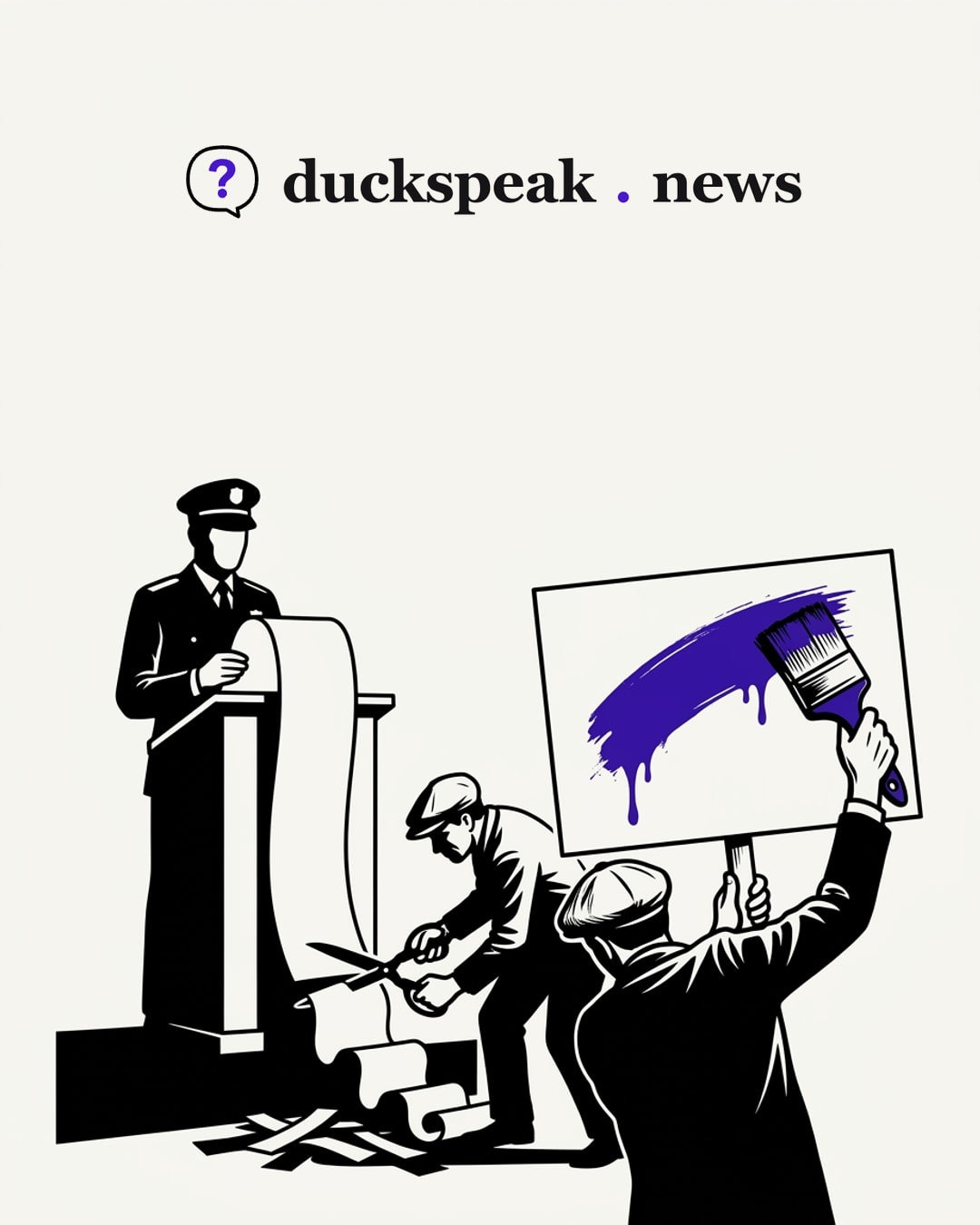
Before the tabloid is faulted for adding gore, the record should be faulted for removing it. The general’s own vocabulary is the first layer of laundering. The promise to strike “anything and everything that supports, sustains, or controls that force” [4] is a sentence with no human object in it. “Enemy formations will be starved of replenishment. Enemy commanders will be unable to control their forces, and enemy forces and support capabilities will be reduced and destroyed” [4]: everything is passive, everything happens to things. What supports and sustains a modern military includes grids, factories, and people, but the grammar holds it all at the level of systems engineering, down to borrowing Clausewitz to say the enemy will be made “to culminate” [4]. This is the Orwell mechanism in its purest form: violence recast as process, agents deleted, destruction rendered in the register of logistics. The Mirror did not misread that register; it re-painted it for a market that buys war as gore rather than as systems. Same product, different wrapper.
A sedative, reported as a stimulant
The Q&A contains the fact that none of the three outlets reported as news: the general’s stated reason for going public. Populations around the alliance “are a bit nervous,” he said, and “what I want to do is assure the 900 million citizens of our alliance that we’ve got this” [4]. The moderator had opened the session promising “a little bit of optimism” [4]. The speech’s purpose, by its author’s own account, is reassurance, and that Huxleyan half ran on schedule. RFI’s headline verb is “assure” [1]. It prints the martial quotes (“Nous détruirons l’ennemi et nous vaincrons” [1]) and, to its credit, the “Je ne considère pas qu’un conflit soit imminent ou inévitable” (I do not consider a conflict imminent or inevitable) line [1], then hands the floor to a single expert whose function in the piece is to convert the speaker’s self-description into analysis: the general “a très bien rappelé que l’Otan est une alliance défensive” (very well recalled that NATO is a defensive alliance), so the martial tone is really “une mesure de dissuasion” (a measure of deterrence), indeed “une mesure de crédibilité” (a measure of credibility) [1]. “Defensive alliance” is the general’s own claim [4]; after one expert lap it returns as independent verdict. RFI is meanwhile more euphemistic than the soldier, calling Russia a “compétiteur” [1] in the same paragraph that quotes him promising to destroy “l’ennemi” [1]. Its closing verdict on US troop cuts, “Comme un mauvais signal” (like a bad signal) [1], arrives as an unattributed editorial fragment.
The best of the three still cut the same sentences
The AP copy is the strongest account here. It keeps the “not imminent or inevitable” caveat, notes the general “provided no specific details about what kind of attack NATO is preparing for, nor where, nor with what kind of forces,” and reports the detail that undercuts the show: some NATO nations “have previously struggled to perform in exercises simulating drone warfare,” and the spokesperson concedes the counter-drone network is still being built and has “not yet taken down any drones” [3]. Set that against “If attacked, we are ready to fight tonight” [4] and you have the actual story. But PBS also drops the escalation limits and the reassurance rationale, and all three outlets repeat the branded phrase “Theory of Victory” [1][2][3] without printing the general’s own disclaimer that “some have called it a plan, but it’s not” [4]. A theory that is not a plan is a communications product; the press ran the product name as doctrine.
What a reader would need instead
The primary source is public: the forum’s own transcript [4]. The two sentences a general reader most needs are the two the coverage largely withheld: no conflict is assessed as imminent or inevitable, and the alliance caps its war aims at stopping an attack, “but no more” [4]. The threat baseline is Denmark’s defense intelligence assessment of a “low but growing risk” of a limited attack [3], with both the Danish service and NATO’s own spokesperson judging an outright attack unlikely while Russia fights in Ukraine [3]. Casualty figures should carry their source in the same sentence; Kyiv’s tallies are claims inside an information war, and PBS’s attributed count of 211 tracked incidents [3] shows the practice is possible. And “ready to fight tonight” [4] should travel, in any honest account, with the admission that the drone-defense network has “not yet taken down any drones” [3]. Caveats on this critique: quotations come from the prepared forum transcript [4], so delivered wording may differ slightly; and our claims about omissions are verified against the three pieces as given, not against those outlets’ wider output.