

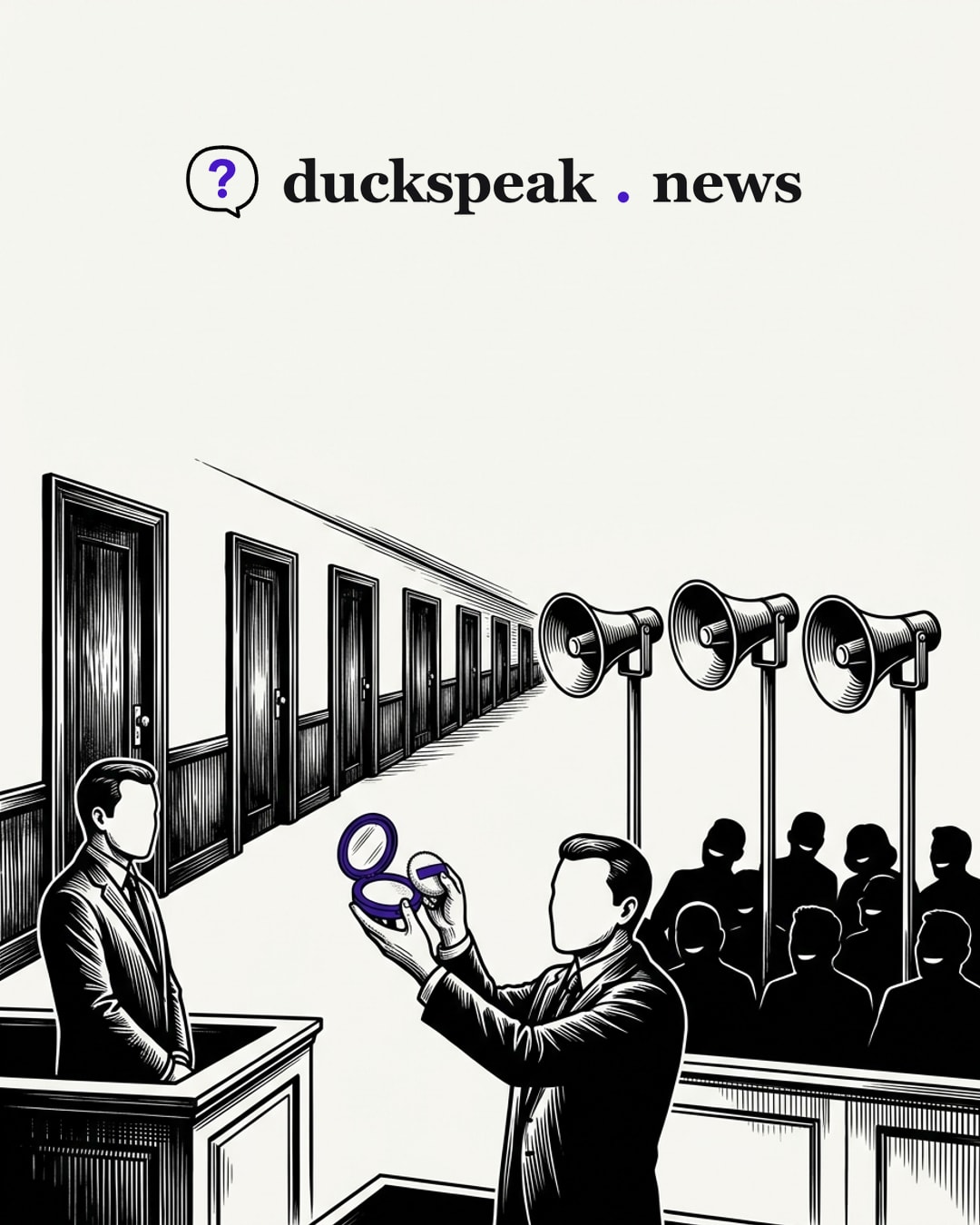
Three outlets, one script
The Independent, GB News and the BBC all covered the opening of the trial of Kashim Chowdhury at Southwark Crown Court. The overlap is striking. The Independent and GB News share, almost sentence for sentence, the same structure: the “183 hours a week for five jobs” line, the “exploited” work-from-home culture, the white make-up, the “laughable” incident [1][2]. The BBC compresses the same material [3]. That is likely a shared source (the prosecution opening, possibly via a press agency), which is ordinary court reporting. But it means the reader is getting one party’s account three times, and repetition feels like corroboration. That is the duckspeak mechanism in its mildest form: not a lie, but an echo.
The headline does the convicting
The body copy is careful. Each paragraph hangs on “prosecutors allege” or “the court heard” [1][2][3]. The headlines are less careful. The BBC’s reads “Civil servant faked illness with make-up to juggle five jobs, court hears” [3]. “Faked” is stated as fact in the headline’s own voice; “court hears” is a trailing tag most readers will skim past. The body of the same article only says the make-up was worn “to try to look ill” as the jury “has been told,” and attributes the observation to Ms Adams, who “claims” it [3]. The Independent and GB News use quotation marks and attribution in their headlines (“used ‘remote working and sick leave’”; “‘used remote working to fraudulently juggle’”) [1][2], which is better, though the word “fraudulently” survives inside GB News’s quotes as an adverb the reader may attach to the man rather than to the prosecution [2].
The defence, by contrast, gets one sentence everywhere: he denies nine counts of fraud. The BBC adds that he “denies acting dishonestly or intending to make a dishonest gain” [3], the only outlet to say what the denial actually contests. That is a real difference, and it matters, because dishonesty is the contested element.
The anecdote as the story
The prosecutor herself calls the make-up episode “laughable” [1][2][3]. All three outlets pass this on, and the BBC puts it in the headline. Huxley’s point in Brave New World was that distraction can do the work coercion once did. A man with peeling face paint is a better story than a procurement and vetting question, and it invites mockery in place of scrutiny. It also arrives as the prosecution’s chosen illustration of “deceit,” in the prosecution’s words [1][2][3]. Nothing in the reports tells us how the defence will answer it.
There is also a sensitive detail all three mention in passing: the court heard he was signed off for “mixed anxiety and a depressive disorder” [1][2][3]. The reports do not say whether the diagnosis is disputed. The juxtaposition with the make-up story risks teaching readers that mental ill health claims are suspect. I flag that as an implication of placement, not a claim any outlet makes, and it is speculative.
Small discrepancies, small warnings
GB News gives the defendant’s age as 55 in the text but captions a photo “Kashim Chowdhury, 54” [2]. The BBC spells the surname two ways in a single article (“Chowdury” and “Chowdhury”) [3]. Minor, but these are the details readers use to judge care, and they sit beside a man’s alleged guilt.
The omission: the system
The most telling fact appears last or not at all. GB News and the BBC note the alleged frauds “came to light after the National Fraud Initiative alerted Defra” [2][3]; the Independent omits this [1]. So by the prosecution’s account it was a data matching exercise, not any of the eight employers, that surfaced the problem. Yet none of the three asks what that implies: how a person could allegedly hold overlapping roles at the Home Office, the Department of Health and Social Care, Defra and others across more than three years [1][2][3] without internal checks catching it. The framing instead locates the cause in “work-from-home culture” [1][2][3], a phrase the prosecution used and the outlets adopted. GB News’s “Whitehall” headline adds its own flavour [2]. A diffuse cultural villain is easier to write than an institutional failure, and nobody has yet been asked about the latter.
What a reader would need instead
- Plain tense: “is accused of” in the headline, not “faked.”
- The defence case, not just the denial. If the reporters did not hear it at the opening, say so.
- The National Fraud Initiative, which the reports name, is the body that matches public sector data to detect such cases; a reader should be told what it does and how often it flags overlapping employment. The reports do not say, so I cannot.
- Questions to the departments named: what pre-employment checks existed, and did any change?
- Clear separation of what the prosecutor characterised (“laughable,” “deceit,” “exploited”) from what a witness said she saw.
The trial continues [2]. Until a verdict, the honest summary is short: a prosecutor has made serious allegations, a man denies them, and three outlets have mostly repeated the first half louder.