

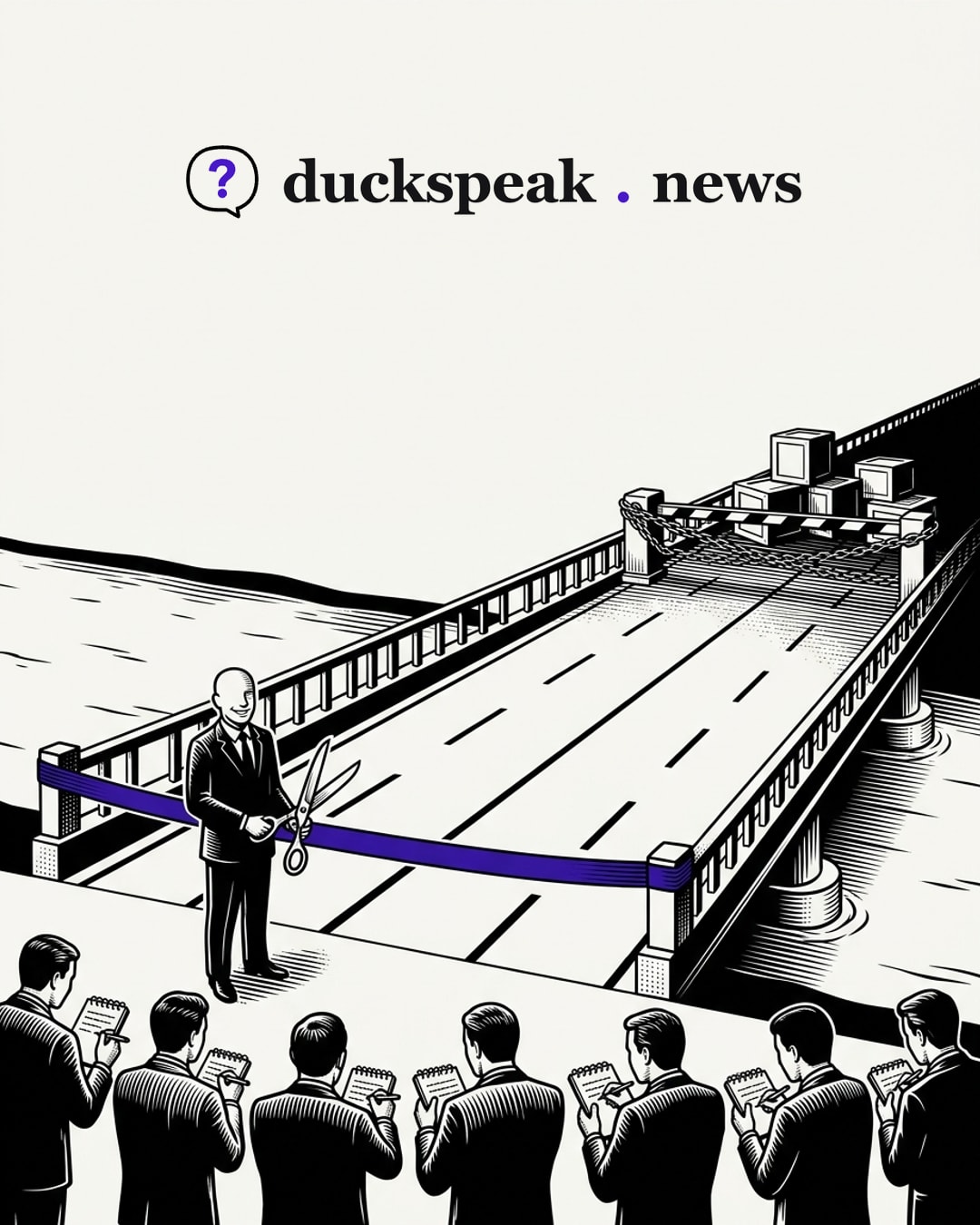
Same bridge, different amounts of context
A four-lane bridge between Dandong and Sinuiju is due to open. France Info and ABC News both report it, but they give readers very different amounts to work with. This critique is modest in scope: neither piece is propaganda. The issue is how much of the official vocabulary passes through unchallenged.
The state’s words, delivered as the lede
France Info’s report rests on «les médias d’Etat chinois» (Chinese state media) [1]. Its central quote comes from Mao Ning, spokesperson for China’s foreign ministry. She says the opening will «favoris[er] davantage les échanges économiques et commerciaux ainsi que la circulation des personnes» (further promote economic and trade exchanges as well as the movement of people) and «améliorera le bien-être des deux peuples» (will improve the well-being of the two peoples) [1]. The piece’s own subhead repeats the same idea: «Il favorisera davantage les échanges et la circulation entre les deux pays» (it will further promote exchanges and movement between the two countries) [1].
That is a promotional line, and the headline and standfirst treat it as the story’s summary. «Bien-être des deux peuples» is the kind of phrase Orwell warned about: pleasant, abstract, and hard to dispute because it asserts nothing checkable. The article never says who gets to trade across this bridge, or on what terms. It does call North Korea «soumise à de multiples sanctions de l’ONU» (subject to multiple UN sanctions) [1], but it never connects that to the ministry’s talk of «commerce».
A second voice, Ahn Chan-il, is described as «un chercheur d’origine nord-coréenne» (a researcher of North Korean origin) [1]. He says the bridge could give the North Korean economy «un coup de fouet considérable» (a considerable boost) [1]. The piece gives no institutional affiliation for him, so the reader cannot weigh his claim. The article also gives no sign of whether he sees the sanctions as an obstacle.
What ABC supplies, and what it leaves loose
ABC News [2] is more detailed. It gives the delay’s history: the bridge was expected to open in 2014, and the date passed «with no sign of an opening» [2]. It notes speculation that North Korea «was wary of an increase in economic dependence or was unhappy with China voting for United Nations resolutions» [2]. It also names its analysts’ institutions, such as Seoul’s «state-run Institute for National Security Strategy» [2], and it gives figures: about 98% of North Korea’s external trade was with China last year [2].
Even so, there are soft spots:
- «Apparently» recurs: China «apparently completed construction» and Kim drew closer «apparently» to build «a front against the United States» [2]. The hedge is honest, but the second claim ascribes a motive to Kim with no source.
- «Experts say Chinese officials likely felt uneasy» about the Russia-North Korea bridge [2]. No expert is named, and the claim is inference presented as consensus.
- The piece says the bridge is expected to boost trade, then says that in the short term it won’t likely produce a sharp increase [2]. The reader is left with two predictions and no way to tell which one carries the weight.
- ABC cites two South Korean state-linked institutes, and says so for one of them, but does not remark that both analysts come from the same government’s orbit.
The Orwell and Huxley reading
The Orwellian risk here is mild: euphemism and repetition. When a state ministry’s phrase («bien-être des deux peuples») becomes the headline logic, readers take in its framing before they see the facts.
What a reader would need instead
- Clear labelling of the ministry quote as a state claim, set beside the UN sanctions context.
- Named affiliations for every analyst, as ABC does in part and France Info does not.
- A line on what the sanctions regime actually restricts in cross-border trade. Neither piece says, and we have not gone beyond the sources to supply it.
- ABC’s history of the delay, which France Info reduces to «différents problèmes» (various problems) [1] on Yonhap’s authority.
- Separation of reported fact from inferred motive, especially on Kim’s intentions and Beijing’s unease.
Caveat: this is a two-source comparison of short pieces, and France Info’s text may be incomplete. The pattern is suggestive, not proof of editorial intent.