

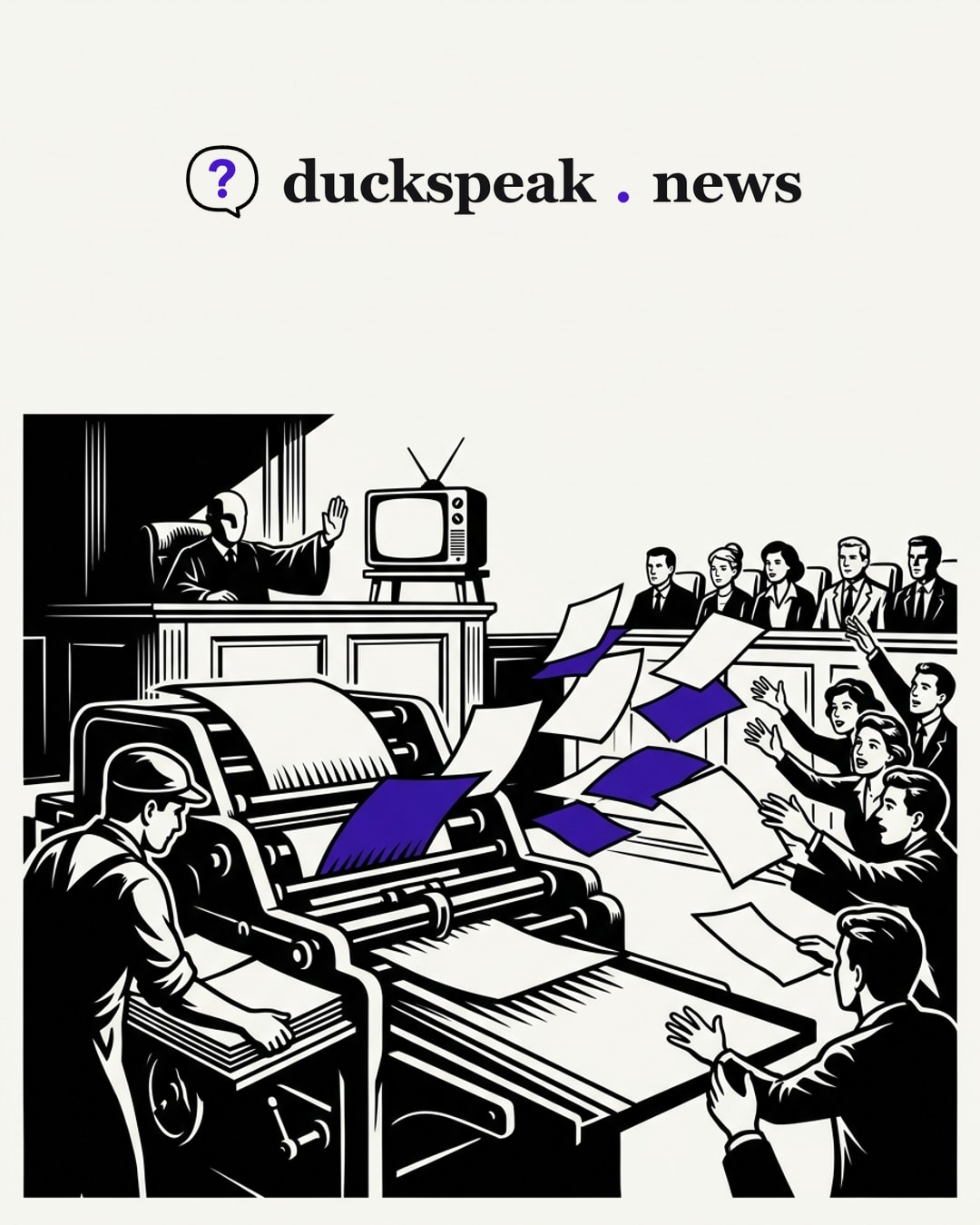
Our earlier piece on this trial looked at the wardrobe lede, the red-carpet texture that displaced the allegations. This time the trial is in evidence, and the framing problem has changed: it is no longer what the coverage leaves out, but how it converts allegation into fact by grammar and headline. Where the evidence is thin, we say so.
“Told her ‘it’s just fun’ as he raped her”
The Guardian’s headline reads: “Russell Brand told woman ‘it’s just fun’ as he raped her, court hears” [4]. The standfirst-level claim is stated in the outlet’s own voice, with the attribution (“court hears”) parked at the end. The opening sentence is more careful: “A woman has alleged Russell Brand told her ‘it’s just fun’ as he raped her” [4]. So the body hedges what the headline does not. Most readers meet only the headline, and that is where the verb “raped” sits unqualified.
The other Guardian headline does the same with adjectives: “Russell Brand was ruthless, calculated and manipulative sexual predator, court told” [6]. The Independent: “Russell Brand was a ‘manipulative’ predator with a ‘voracious’ sexual appetite, court told” [5]. These are the prosecutor’s words in an opening speech, which is advocacy by design. The Independent at least keeps scare quotes on two of them [5]; the Guardian drops them entirely in its headline [6]. “Court told” is doing the work of a disclaimer, and it is a thin one: a court was told something, and the headline then reads as a finding.
The judge’s warning, filed late
The most important sentence in this batch of coverage is from Mr Justice Bennathan, who told jurors that the 2023 documentary, in which “a few women were quoted making anonymous allegations,” adds no support to the prosecution: “because it doesn’t and it mustn’t” [1]. He also noted the allegations “have never been tested in any court” and that the defence may argue the programme “twisted” memories [1].
Only the Independent’s live blog carries this, and it sits mid-page between a description of Brand’s gaze and a police interview [1]. The Guardian’s piece on the same day’s evidence instead reports that the woman said the 2023 Dispatches documentary “triggered” her to go to police [4], with no mention of the judge’s direction in that article. That may simply be because the direction was reported elsewhere in the Guardian’s coverage; we read only these two articles, so we cannot say it was omitted from the paper. But within this set, the press’s own earlier product is both the trigger for a complaint and something a judge told jurors to discount, and the reader of the Guardian piece gets only the first half [4].
Brand’s defence, as the Guardian relays it, is that accounts “may have been reinvented or imagined after a documentary” [6]. The Independent says he claims some accounts “have been reimagined following a documentary” [5]. Both wordings come from prepared statements as relayed by the prosecutor. The media is, in other words, a party to the dispute it is reporting. No outlet here says so plainly.
Sensory detail as a Huxley mechanism
The coverage of the complainant’s police interview is dense with sensory material: “snake-like,” “lizard,” “prancing around” like an ostrich [4], “budgie smugglers” [2], Basil Fawlty goose steps [3][7]. The Independent runs a piece whose headline is about topless photographs shown in court [7], and its text describes his “slight smile” and lips “pursed as if he was blowing a kiss” [7]. The photographs are real evidence, and reporting on them is legitimate. But the register is of spectacle: a reader is invited to picture the scene. This is less Orwell than Huxley; nothing is hidden, the trial is simply made vivid, consumable, and serialised. The BBC even points readers to a day-by-day podcast, “Fame Under Fire” [3], so the trial arrives as a subscription product, with the title again placing fame under fire.
To be fair: this is complainant testimony relayed in a court that allows it, and much of it is attributed with “she told police” [4]. GB News strings together “alleges,” “claims” and “is said to have asked” in a single sentence, so awkwardly that the hedging itself becomes noise: “The woman claims Mr Brand is said to have asked her” [2]. That is double attribution used as a reflex rather than as precision.
“Most blessed”
Brand’s arrival quotes are treated as news in two outlets: “most blessed” [1] and “concerned but hopeful” [5]; the Guardian carries “I feel blessed” and “That’s my prayer” [6]. The Independent notes he carried a Bible study book [1]. These are choices of what to include, and they invite the reader to read piety as performance. Whether that is fair is a question the outlets leave to the reader without saying they are posing it. We flag this as speculative: no source claims the piety is staged, and this critique does not either. The point is that a defendant’s greeting is being supplied as characterisation with no evidential function.
Where the defence barely appears
Defence material is thin in this set. Cross-examination of the friend Mark Pinheiro is reduced to a line in the Independent and Guardian [5][6]. Pinheiro’s evidence that Brand said “I think things may have gone a little bit too far” [5] is reported in both, with the caveat that Pinheiro said he had “merely described” behaviour [5][6]. The BBC says Brand “has said that any sexual contact if it happened, would have been consensual” [3], one sentence, not attributed to a specific document or date. The Guardian says Brand’s prepared statement described “countless locations and scenarios” of encounters [6], which is not a denial of the specific allegation, and the piece does not say whether he addressed it further. A reader cannot tell from these pieces what the defence case is.
What a reader would need instead
- Headlines that keep the attribution in the headline, not after the comma: “alleges,” not “raped.”
- The judge’s direction on the documentary, prominently, in every piece that mentions the documentary as a trigger [1][4].
- A plain statement that prosecution adjectives like “predator” and “voracious” are opening-speech advocacy, not evidence [5][6].
- The defence position, specifically sourced, in every report of the day’s evidence.
- Context a reader can verify: contempt-of-court rules on reporting active proceedings, and the court record itself. We had no transcript, only press accounts, and one article cited is a rolling live blog whose entries may have been revised.
A court is trying to decide what happened. A headline has already told the reader.