

Note: This critique is based only on three press articles; no official record (court filing, DOJ statement) is cited, so claims about the case rest on what the outlets themselves report.
One event, three levels of detail
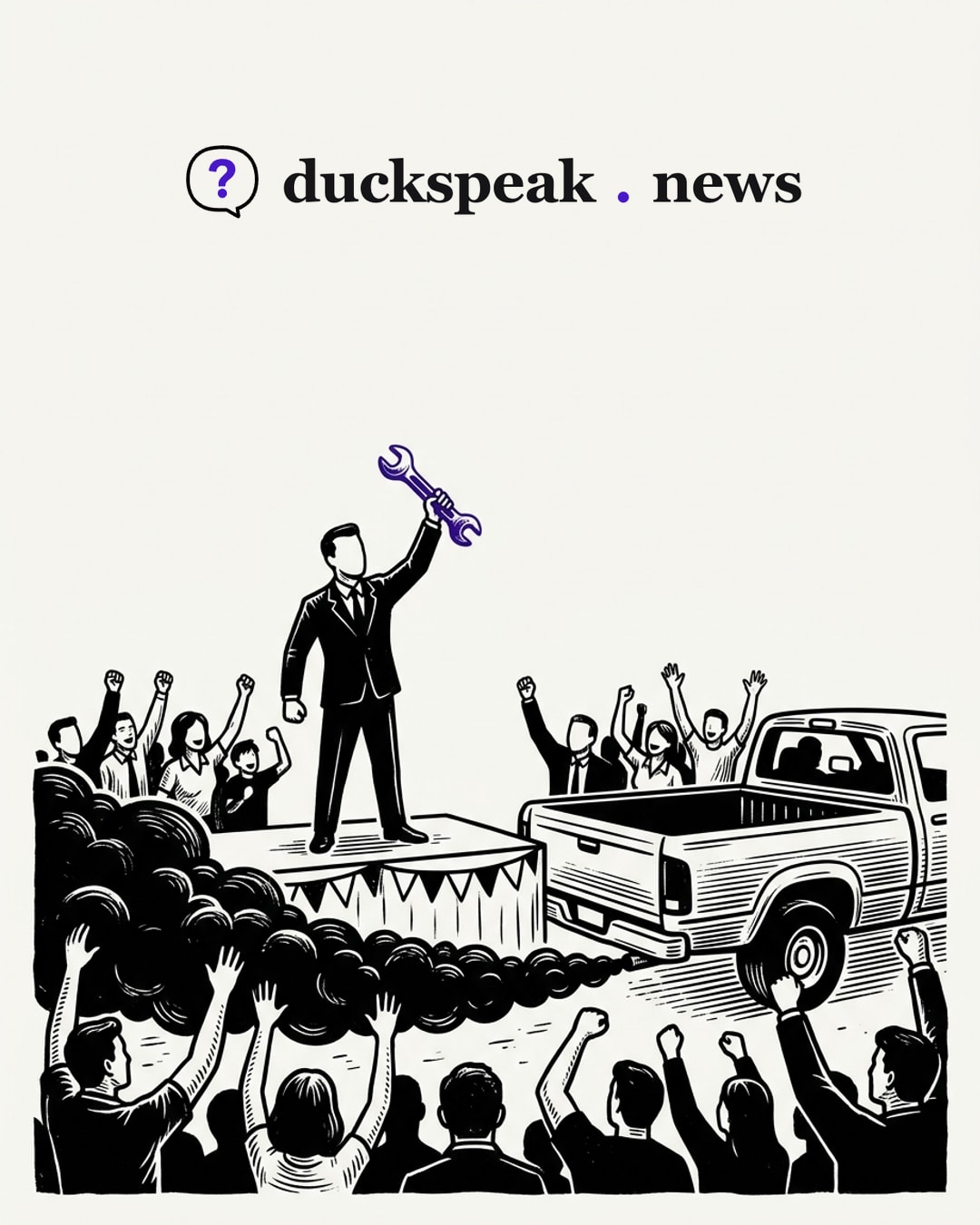
On Tuesday in Wasilla, Alaska, President Trump signed pardons for two men, Zachary Czubak and Patrick Fleming, on stage at a midterm rally. All three outlets agree on the basics: the men pleaded guilty in 2022 to conspiracy to violate the Clean Air Act. What differs is how much of the offense survives the retelling.
The euphemism at the center
Trump’s own description, quoted by the New York Post and CBS, is that prosecutors “wanted to put them in jail for 10 years because they fixed an engine” [2][3]. Call it a small piece of Newspeak: “fixed” does the work that “removed emissions controls” would not. CBS reports that prosecutors say the shop offered to remove emission control systems for $1,140 to $5,445, “in part by modifying their physical components and preventing their diagnostics systems from noticing a problem” [3]. That is a description of disabling a pollution system and hiding that it was disabled, not repairing a malfunction.
CBS is the only outlet that sets the two descriptions side by side. It also notes that the Biden-era statement warned that cutting out emissions controls “results in a massive increase in air pollution from even a single vehicle” [3].
What the thinner versions leave out
Fox News gives the prosecutors’ account in one sentence, attributed to “the Biden Justice Department,” and describes the case as one brought “under the Biden-era Department of Justice” [1]. The partisan label is repeated in the lede, and the allegation is carried as “According to the Biden Justice Department” [1]. A guilty plea is mentioned, but the label “Biden” does framing work: it presents the charges as a political product. The piece also runs a headline link calling the mechanics “‘PERSECUTED’” in a “RIGHT-TO-REPAIR CRACKDOWN” [1]. That is a ready-made frame, in quotation marks but without attribution in the article. Whether “right-to-repair” applies to defeat devices is not examined.
The New York Post headline puts “wrongfully charged” in quotes, but the body hedges the facts with “allegedly tampered” [2], even though both men pleaded guilty, a fact the Post does state. Neither Fox nor the Post mentions the cold-weather argument made by supporters, or that the Justice Department announced in January it would stop pursuing such tampering charges [3]. Only CBS supplies that context.
Fox’s story is also notable for what it treats as the news: “major energy deals.” The pardons are folded into a rally story about a pipeline, and the writer relays Trump’s claim that “every single permit” has been granted while noting only that Fox “reached out to the White House” [1]. That is stenography with a footnote, not verification, though the piece is short and this may reflect a breaking-news format rather than intent.
Spectacle as the story
CBS calls the onstage signing “an unusually public use of the president’s clemency power” [3]. Trump’s own remarks make the Huxleyan point for us: “What an honor. I love doing this stuff” [1], and a riff on the phrase “clean as a newborn baby’s ass” [2][3]. Clemency is staged as entertainment, and the rally crowd is the audience. Fox’s phrase “shared candidly the privilege of the presidential pardon power” [1] reads the moment as warmth.
CBS also supplies the political link: the rally was held partly to help Sen. Dan Sullivan, who had called the charges the work of “overzealous federal prosecutors” [3]. The Post mentions the rally was for Sullivan and Rep. Nick Begich but not Sullivan’s role in the Spurlock case [2]. CBS adds that the president “has also frequently used his pardon power to grant clemency to political allies and people who … argue they were wrongly prosecuted” [3]. That is a judgment, and a reasonable one, but it is unsourced in the article.
Caveats
The cold-weather claim is attributed to Spurlock and supporters [3]; none of the three outlets evaluates it. Nor do we know from these sources whether Czubak and Fleming made that argument in court. We should not assume either way.
What a reader would need instead
- The plain description of the offense (removing emissions controls and masking diagnostics, per prosecutors), next to the pardon rationale, not instead of it.
- The court record, including the plea and sentences ($66,000 fines; probation), and the DOJ’s January policy change [3].
- An independent check of the cold-weather claim, for example from the EPA or engineering sources, which none of the outlets here provide.
- Clear attribution when a headline or label (“persecuted,” “Biden-era”) is an editorial or partisan frame.
- Verification of the pipeline permit claim, not just a note that the White House was asked.