

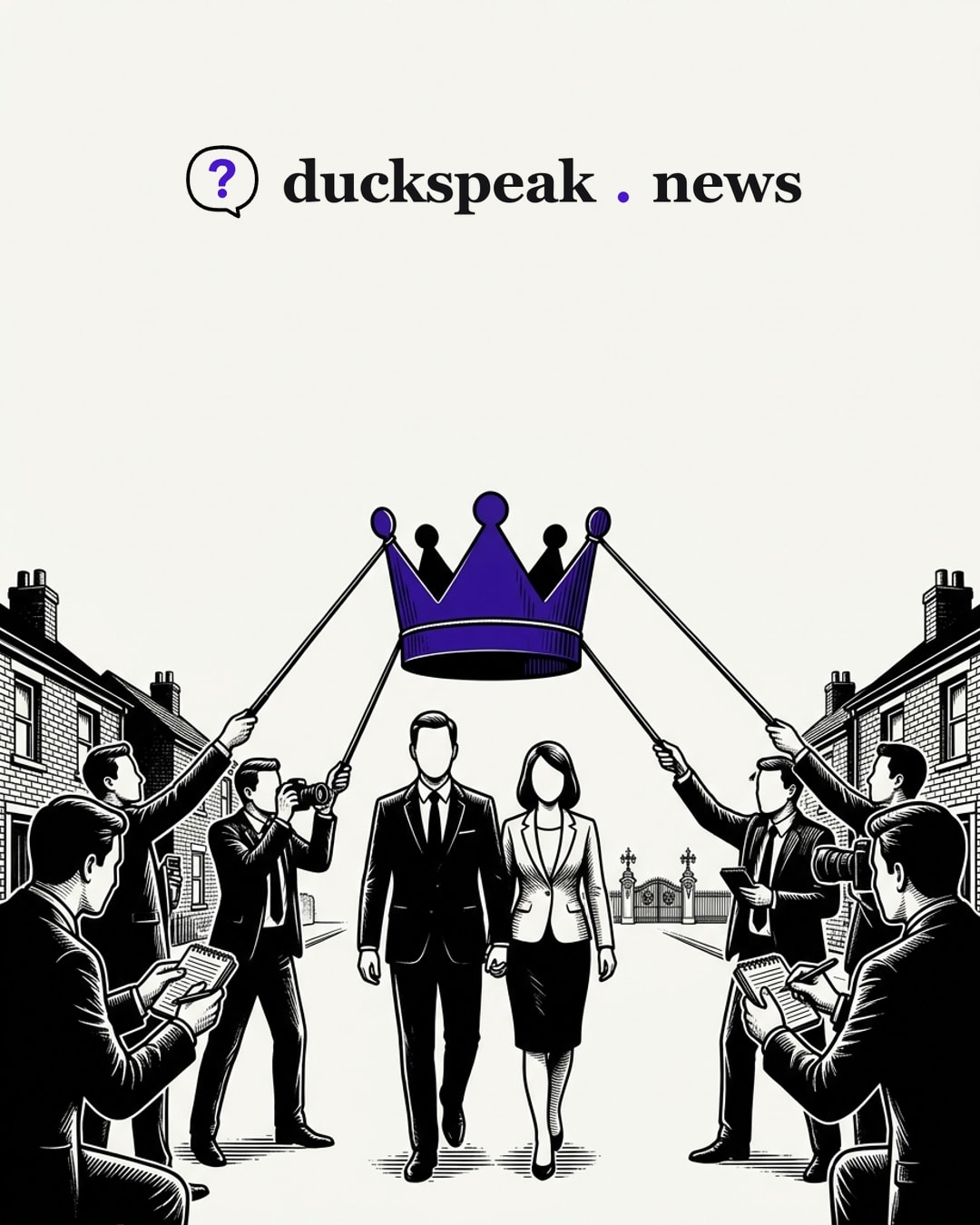
A visit with no name
Prince Harry and Meghan visited three charities in Nottingham, and the coverage had trouble naming what that was. The Mirror calls it a “‘royal-style’ away day” [4] and, elsewhere, “pseudo-royal engagements” [6]. The Independent says “quasi-royal appearances” [2]. NBC calls it a “royal-style public appearance” [3]. BBC News, by contrast, says “first official public appearance” in its headline [7], then, a few lines on, that the pair attend “not as working royals, but as public figures” [7]. “Official” in a headline and “not as working royals” in the copy cannot both do the same work for the reader.
This piece builds on an earlier one about the King’s letter, so I won’t re-explain how that letter was framed. What is new: the letter is now the fixed point, and the outlets spend a day of copy circling it.
The hedge as a product
The letter, as quoted by several outlets, says the Sussexes remain “private citizens” [1][2][5][6]. The Mirror and Independent then immediately add that the events “are likely to bear all the hallmarks of such” [1][2][6]. That sentence appears nearly verbatim in at least three pieces [1][2][6], and the Mirror’s own live blog repeats it twice [1]. This is the “unexamined repetition” in its plainest form: one boilerplate line, recycled across outlets and even within one page.
The result is a prefix economy. “Royal-style”, “pseudo-royal” and “quasi-royal” all say “not royal” and “royal” at once. The prefix lets the headline sell the royal frame while the sub-clause keeps the outlet technically accurate. It is the Newspeak habit of building a word that carries its own denial. A caveat: the coverage shows the repeated phrasing but cannot show whether it comes from shared agency copy, a briefing, or coincidence.
Whose status is it, anyway?
The label fight is also a sourcing fight. The Independent and Mirror say the couple “are said to consider themselves ‘public figures’” [2][6]. Said by whom? Not stated. The letter’s “surprised” effect is likewise reported as the Sussexes being “caught off-guard” [2][6]. NBC at least attributes it: a spokesperson for the couple told NBC News they were “surprised” [3]. BBC likewise quotes a spokesperson saying they are back “primarily because they support and believe in the organisations they are visiting” [7]. So some of the self-description is attributed to the couple’s own representatives, and some floats as ambient fact. Readers get both without being told which is which.
Opinion in the news voice
The Independent’s Nottingham passage is the clearest Huxleyan sample. It calls the city one of “disruptors, mavericks and rebels with a cause” and says the couple “have chosen to join their ranks”, adopting it as a “surrogate spiritual home” [2]. That is lifestyle copy sitting inside a news report, flattering the subject through the city’s heritage. It also calls Harry’s memoir “ironically unsparing” [2], an editorial judgment carried in an adverb. Nothing in the other sources supports “spiritual home”; the BBC’s spokesperson says only that Nottingham is “a special place” [7].
NBC offers a different mechanism: a paid-style framing by contributor. Royal contributor Emily Nash calls it “almost a full circle moment because it looks very much like a royal engagement” [3]. The appearance of the thing stands in for its status, and the assertion that the couple “don’t need the palace’s permission” [3] is presented as analysis, not as an argument that could be contested. NBC also says they “look to rebuild their image” [3], a motive attributed with no source.
Enthusiasm, measured and unmeasured
The Mirror’s picture piece headline says “crowds in Nottingham welcome couple” [4]. Its own numbers are about 50 fans outside Himmah Hub and around 120 at the final stop [4]. One named fan, Margaret Langdon, is quoted, including that “it’s not very often you get a woman of colour in that position” [4]. These are real quotes, but one voice and two small counts carry the headline word “crowds”. Then a separate Mirror piece, using a podcast, says it “doesn’t feel like they’ve been welcomed back with arms wide open” [5]. The Mirror hosts both the warm and the cool reading, each with its own headline, and the reader can pick a temperature.
That piece also offers a small lesson in sourcing chains: Roya Nikkhah’s remarks on a podcast, “reported by the Express”, rewritten by the Mirror under a headline promising “regular phone calls” “exposed” [5]. Her actual words are hedged: “We’re told”, “I understand”, “I’m told” [5]. “Exposed” is the Mirror’s, not hers.
Likewise, the claim that Meghan’s appearances will be “relatively rare” comes from “a source close to Meghan”, via The Telegraph [6]. The article then wanders through speculation about a Netflix role, which it admits is “rumours” [6]. A friend of the couple is the only voice for why they can now “focus on causes close to their hearts” [4].
What the record does and doesn’t show
Verifiable in these pieces: the three venues; the 2017 Nottingham visit; the £1.1 million Harry donation to BBC Children in Need [2][4]; the CRS chief executive Trevor Rose telling the BBC the visit was a “complete shock” arranged within weeks [7]; and that RAVEC is reportedly reviewing their security [7]. Not verifiable: what the couple “consider” themselves, the palace’s feelings, or any measure of the public mood beyond a few counted crowds.
One thin point worth keeping: the Mirror says the couple are “awaiting a decision” on security [5], while the BBC says only a review is “understood” to be under way [7]. Neither source gives the review’s terms.
What a reader would need instead
Read the status question as a question of record. The King’s letter (quoted in part, never in full here) and RAVEC, the committee that oversees royal and VIP protection [7], are the institutions that decide status and security. Everything else is labelling. Ask of each prefix, “pseudo”, “quasi”, “style”, whether the article tells you what is missing: official funding, official duties, official protection. Notice who is named (Rose, Langdon, Nikkhah, a spokesperson) and who is “said” or “understood”. And note the one claim the BBC makes plainly, that the Royal Household “view them as private citizens” while “Thursday’s schedule has a distinctly royal feel to it” [7]. That sentence admits the whole problem: the event is being sold on its feel.