

The comfort word
A 71-year-old man fishing at Dr. Bradford Memorial Park in Winter Garden, Florida, was killed by an alligator. Five outlets covered it. Each, in its own way, reached for the same reassurance: this is rare.
NBC relays the Florida Fish & Wildlife Conservation Commission (FWC) line that “serious injuries caused by alligators are rare in Florida” [1]. The BBC says attacks are “relatively rare, despite a population of about 1.3 million across the state” [3]. CBS says they are “still fairly rare, despite there being hundreds of thousands of the animals in the state” [4]. The same adjective arrives from three institutions’ worth of copy, each with a different qualifier and a different population figure.
The evidence is modest: this is routine breaking news, not a scandal. But the pattern is worth looking at, because it shows how a soothing frame travels.
Huxley’s soma, in a news brief
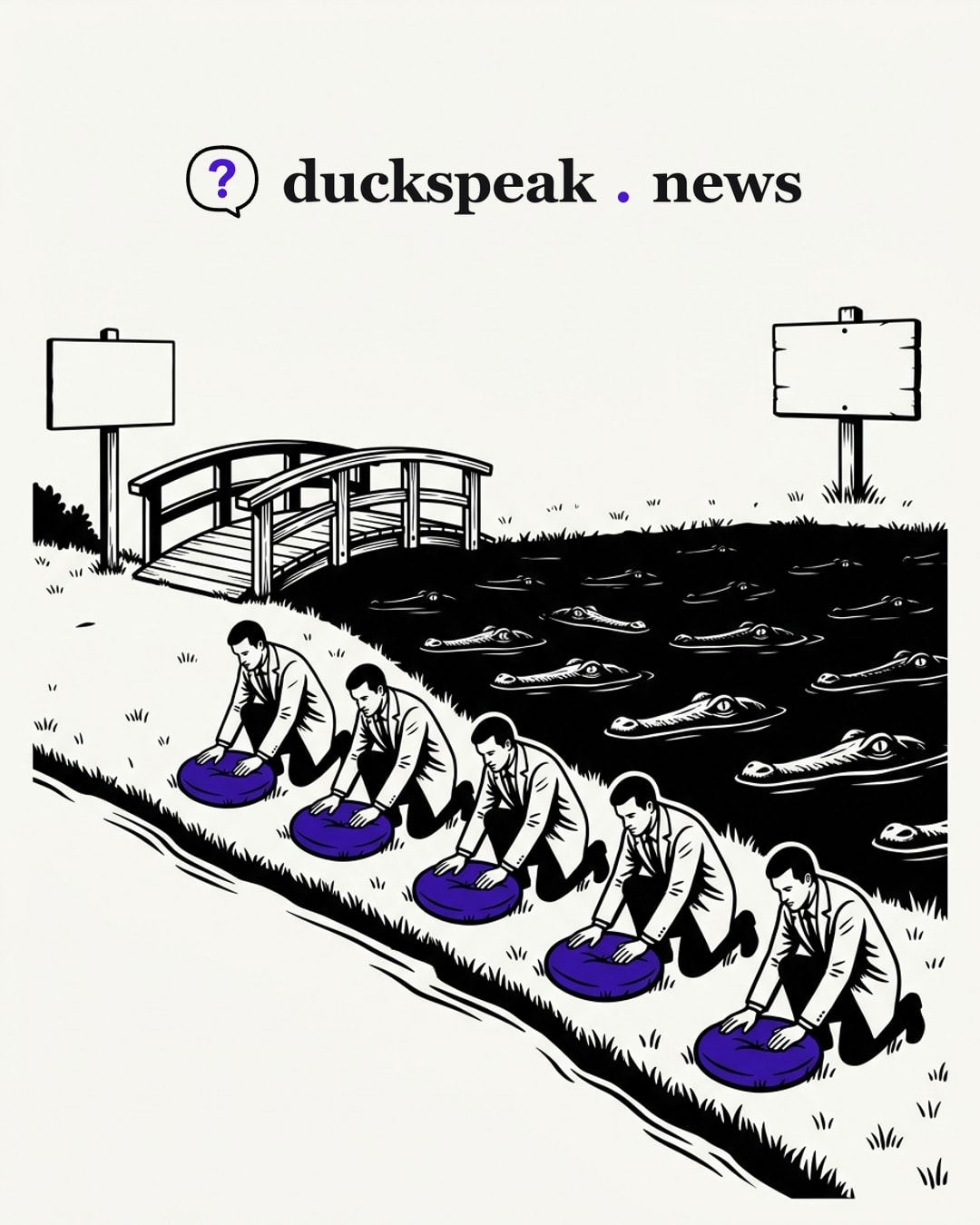
Huxley’s mechanism was not suppression but comfort. “Rare” is true as a statistic and also works as a sedative. It tells the reader the event belongs to the category of things that need not trouble them. The sourcing is where it gets interesting.
CBS reports that “outside of 2022, when there were 23 attacks on humans, the total number of attacks usually hovers around a dozen each year,” that there were 13 attacks last year including eight major ones, “two of which were fatal,” and that “there have never been more than three fatal attacks in a year” [4]. Those figures are useful. But they sit beside two other counts that do not match. The BBC cites 32 fatal attacks between 1948 and 2025, “out of 500 total incidents” [3]. ABC, “using Florida state data,” says the two 2026 deaths bring the total to 34 since 1948 [2]. CBS says 32 since 1948 and, in the same piece, counts Hamilton as the second death this year [4]. If 32 is the figure through 2025, ABC’s 34 fits. If CBS’s 32 already includes 2026, the two disagree. We cannot tell which from the articles, and none of the outlets reconciles them. That is an unresolved discrepancy in the “rare” story, not a conspiracy.
The quote that became a refrain
Four of the five outlets run the same line from Capt. Michael Mason: “It looks like it’s docile, it looks like your Florida emblem, but it can be dangerous” [1][2][3][4]. The New York Post trims it to “It looks like it’s docile … but it can be dangerous” [5]. The “Always be aware of your surroundings” half is a stock safety phrase; the emblem line is vivid, and it is repeated nearly verbatim everywhere. Unexamined repetition here is mild, but notice what it does: it places the risk in the viewer’s perception (“it looks docile”) and the remedy in individual vigilance (“respect it, keep your distance”).
Meanwhile, Mason also said the lake “has tons of alligators in it” [4], and ABC reports police were not alerted in advance, “possibly because” of that [2]. That detail sits awkwardly with “be aware of your surroundings”: a park with a “Gator Bridge” [4] and a well-known alligator population is a place where the danger was presumably not a surprise. None of the outlets asks what signage or management exists at the park. That is an omission, though the sources may simply not have the answer.
Two verbs for one animal
Word choice splits along familiar lines. The New York Post says the man was “fatally savaged” and “mauled by the beast” [5]. ABC says “the reptile struck” [2]. The BBC says the alligator “came up to the shoreline and attacked him” [3]. NBC and CBS stay closer to the agency’s wording: “bitten” [1], “dragged into the water” [4]. Meanwhile the animal’s fate is rendered in bureaucratic Newspeak: Mason says it was “removed as a danger to the public” and “dispatched” [3], and the BBC repeats both words in quotation marks. NBC and the Post say “trapped and killed” or “captured and killed” [1][5]. “Dispatched” and “removed” are the softer register, and only the BBC leaves them in the captain’s mouth, where they belong.
The policy detail only one outlet wanted
ABC alone mentions that, after the June death, Republican Rep. Greg Steube introduced a resolution asking the Comptroller General and Interior Department to study the alligator’s listing as “threatened due to similarity of appearance” and its effect on Florida’s ability to remove nuisance alligators [2]. ABC also notes the species “has been fully recovered since 1987” per Steube, and that protection continues to prevent trafficking and hunting of the similar-looking American crocodile [2]. This is the only place a reader learns there is an institutional debate about management. It is presented as one congressman’s claim, which is fair, but the other outlets leave the whole question out, leaving “be careful” as the only available response.
There are also small factual wobbles worth flagging: the alligator is “roughly 12-foot” [1], “nearly 12-foot” [4], “11-foot, 8-inch” [4], “11.8-foot” [5] (the last two are consistent). The BBC says Clark was “swimming with her friends” [3], CBS places it in Little Big Econ State Forest [4]. These are minor, but they show how copy gets smoothed in transit.
What a reader would need instead
- The FWC’s own incident dataset, which the outlets cite but do not link or reconcile, so the 32 versus 34 discrepancy can be resolved.
- Whether “rare” is measured per resident, per visitor to waterfront parks, or per fisherman; a statewide denominator of 1.3 million alligators [3] says little about risk at one lake.
- What warnings or management exist at Dr. Bradford Memorial Park.
- The Steube resolution’s actual text and its critics, not just a summary [2].
- Plain verbs for what officials did to the animal.
We have not verified these figures independently; all are as reported by the outlets above.