

The event, and the vocabulary around it
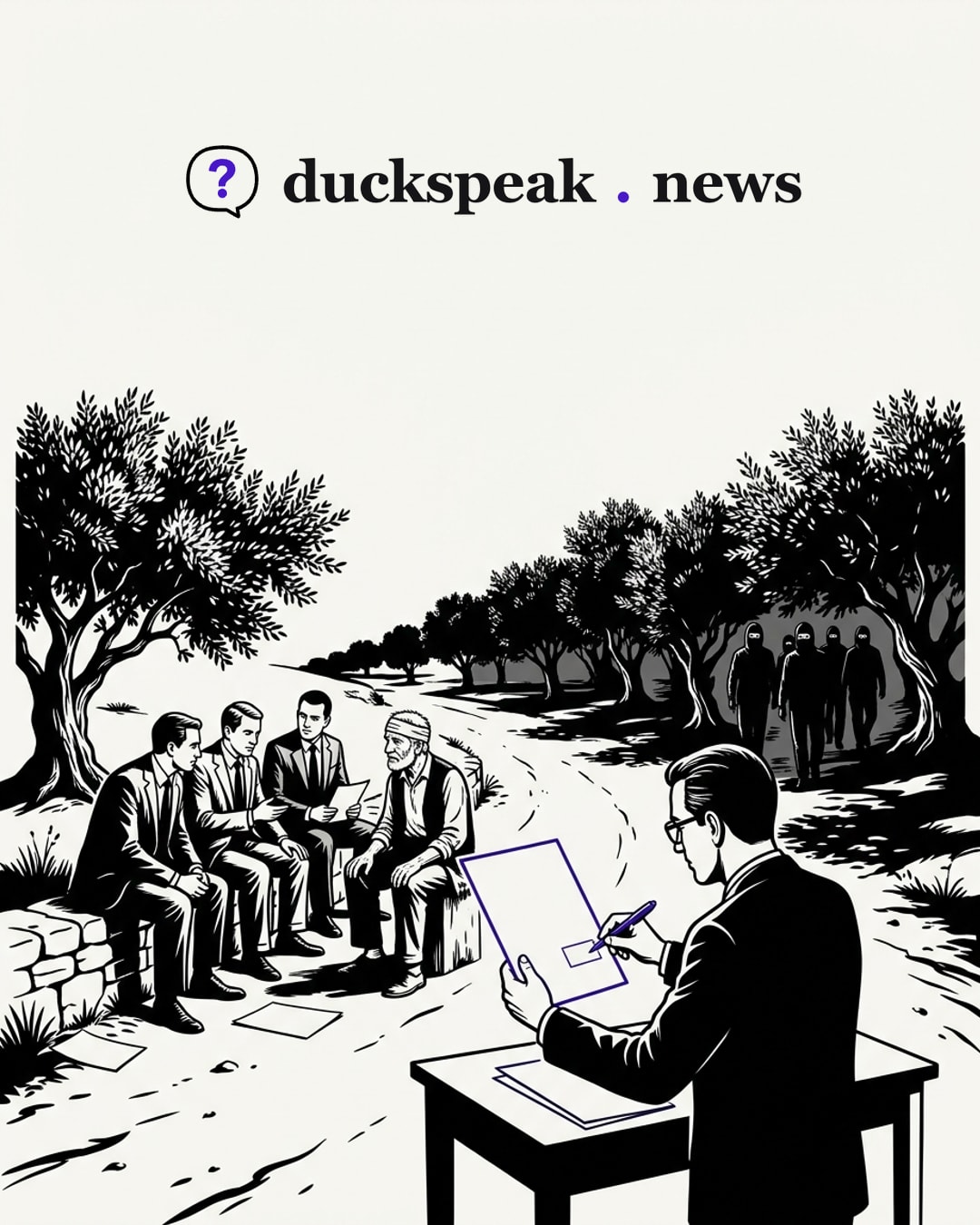
On 17 October, masked settlers attacked a European diplomatic delegation in Taybeh, a largely Christian village in the occupied West Bank. A 78-year-old French mayor, Bernard Baudoux, was hurt. Coverage across outlets is broadly consistent on the basics. What differs, and what interests us here, is which words carry the weight of the story once the officials start talking.
“Rioters”: a word that sounds like condemnation
Israel’s foreign minister and army both condemned the violence, and both used the same noun. The army said diplomats “were attacked by Israeli rioters” [4]. Gideon Saar spoke of “Israeli rioters” [2][4]. Several outlets repeat it without comment [1][6].
“Rioters” is not a neutral label. It implies spontaneous disorder, a crowd that got out of hand. Yet the reporting in these same articles describes something more specific: masked men, some carrying sticks, who “threatened to kill us,” per an activist quoted by AP [2]; settlers who, per The Guardian, first assaulted Palestinian harvesters, then a group of seven men, some armed with clubs, who threatened the mayor’s party [5]; and a mayor who says he was beaten “with iron bars” [4][7]. The Guardian calls them “settler militants” [5]. The AFP-derived pieces say “colons” and “settlers” [1][3][7]. The choice of noun sets how the reader sees the act: a flare-up, or part of a pattern. The pattern is documented in the articles themselves: Yesh Din counts “more than 170 attacks” since 27 September, and Palestinian authorities report at least four killed [5].
The paperwork pivot
The second move is subtler. Both the army and the foreign minister add that the visit “had not been coordinated” with the military [2][6]. Saar called it “unfortunate” that coordination did not happen, saying it “could have helped safeguard the visitors’ security” [4]. The Prime Minister’s office said the delegation “entered a sensitive area with a history of confrontations” [6].
Read quickly, the sequence is: diplomats were attacked, and also they failed to notify. The grammar quietly gives the victims a procedural share of the cause. The Guardian is the only outlet here that supplies a counterweight, a western diplomatic source (anonymous, so unverifiable) saying that demanding advance notice “violates both diplomatic conventions [and] international law” and that Israel “is obliged to assure safety there for all” [5]. Everyone else reports the coordination point and moves on. Note also the army’s own statement that “no IDF soldiers were present” [4][2]. That is offered as a fact, but it raises the question of who was responsible for security there, which The Guardian’s diplomatic source answers (Israel, in Areas B and C) [5] and no other article pursues.
“Premature conclusions”: the story about the story
Netanyahu’s office urged caution against “drawing conclusions,” said images “do not establish the complete sequence of events,” and warned of “a coordinated campaign to smear Israel” relying on “sensational headlines” [6][4]. It added that “the reputational damage from premature conclusions may already be done” [6].
This is a Huxleyan inversion of the Orwellian one: instead of denying the event, it shifts the topic to reporting standards. Note what is happening structurally. Belgium, Poland, France’s mayor, the Israeli army, Israeli police, and the foreign minister all confirmed or condemned the attack, per these articles [2][6]. The “smear” claim is therefore aimed at a version of events that the Israeli state’s own agencies had already acknowledged. CBS carries the statement at length, including the claim that Baudoux once raised the Palestinian flag over his town hall [6]. That detail has no bearing on whether he was beaten; CBS relays it without comment. These are editorial gaps, not proof of intent.
Also worth flagging: CBS writes that Belgium’s minister “claimed” on social media that settlers targeted the diplomats [6], while the same article says Poland’s foreign ministry “confirmed” the incident [6]. The verbs are small, but they allocate credibility. AP, by contrast, attributes the claim to Prevot and then reports the military’s confirmation [2].
Who gets to say “terror”
AP quotes Eisenkot calling it “Jewish terror” and the Washington Post photographer Heidi Levine, assaulted by settlers the day before, using the same term [2]. The Guardian’s fuller quote reads “Jewish terror under the auspices of the Israeli government,” and it notes he backs settlement expansion but objects that the attackers are “harming the settlement enterprise” [5]. That context matters, and only one outlet gives it. French outlet franceinfo, meanwhile, relays communist leader Fabien Roussel’s phrase “terrorisme d’Etat” (state terrorism) [3], placed beside the mayor’s own party label, “maire communiste” (communist mayor) [3], whereas BBC and Le Monde say “left-wing” and “leftist” [4][7]. Labels attached to the victim are a quiet form of framing too, though here we see no evidence of bad faith, only inconsistency.
Le Monde’s one telling note: the Prime Minister’s office used “the biblical name for the West Bank,” Judea and Samaria [7]. Most outlets quote the phrase without gloss [6][4].
Limits of this critique
These are mostly wire-driven reports written within hours of the event. The coordination point is reported accurately; our complaint is about emphasis and missing context, not about falsehood.
What a reader would need instead
- A plain statement that the state’s own agencies confirmed the attack, so the “smear” claim is read against that record [2][6].
- The legal question of whether diplomats must pre-notify the military, with a named authority rather than an anonymous source [5].
- The tracking data already available in these pieces: Yesh Din’s attack count and the UN humanitarian office’s figures on settler violence [5][6], placed high, not as background.
- Consistent labels: describe the attackers by what they did (masked, armed, in groups), not by a government’s preferred noun.
- Acknowledgment that the army says it had no soldiers present [4], and a follow-up on who was responsible for protecting the area.