

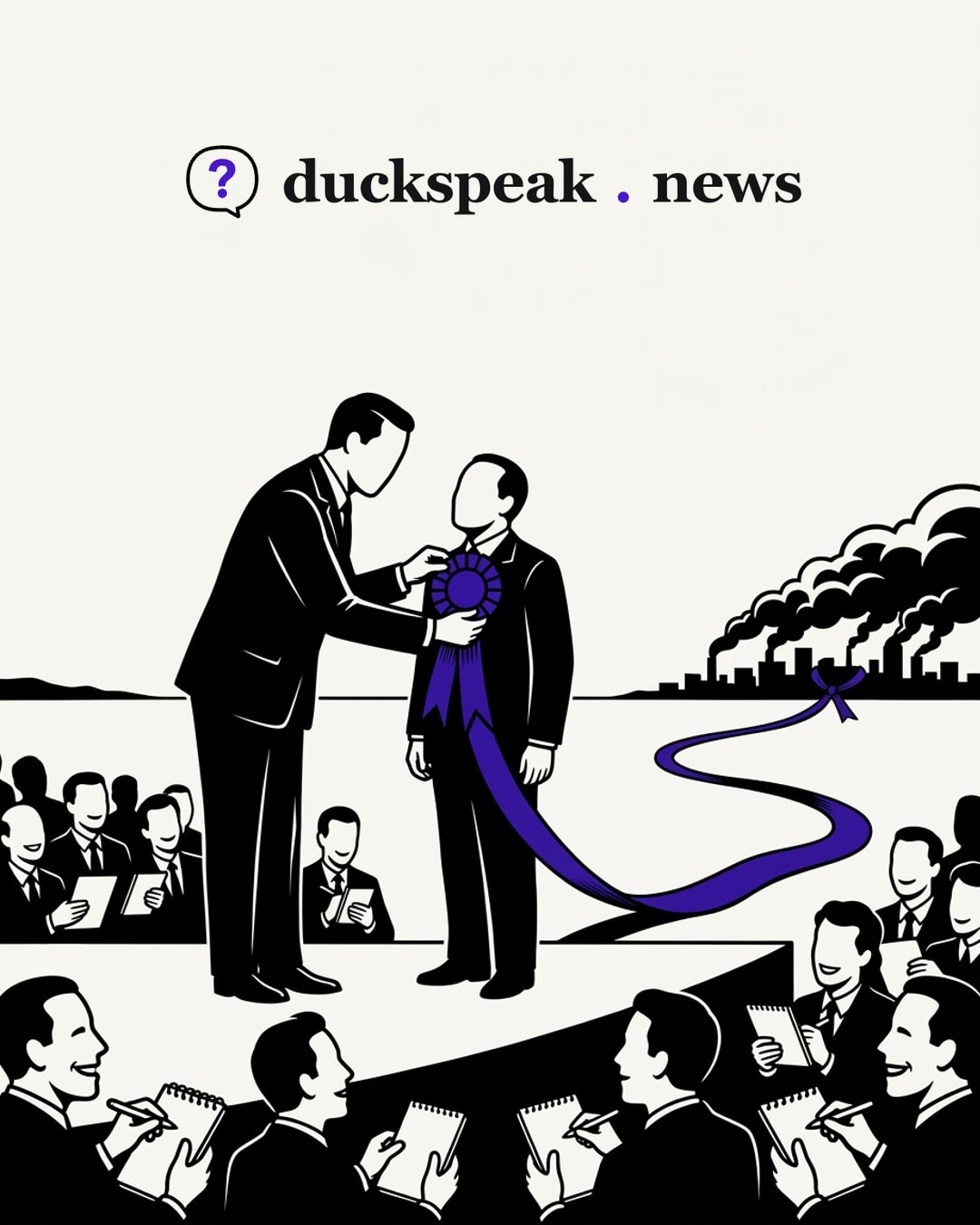
An endorsement, or an ultimatum?
Donald Trump’s Truth Social post about Benjamin Netanyahu was covered almost uniformly as an “endorsement.” The word is tidy and electoral, and it fits a familiar story. But the post’s own text, which The Independent [1] reproduces in full, contains something else: “If Israel has the wrong Leader, which would be anyone other than Bibi, America will have to do this work ourselves, and I am not inclined to do so.” That is a conditional: re-elect this man or the US may not continue the war on Iran. How each outlet handles that sentence is the whole story.
Fox News [2] puts it in its headline: Netanyahu “needs to be re-elected, or else US will have to ‘finish the job’ against Iran alone.” That is the most direct treatment of the four. Yet even there the phrase “finish the job” is quoted and passed along, never unpacked. Fox’s lede describes “the multi-front war on Iran and its nuclear weapons aspirations” [2]. Whose description is that? It is presented as the outlet’s own.
Euphemism by quotation
“Finish the job” is a classic Newspeak construction: a task-word that hides the thing being done. In Trump’s text Iran has been “systematically destroyed, both Militarily and Financially” [1], and the job to be finished is more of that. Netanyahu answers, “Together we will complete the mission!”, and CBS [3], Fox [2] and The Independent [1] all repeat it without comment. France Info [4] and France 24 [5] carry it in French as « Ensemble, nous mènerons la mission à son terme ! » (Together, we will carry the mission to its end) [4][5].
Quoting is not an error. But a mission with no stated object, repeated by two leaders and then by four outlets, becomes a phrase readers absorb rather than question. Orwell’s point in “Politics and the English Language” was that vague words let the speaker avoid naming the act. Here the act is a war that The Independent says is “in its seventh month” and has “disrupted energy markets globally and wreaked havoc across the Middle East” [1]. That sentence sits in paragraph four and is never connected to the “mission.”
“Partner for Peace” in a war
Trump calls Netanyahu “an even greater Partner for Peace in combatting the Islamic Republic of Iran” [3]. CBS leads with that phrase [3]; Fox repeats “partner for peace” in its lede [2]. France 24 renders it as « un encore plus remarquable partenaire pour la paix » (an even more remarkable partner for peace) [5]. The Orwellian inversion (peace as the name for war-making) is Trump’s. The outlets’ task is to notice it. Only CBS adds a counterweight nearby, saying many Israelis “have expressed disappointment over the inconclusive outcome of the Iran war” [3]. Fox does not.
Who gets context, and who doesn’t
The context each outlet supplies differs sharply:
- CBS [3] is the most explicit about the stakes for Netanyahu, calling his government “the most nationalist and far-right in Israel’s history” and noting that Trump “withheld” the endorsement “for months as their strategies in the Middle East diverged.” That is useful, though the “most nationalist” judgement is the outlet’s own, unattributed, and a reader may want to know on what basis.
- France Info [4] and France 24 [5] note that the government “a aussi accéléré la colonisation de la Cisjordanie occupée, où les attaques de colons ont explosé dans un climat d’impunité” (has also accelerated settlement of the occupied West Bank, where settler attacks have exploded in a climate of impunity). Both use identical wording, which suggests a shared agency source; neither outlet says so, so that is speculation. Only France 24 gives the rival Gadi Eisenkot’s reply in full: « Israël est un pays démocratique : seuls les Israéliens peuvent choisir leurs dirigeants » (Israel is a democratic country: only Israelis can choose their leaders) [5].
- The Independent [1] attaches the settler-violence story (the attack on photographer Heidi Levine) but as a trailing “comes after” item. It reports Netanyahu “has blamed” violence “on a small number of troublemakers” and that Levine was “shocked and insulted” at his use of “alleged” [1]. Placing it after the endorsement text, with no analysis linking them, leaves readers to guess why it is there.
- Fox [2] supplies seat projections and coalition mechanics, but its context is procedural. A caption describes “the pressure on Iran and war against its terrorist proxies” as rarely a point of difference between the leaders [2]. That is a framing sentence, not attributed to anyone.
The Huxley problem: the soothing frame
Fox also surrounds the article with linked headlines such as “Netanyahu praises Trump’s ‘wicked sense of humor’” [2]. Huxley’s concern was less lies than distraction and pleasantness. A leader’s wit and “ironclad alliance” are placed beside a post that links a foreign election to continued military action. We cannot say this was deliberate; related-link blocks are often automated. It is still what the reader sees.
Limits of this critique
No polling or Israeli-press source is cited here, so claims such as Trump’s declining popularity in Israel come only from The Independent [1] and CBS [3], which disagree in emphasis: “diminished” [1] versus “still popular” [3]. That conflict is itself unreported by either.
What a reader would need instead
- The conditional named as a conditional: a US leader tying future military action to a foreign election outcome, in those terms, not folded under “endorsement.”
- “Mission” and “job” defined: what objectives, by whose account, and what the ceasefire proposal CBS mentions [3] left unmet.
- Attribution for characterizations (“terrorist proxies”, “most nationalist”) so they read as claims, not facts.
- Settler violence and the Iran war connected to the election in the reporting, not merely sequenced.
- Independent tracking for the numbers: UN OCHA and Israeli rights groups monitor West Bank settler attacks, and the Knesset’s election committee and established pollsters are the places to check the seat forecasts Fox cites [2]. We have not verified those figures.