

The sentence everyone repeated
The most quoted moment of the CBS town hall in Flat Rock, Michigan, came when Joey Amor asked about the “failures” that preceded his wife’s death in Kuwait. Vice President JD Vance replied that “you live in a bit of a bubble and sometimes information doesn’t filter upAgentless passiveThe agentless passive is a sentence built so the action happens with no one doing it.” (AP, via PBS NewsHour [1]). CBS repeats it nearly verbatim in its own recap [2].
The agentless passive is a sentence built so the action happens with no one doing it.
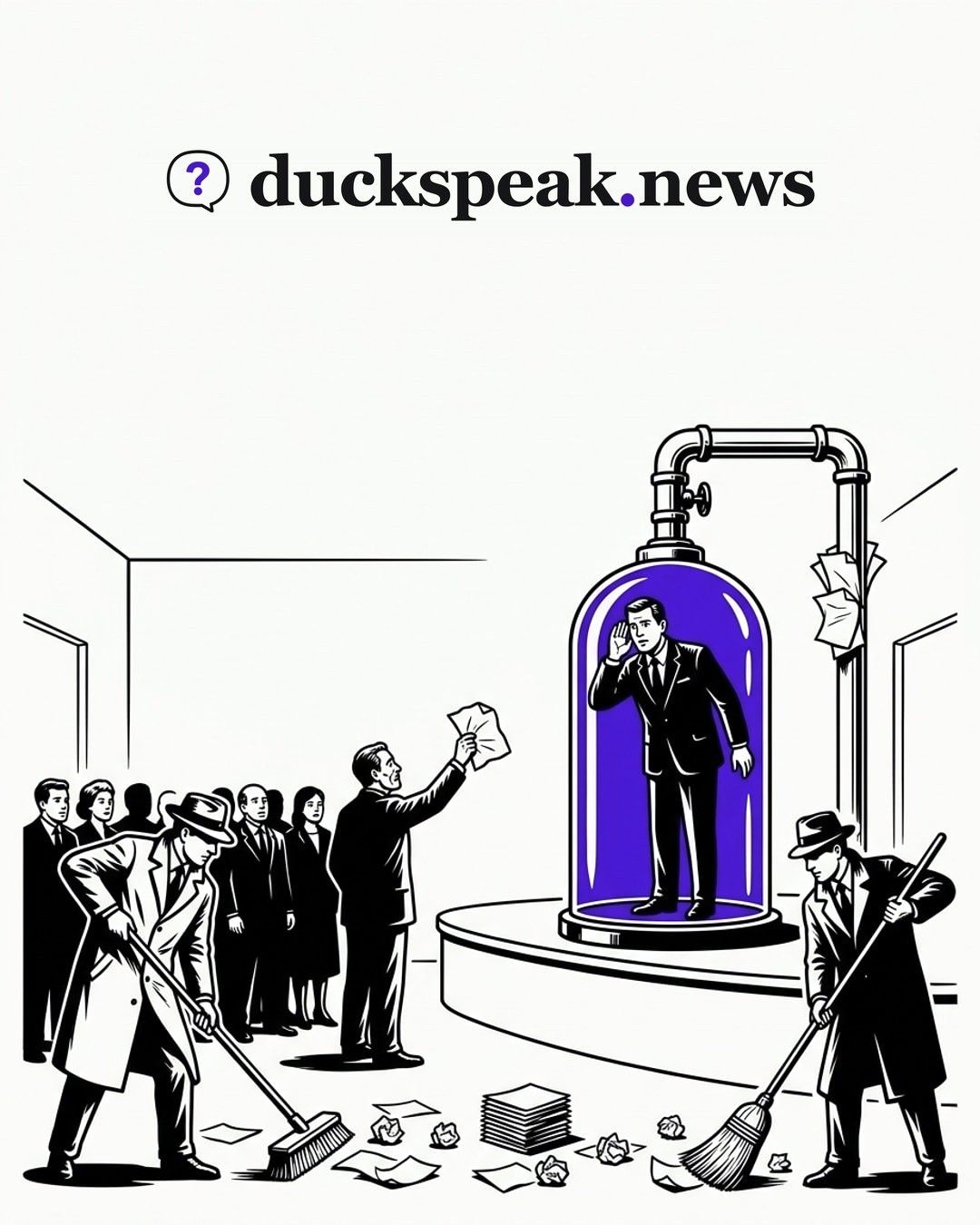
This is Orwellian grammar, in the plain sense of Newspeak’s habit of removing the actor. Information does not “filter up” on its own. People decide what goes to whom. The transcript [4] also shows Vance describing the fault as “issues with how where troops were located that we realized was a huge mistake.” Who realized it, when, and who was responsible are not stated. The grammar makes the mistake a weather event.
The outlets handle this unevenly. AP at least reports Vance’s “This literally is the first time I’ve heard of this” [1]. But AP then adds the interpretive gloss that he “seemed taken aback” [1], which is the reporter’s read of his face, not a fact. CBS offers the passive phrasing with little scrutiny and moves on, closing the section with his vow to “take every single failure extremely seriously” [2]. The transcript [4] also contains something neither recap carries. Vance declines to give details because “I don’t want the Iranians to learn something else,” so a question about accountability ends in a justified silence.
A quote that may have changed shape
The gas price answer is the clearest mismatch between press and record, and we flag it as unresolved. CBS quotes Vance: “When this conflict is over, we are going to see gas prices come down” [2]. The transcript [4] reads “I don’t think that when this conflict is over, we are going to see gas prices come down.” Those are opposite claims.
The transcript is a third-party posting and is visibly messy. It misassigns some lines and mangles at least one name (it gives “Keyshawn Wheaton,” while CBS has “Keshon Wheatley” [2]). The surrounding passage in [4] suggests CBS’s version is the intended meaning, since Vance goes on to discuss prices easing. If CBS silently cleaned up a verbal slip, that is defensible, but readers are not told.
Framing in the outlet’s own voice
CBS’s lede says Vance “argued the Trump administration’s handling of the economy and Iran strategy will pay dividends in the future” [2]. “Dividends” is the outlet’s word, not a quotation. In the transcript [4], Vance talks about time (“it’s going to take more than 18 months”), not payoffs. It is a small financial metaphor, but it converts a plea for patience into a promise of return.
AP’s headline, “tough questions” [1], flatters the event as adversarial. The body gives some support, since voters pressed him and AP notes that Vance spoke “without acknowledging that situation occurred because of the war Trump launched” [1]. That is the sharpest context in any of the three pieces. But AP also gets a basic fact wrong. It describes a voter as having “became an immigrant five years ago” [1]. In the transcript [4] she says her family immigrated about 20 years ago and she became a citizen about five years ago. Fox gets it right [3]. The error matters because it shrinks a long-settled resident into a recent arrival.
Fox’s headline calls the immigration exchange “hot takes” [3], which recasts a nun’s question about separated children and a citizen’s question about “scapegoating” as noise. Fox also credits Dokoupil with “citing a Fox News poll showing that 60% of voters were extremely concerned” about corruption [3]. The transcript [4] has him say only that a Fox News poll found corruption was “the number one issue.” The 60% figure is not in the record. It may come from the poll itself, but the article presents it as part of the exchange.
What each outlet left out
Omission is where the three diverge most. CBS’s seven highlights [2] skip the Temple Israel exchange entirely. In it, a father asked Vance to confront “influential people like Tucker Carlson.” Fox reports the question and Vance’s “I condemn anti-Semitism” [3]. It does not note, and the transcript [4] confirms, that Vance never named Carlson. He spoke of “this podcaster” and said “we’re in the same boat.” Fox does include the El-Sayed attack line. It leaves out that the question was about Vance’s own coalition.
The corruption answers are also trimmed. In the transcript [4], Vance says he reads reports and judges “based on the facts and not based on a random news media report.” He repeatedly declines to treat his own account as evidence either way. CBS and AP quote “I’ve never seen anything like that from the president” [1][2]. A reader would not learn that the claim rests on his personal vantage point, which he admitted a few minutes earlier is a “bubble.”
Huxley’s side
The softer, Huxleyan risk is the format. A town hall hosted by a network, recapped by that same network as “7 highlights” [2], turns an hour of contested claims into a list. Each item is tidy and none is cross-examined. We have no evidence of intent here. This looks like the ordinary economy of recap writing, which is the point.
What a reader would need instead
4 checks to run on the next story like this one.
-
The full video, or a verified transcript, since the only transcript available is unofficial and error-prone. The gas price quote needs checking before anyone relies on either version.
Gap in the coverage
-
A plain statement of who decided the Kuwait troop placement and who knew. Public reporting by CBS is referenced in the transcript [4] but not summarized in any recap here.
-
Recaps that mark where the outlet’s own words (“dividends,” “hot takes,” “seemed taken aback”) replace the speaker’s.
Gap in the coverage
-
Corrections for plain factual slips, such as AP’s description of the voter’s immigration timeline [1].
Gap in the coverage
Caveat: this critique rests on three recaps and one unofficial transcript. The transcript’s reliability is itself uncertain.