

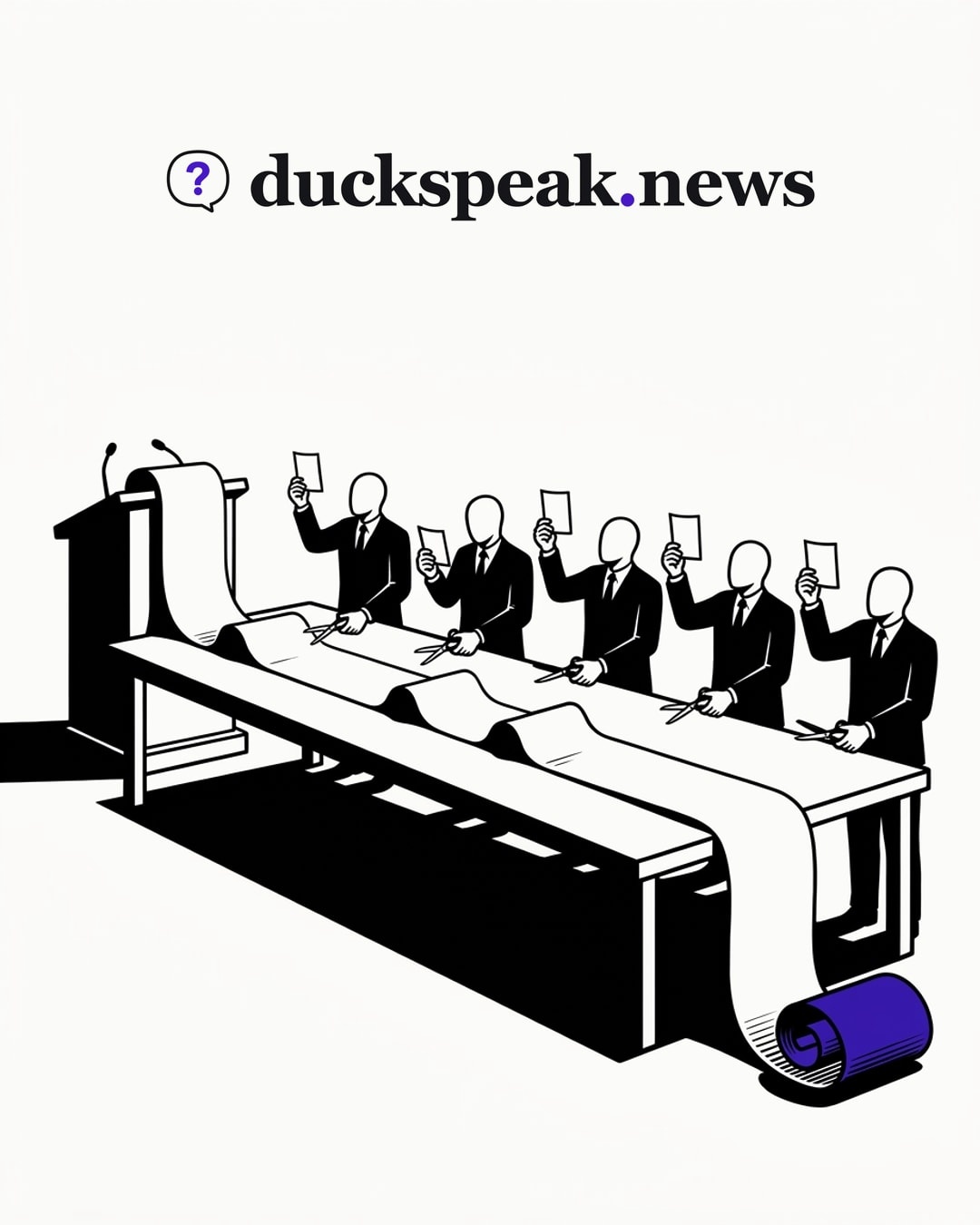
The Fed’s own transcript of the press conference [7] is the best yardstick for the six news reports of the October rate hold, and it shows four things worth learning to spot: an assumed cure, a softened cause, an inferred motive, and a buried announcement.
The cure everyone assumes
ABC writes in its own voice: “That rate hike should help cool off inflation by slowing the economy and eating away at demand”PresuppositionPresupposition embeds a huge, unstated fact as an assumed background detail instead of reporting it, so the question of how we got here becomes structurally impossible to ask. [2]. The sentence treats it as settled that a rate rise is the right tool for this inflation. The same coverage says the inflation is driven by energy. NBC cites “soaring cost of gas, diesel and crude oil” [3], and The Guardian says oil soared “with the closure of the strait of Hormuz” [6]. Only The Guardian lets an economist object: “If inflation is caused by supply factors, it doesn’t make sense to try to cure it by increasing interest rates because it won’t work” [6]. That is one professor’s view, and the other outlets don’t engage with it. But a reader of ABC, CBS or NPR is never told the premise is contested. Even Warsh was more careful than ABC. He said the committee’s view is that the policy is “starting to work some, but there’s no firm conclusions” [7].
BBC quotes the first half of that sentence (“The overwhelming consensus, the overwhelming judgement, is that what we’ve done in this monetary medicine is starting to work some”) and stops there [5]. The clause “but there’s no firm conclusions” [7] is what the quote needed. The outlet also never mentions that the “consensus” sat beside two dissents, which it reports separately.
The cause that changes name
The energy shock is the shared explanation, but the outlets name it very differently. NPR says “a spike in energy prices tied to the U.S. war with Iran” [4]. NBC says “Trump’s Iran war” [3]. The Guardian says “war in the Middle East with Iran” [6]. ABC says fuel prices climbed “in response to unrest in the Middle EastEuphemism launderingEuphemism laundering is official or institutional vocabulary repeated across coverage until it stops sounding like a chosen frame and starts sounding like plain description.” [2].
“Unrest” fits the Fed’s own register. The statement NBC quotes says uncertainty is elevated “owing, in part, to geopolitical developments” [3], and the transcript uses the same phrase [7]. The mechanism is repetition. An institution’s abstraction travels into a news outlet’s narration and starts to read as plain description. The reader of ABC alone could not tell that a US war is involved. The reader of NBC alone would take the war as the president’s. Neither is neutral, and the inconsistency is the point: check which noun an outlet chose before you accept the cause it describes.
The motive nobody could document
NPR writes that the decision “comes less than a week before votes are tallied in the midterm election, which may have contributed to the Fed’s cautionUnsourced motive attributionUnsourced motive attribution is a news text stating what an institution or government 'wants', 'fears' or 'seeks' as plain fact, with no official, document or source behind the intention, so the reporter's hypothesis reads as a finding.” [4]. The hedge “may” is honest, but the article offers no document or official behind it. Its only supporting quote is an economist saying “It would be suspicious if there were a hike before the midterm” [4], which concerns a hypothetical hike, not the actual hold. NPR also leaves out the Fed’s direct answer, which the transcript has in full: “Politics played no role in the decision… I didn’t hear an utterance about politics” [7]. NBC and The Guardian include that denial [3][6]. CBS does not [1].
Readers can weigh a denial, and may reasonably doubt it. They can’t weigh one they were never shown. ABC, to its credit, labels its version as a bank’s speculation: Deutsche Bank “could imagine” the Fed preferring to “stay out of the headlines” [2]. The Guardian is closer to NPR, saying the pause “signals the central bank is taking a wait-and-see approach ahead of the midterms” [6]. That ties a timing coincidence to a reason, and the Fed’s stated reason (waiting for more data) is a different one.
The announcement in the last paragraph
The transcript’s one structural announcement is that, starting next fall, one meeting in 2027 and two in 2028 become strategy sessions with no rate vote and no policy statement [7]. Warsh said “eight meetings per year is the right number” [7]. CBS, ABC, NPR and BBC do not mention the change at all. NBC leads with it in the third paragraph, but calls it a “seismic change” [3], a word Warsh didn’t use. He called the reasoning “quite straightforward” [7]. The Guardian puts it at the very end: “On Wednesday, Warsh also announced upcoming changes to the Fed’s eight board meetings it conducts annually.”Buried ledeA buried lede is the fact that should have organized the whole story, relegated instead to the final sentence or hidden inside someone else's quote. [6]
What none of them reports is the exchange about public disclosure. Asked what the public would see for meetings with no statement, Warsh said “It’s not obvious yet. There’s more news to come on that” [7]. Fewer rate-setting votes, with unspecified transparency, is a question about accountability. It was answered in the room with “not obvious yet”, and it didn’t make the news.
Smaller mismatches
NBC says that, asked about Trump’s claims regarding the board, “Warsh defended his colleagues” [3]. The transcript has him say “I’m not going to be responding to quotes from public officials” before the “family fight” line [7]. The Guardian reports that he “declined to comment” [6], which is closer. ABC also reports a jobs gain of only 29,000 in September [2], while Warsh told reporters payroll growth is “noticeably above last year’s pace” [7]. No outlet reconciles these.
What a reader would need instead
6 checks to run on the next story like this one.
-
The Fed’s own transcript, read alongside the coverage; the Fed publishes it.
Gap in the coverage
-
The full sentence behind any clipped quote, especially hedges.
Gap in the coverage
-
The war named as a war, by whoever is responsible for it, instead of “unrest” or “geopolitical developments”.
-
Any claim about motive tied to a named source, plus the official denial, if there is one.
-
The meeting-schedule change reported prominently, with the unanswered disclosure question.
-
The supply-shock objection to rate hikes stated as a live debate, not left to one outlet.