

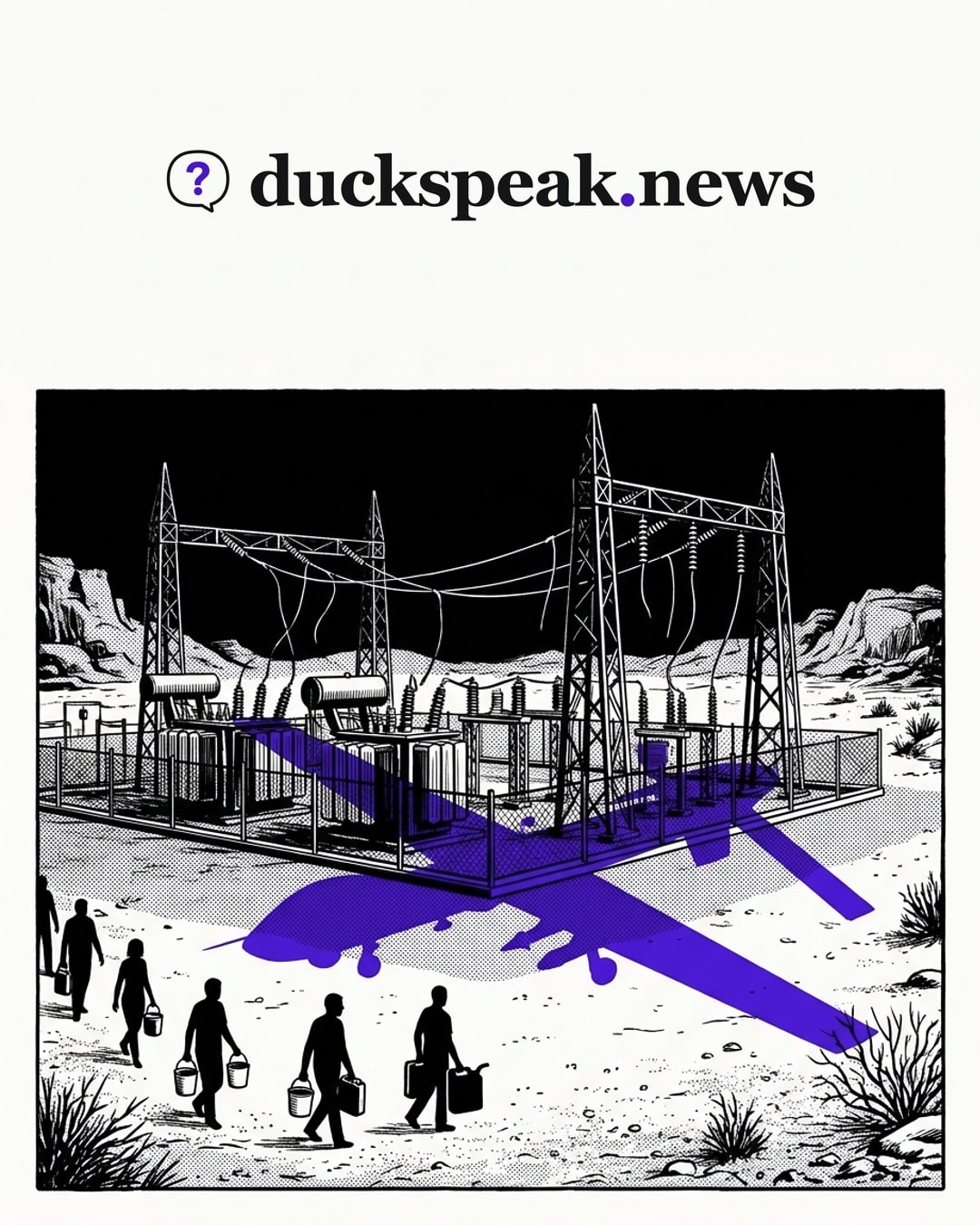
One sentence, right at the bottom
Of the three articles, only one says where the drones allegedly came from. The Los Angeles Times, running an Associated Press dispatch, does so in its second-to-last paragraph: “Sudan’s Foreign Ministry said Saturday the drones were supplied by the United Arab Emirates and launched from Ethiopia.Buried ledeA buried lede is the fact that should have organized the whole story, relegated instead to the final sentence or hidden inside someone else's quote.” [2]. This is a buried lede: the accusation implicates one state as supplier and a neighbouring state as launch base, which would turn a civil war into a regional affair. The reader only reaches it after the megawatts of the Merowe dam and the price of solar panels. To spot this next time, look for whatever in an article changes the answer to “who?”: if it comes after the technical details, the order of the text has already decided how much it matters.
That sentence rests on a single source, the Sudanese government, which is a party to the conflict. The counterpoint takes up one line: “The UAE has repeatedly denied arming the RSF.” [2]. That denial is about arming the RSF in general. It says nothing about these drones or about Ethiopia, and the article reports no response from Ethiopia. Next comes “The RSF did not immediately respond to a request for comment” [2], then the war’s death toll. RFI and UN News never ask where the drones came from.
“Attributed” by whom?
RFI opens like this: “Des frappes attribuéesAgentless passiveThe agentless passive is a sentence built so the action happens with no one doing it. aux forces paramilitaires qui se battent contre l’armée soudanaise” (Strikes attributed to the paramilitary forces fighting the Sudanese army) [1]. Attributed by whom? The sentence does not say, and neither does the rest of the article. This agentless passive lets the reader assume the attribution is established, when they have no idea whether it comes from the army, the government, an NGO or the newsroom itself. The passive returns in the account of the damage, “Trois centrales ont été visées lundi 2 novembre” (Three power plants were targeted on Monday 2 November) [1], and the only sources the article names are a collective with no names attached: the count of 17 damaged facilities comes “selon la société civile” (according to civil society) [1], with no organisation identified.
The agentless passive is a sentence built so the action happens with no one doing it.
The Los Angeles Times does better in the body of its article: it names the Sudanese government and Emergency Lawyers, “a Sudanese rights group tracking the attacks” [2]. Its headline, though, keeps the construction: “drone strikes blamed on RSF” [2]. The counts don’t match either. Emergency Lawyers speaks of “Fifteen substations […] targeted since early October” [2], while RFI reports 17 facilities “en plus d’une semaine” (in over a week) [1]. Neither article points out the gap.
“The parties”, plural
RFI quotes the UN spokesperson, Stéphane Dujarric, who “condamné fermement l’escalade des attaques de drones au Soudan par les parties au conflit” (strongly condemned the escalation of drone attacks in Sudan by the parties to the conflict) [1]. The plural implies that more than one side is carrying out drone strikes, and this is the only place in the three articles where the idea comes up, inside someone else’s quotation. Just before that, RFI writes that “une frappe sur un marché au Darfour a fait au moins 102 morts” (a strike on a market in Darfur killed at least 102 people) [1], without saying who carried it out. None of the three articles mentions drone strikes by the Sudanese army, either to describe them or to say there are none. So when the UN calls on “les parties à épargner la population civile et les infrastructures critiques” (the parties to spare the civilian population and critical infrastructure) [1], the reader does not know who those parties are or what each of them is hitting.
UN News: the machine as subject
The UN News headline makes the drones the perpetrators: “les drones paralysent les secours” (drones are paralysing relief efforts) [3]. The tool takes the place of whoever is using it. Denise Brown, for her part, says plainly what she doesn’t know: “Je ne sais pas d’où proviennent ces frappes” (I don’t know where these strikes are coming from) [3]. The UN’s news service stops there and sums up: “La responsabilité première incombe, selon elle, à ceux qui lancent les frappes” (Primary responsibility, in her view, lies with those who launch the strikes) [3]. The sentence assigns responsibility without naming anyone, even though the same organisation’s spokesperson speaks of the “parties au conflit” (parties to the conflict) [1].
Elsewhere in the interview, the passive voice erases other perpetrators. The WFP “a vu ses convois attaqués à sept reprises depuis le début de l’année” (has had its convoys attacked seven times since the start of the year) [3], and those attacks become “Ces incidents” (These incidents) [3]. Sexual violence follows “les atrocités commises à El-Fasher” (the atrocities committed in El-Fasher) [3], with no word on who committed them. The Los Angeles Times at least says who took the city: “the RSF seized the city of Al Fasher last year” [2]. Even the crisis is caused by an abstraction: “une catastrophe humanitaire provoquée par la guerre” (a humanitarian catastrophe caused by the war) [3].
What a reader would need instead
6 checks to run on the next story like this one.
-
Who is accusing whom. First, to know who is accusing whom, strike by strike. The Los Angeles Times shows it can be done: it names Emergency Lawyers, which tracks the attacks, and the Sudan Doctors Network, which describes the risks to hospitals [2]. RFI could name its “civil society”.
-
The gap between the counts. And explain the gap between 15 and 17 facilities.
Gap in the coverage
-
The accusation at the top. Second, the accusation against the UAE and Ethiopia at the top of the story, presented as one belligerent’s claim.
-
A response from both states. With a response from both states about these specific drones rather than a recycled general denial.
Gap in the coverage
-
The sides behind the plural. Finally, an answer to the question the UN’s plural raises: which sides are using drones in Sudan, and against what?
-
Who struck Darfur. Who struck the market in Darfur?
Gap in the coverage
As long as these questions go unanswered, the reader knows the Merowe dam’s output to the megawatt, but not who is flying the drones.