

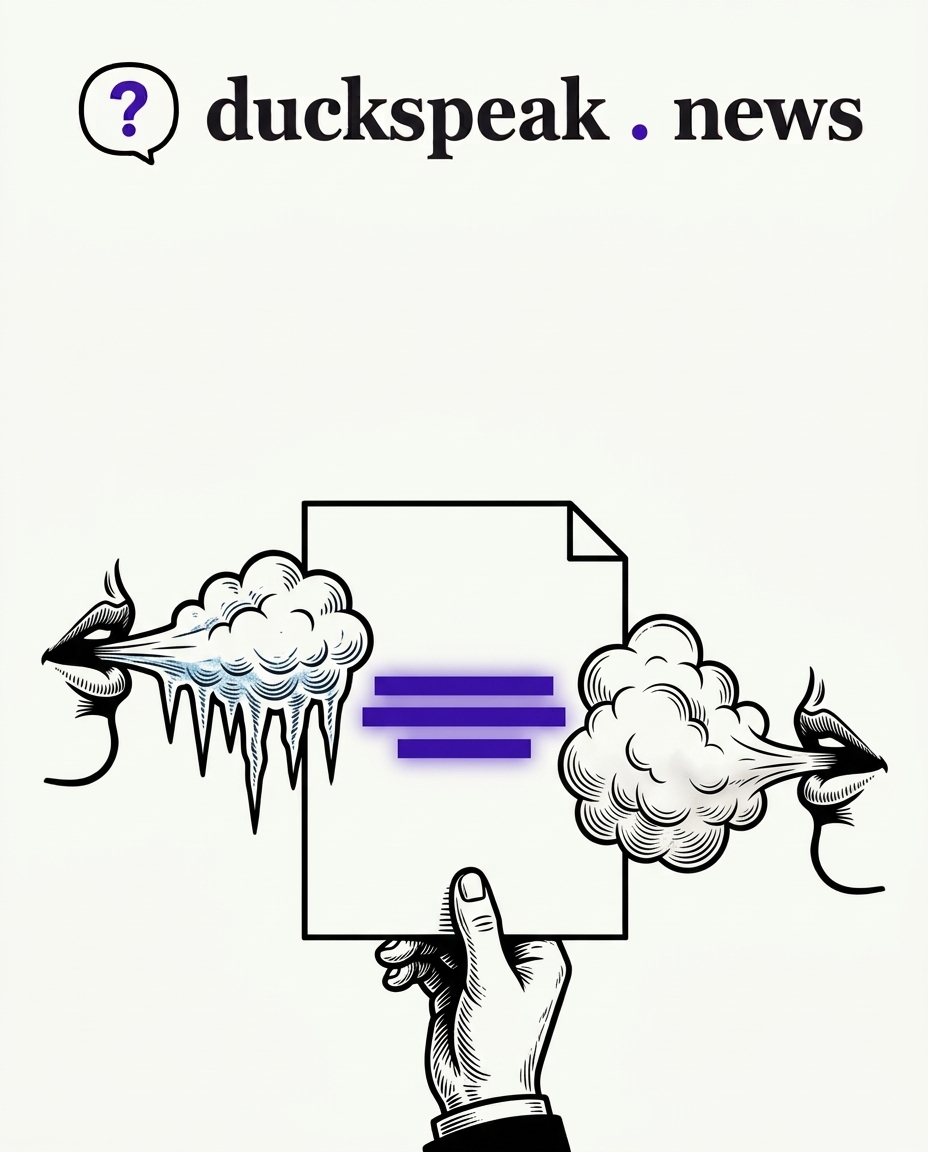
One letter, two temperatures
On the same day, two British outlets published the same news. The Mirror’s headline announces the King “making clear Prince Harry and Meghan are still not working royals” [1]. The Independent’s says “King Charles confirms” the identical fact [2]. Same letter, same Lord Chamberlain, largely the same quoted passages. Opposite temperatures. The Mirror’s version is a cold shoulder, delivered by “a royal source” who declares: “You may have come back to the UK, but you are on your own” [1]. The Independent’s is a sleeping draught, in which “Palace officials insisted there is nothing controversial about the letter” [2]. Neither temperature is in the document. Both are in the sourcing.
What the letter actually says
Start with the text, because both outlets quote enough of it to be checked against. “To help avoid doubt or confusion, the King has directed that the following information be shared” [1][2]. The information is a restatement of the January 2020 Sandringham arrangement: the couple “are no longer working members of The Royal Family” [1], their HRH styles “remain in abeyance and are not used” [1], their charitable work is “a personal matter for them both” [1], and “their position is akin to private citizens with commercial and charitable interests” [1][2]. Then comes the sentence the framing has to survive: the arrangement “will continue to be fully respected” [1]. The letter’s operative business is routing. Questions about courtesies go to Buckingham Palace; “Any operational security issues should continue to be directed to the relevant police authorities” [1][2]. This is a memo. On its face it is courteous, and it exists because official bodies, in the Mirror’s description “those in government, the military and lord lieutenants” [1], asked for guidance.
The Mirror’s layer: a slap stitched onto a courtesy
The Mirror calls it “a firm letter” [1]. Firmness is an inference; no quoted sentence is firm. The emotional payload arrives through an unnamed source: “Timing is everything” and “this important line has been drawn early, leaving no one in any doubt where his feelings lie on the matter” [1]. The same source predicts “clashes in the future” and asserts that “no one expects them to give the royal households the courtesy of their plans” [1]. An anonymous person forecasts the couple’s future rudeness as fact, and the article prints the forecast as color.
Then, lower down, the article quietly dismantles its own headline. “It has been stressed that there is nothing new in the letter” [1], and the guidance was sent in line with Harry and Meghan’s own wishes to “remain private citizens while in the UK” [1]. A letter containing nothing new, reflecting the couple’s stated preference, is headlined as the King drawing a line and leaving them “on their own” [1]. The firmness lives entirely in the unsourced layer. The drama is sourced to no one.
Note the grammar of the retraction. “It has been stressed” [1]: stressed by whom? “It is understood that the letter has been issued to the Sussexes’ team” [1]: understood by whom? The passive deletes the agent, and the deletion is the point. Orwell treated the agentless passive not as a style tic but as a machine for removing responsibility; here it lets the message arrive as ambient knowledge, authorless and unchallengeable.
The Independent’s layer: the sedative
The Independent opens by asserting “confusion over their roles since returning to the UK” [2]. Who was confused? The letter says the requests came from official bodies [1][2]; administrative housekeeping becomes, in the retelling, a public question mark hanging over the couple. The resolution is the headline verb: “confirms” [2]. To confirm is to settle a dispute. The verb manufactures an event out of a restatement of a 2020 agreement.
There is a subtler move. The Mirror’s excerpts include the letter’s most conciliatory sentence, the one about the position being “fully respected” [1]. The Independent’s excerpts do not; instead, its substance is reassigned to anonymous “royal aides,” who “emphasised that the directive aligns fully with the couple’s previously stated wish to live as private citizens” [2]. A caveat this critique should keep: that observation rests on the passages each outlet chose to print, not on the full letter, which neither reproduces. What can be verified is that the sentence appears in one outlet’s quotations and not the other’s, and that in the second outlet the accommodating reading is attributed to people with no names.
The duckspeak tell
Both outlets carry the same official message in different grammatical disguises. The Mirror: “It has been stressed that there is nothing new in the letter” [1]. The Independent: “Palace officials insisted there is nothing controversial about the letter” [2]. One is an agentless passive; the other is a vague plural. Neither names a human being. The message is identical: do not treat this as an event. The packaging around the message is opposite. The Mirror treats it as an event anyway, a “bombshell move” [1], a line “drawn early” [1]; the Independent treats it as a non-event, “a routine administrative measure” [2]. Same input, two dialects: feud or sedative.
The mechanism
The Orwellian move is the headline verb. “Making clear” [1] and “confirms” [2] both encode authority settling doubt; they pre-select the reader’s conclusion before the letter is read. The letter’s own stated purpose is humbler: “to help avoid doubt or confusion” [1][2]. Clarity as administrative assistance becomes clarity as a message about “where his feelings lie” [1], and the conversion is performed not by the King, not by the Lord Chamberlain, not by Lord Benyon, whose office the Mirror does name [1], but by a source with no name at all.
The Huxleyan move is the packaging. A routing memo about which office answers questions about courtesies cannot be consumed as news; it must be sold as either a family feud or a lullaby. Both packages are instructions about how to feel about a text neither outlet shows in full. The feud version is more obviously manipulable, but the sedative has its own cost: a reader told there is “nothing controversial” [2] is being trained not to ask why a routine memo needed a national story, unnamed officials to insist on its routine-ness, or a headline verb that sounds like a verdict.
What a reader would need instead
The quoted passages are in both articles and they contain no rebuke; read them before the headlines. The checkable skeleton is fully named: the Lord Chamberlain, Lord Benyon’s office, RAVEC (the Executive Committee for the Protection of Royalty and Public Figures), and the January 2020 Sandringham agreement [1][2]. The unverifiable layer is everything attributed to “a royal source,” “royal aides,” “palace officials,” or to nobody in particular. Whether the Mirror’s source speaks for the palace is unknowable from this material, and that is the critique: an outlet that prints “you are on your own” [1] as the meaning of a letter that says “fully respected” [1] has chosen the source’s temperature over the document’s text, and the reader has no way to audit the choice.
One further flag, kept speculative: the near-identical “nothing new” [1] and “nothing controversial” [2] lines could reflect a coordinated briefing or independent editorial caution; the articles cannot distinguish them. What they do show is that every named voice in both stories belongs to paper (the letter, the institutions), and every voice supplying the feelings is anonymous.