

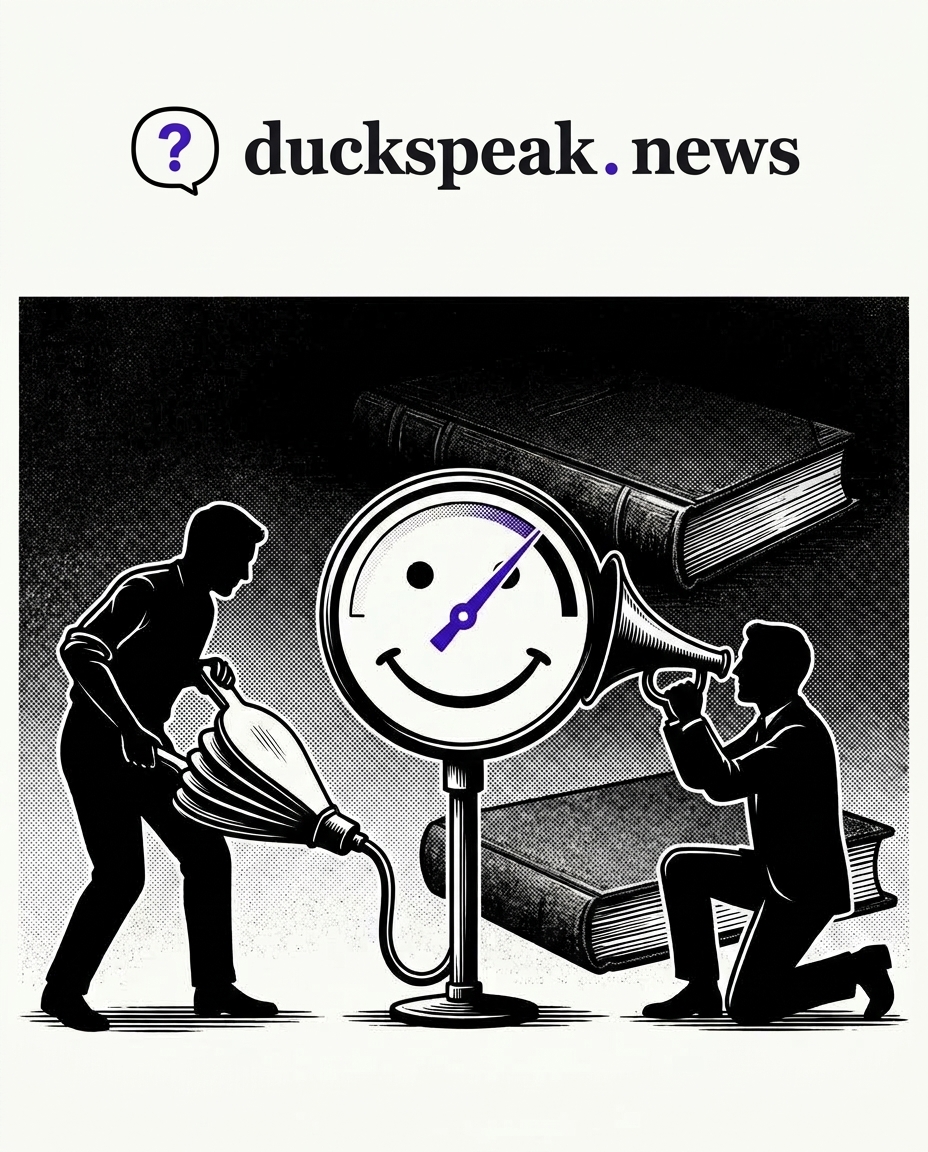
The BBC’s economics editor filed under the headline “Chancellor’s attempts to boost vibes may limit tax rises” [1], and the corporation’s daily podcast went further, making the question its episode title: “Can The Chancellor’s Positive Vibes Limit Tax Rises?” [4]. Neither is hostile, and that is the point. “Vibes” is not a category of economic analysis. It is the government’s own communications strategy, reported as fact and then graded for efficacy. Faisal Islam writes, without distance, that “the prime minister and his chancellor have been engaged in a conscious attempt to boost the economic vibes,” a “new story,” as he called it [1]. The BBC’s question is whether the vibes will work. The question it never asks is whether a government that officially treats public sentiment as a policy instrument, and a press corps that then measures the instrument, is an arrangement anyone consented to.
The mood is the story
The vocabulary spreads from the podium into the copy. Faisal Islam writes of “this precious commodity of confidence” and “the promotion of economic animal spirits” [1]. Keynes coined “animal spirits” to name the irrational energy of markets; here it is something a chancellor can promote, like a regional tourism campaign. The validation arrives without numbers: “There are some positive underlying signs from consumer, business and recruiter confidence measures that indicate this message has been heard, although the hot weather and World Cup have also been factors” [1]. Which measures? Which indices? What movement? The sentence asserts the strategy is working, cites sunshine and football as confounders, and offers no data for any of it. Even the business response is scored in mood terms: the CBI’s chief economist welcomes “the positive signals of intent from the chancellor” [2]. Signals, intent, vibes, confidence. The whole ecosystem speaks in sentiment.
This is the Huxleyan half of the mechanism. In Brave New World the population is managed at the level of feeling; the state does not argue with you, it soothes you. A government that names its own program “boosting the vibes” has made mood management official. A press that asks whether the vibes are working has accepted the premise and become the meter, and the amplifier.
“Being honest” and other pre-softened verbs
The Orwellian half is quieter. The Guardian reports that Healey “warned Labour had to ‘be honest’ about the need to control public spending” [2]. “Being honest” is a euphemism with a job to do: it converts a policy choice into a character virtue. The “need” is asserted by the same person who would carry out the cuts. The same piece reports that economists warn the chancellor “could be forced to increase taxes or cut spending” [2]. “Forced” is the load-bearing verb, an agentless passive in modal disguise. When the choice is grammatically compulsory, the choosing disappears. By Budget day the cuts can arrive sounding like arithmetic, decisions without authors.
The chain continues. The government “could look at finding savings from the welfare bill by tackling youth unemployment” [2]. “Savings” is the standing euphemism for cuts; “the welfare bill” is a ledger term standing in for people’s income. Healey supplies the moral dressing himself, a “moral duty” and a “fiscal duty,” plus the win-win arithmetic: “A person coming off benefits and into work saves the taxpayer money” [2]. Unity gets the same treatment: Healey and Andy Burnham are “in lockstep” on the fiscal rules [2], a military metaphor for agreement, reported straight. None of this is misquoted. The problem is what surrounds it. Four pieces on the same speech contain no arithmetic behind the asserted “need,” and the critics quoted attack the man or the party (“continuity Rachel Reeves” [2]; a “dire and dreary speech” [2]) rather than the premise. And the Office for Budget Responsibility, the independent forecaster whose publications would settle whether the necessity is real, appears nowhere in any of the four texts [1][2][3][4]. That omission is checkable, and it is the story.
The penalty and the muddle
Healey’s most quotable coinage is reported without examination: “Britain was continuing to pay a ‘Truss penalty’ almost four years since the former Conservative prime minister’s ill-fated mini-budget triggered a meltdown in the UK government bond market” [2]. A penalty implies a debtor and an offence; the metaphor assigns blame to a ghost. Yet the same article attributes the current turmoil to “the economic fallout from the war in Iran” and oil pushing “closer to $100 a barrel” [2]. Both causal frames, domestic ghost and global storm, sit in one piece, unreconciled. The reader is invited to hold both: borrowing costs are something done to us, by Truss or by Iran, never something present choices contribute to.
Then there is the benchmark muddle. The BBC’s related headline reads “UK long-term borrowing costs highest since 1998” [1]. The Guardian has long-term bond yields at “an 18-year high” [2]. John Crace, in the same outlet’s sketch column, has the cost of government borrowing at “a record high since the financial crash” [3]. Three different historical benchmarks, 1998, an 18-year high, and the 2008 crash, for the same week’s story. Perhaps they describe different instruments, ten-year versus longer gilts; the pieces do not say. Where a figure might go, the BBC supplies a snake: “The global rise in bond yields is like a boa constrictor squeezing the Budget maths” [1]. This is unexamined repetition in action. Each outlet inherits the frame, not the figure, and no reader can reconstruct the fact from any of them.
The trial balloon with shifting messengers
The triple lock, which guarantees the state pension rises with inflation, wages, or 2.5 percent, whichever is highest [1], is this Budget’s most floated candidate for abolition, and the floating is done in the passive voice. The BBC: “some have argued it is unaffordable” [1]. Some. The named messenger then differs by outlet. The BBC presents the advice as coming from “one of the PM’s favourite economists Lord O’Neill,” for whom rising borrowing rates are “a golden opportunity to scrap the triple lock” [1]. The Guardian presents the same policy as “a suggestion from the British Chambers of Commerce” [2]. Perhaps both said it; the material cannot tell us. What the material does show is an idea arriving pre-softened, attributed to whichever respectable figure each outlet happened to interview, and backed by an ownerless “some.” The repetition across outlets, not any published costing, is what makes “unaffordable” feel established. That is duckspeak: a claim quacked in unison until it sounds like a fact.
Pufins breeding unicorns
The purest Newspeak moment belongs to the BBC. Faisal Islam explains that public finance institutions such as the British Business Bank and the National Wealth Fund “can invest strategically, less constrained by the government’s borrowing rules,” and that “Part of the plan is Pufins to breed more unicorns ($1bn tech startups) in the UK” [1]. Strip the whimsy and read the claim: the state can invest through vehicles that sit outside the borrowing rules it simultaneously insists it is honoring. That is the entire fiscal question of the speech, the difference between “we keep our rules” and “we keep our rules by moving the spending off the ledger.” It is delivered as ornithology. The cuter the name, the less it gets examined. A reader would need to know how these institutions are accounted against the fiscal rules; the National Audit Office, which audits bodies such as the British Business Bank, is where that answer lives. Neither piece goes there.
The ducking as sport
Nobody pretends the chancellor answered anything. The Guardian: “The chancellor ducked questions on whether taxes would need to rise” [2]. The BBC: “Neither answer was a denial, but nor were they any type of confirmation,” and then the cricket: “Like a stubborn batsman, the chancellor is going to stay at the crease, giving little away” [1]. The refusal is narrated as sport, and the analysis becomes tea-leaf reading; Islam tells us the speech “did not seem to me to prepare the ground,” a “pitch roll,” for significant tax rises [1]. This is not conspiracy; it is ritual with comfortable incentives. The pre-Budget blackout guarantees political journalists a month of guessing-game copy, so the blackout is covered as weather rather than as an accountability failure. Healey’s own words are the least softened thing in the coverage: “I won’t comment. I can’t comment. No chancellor can ahead of a Budget” [1]. The outlets quote the refusal, then decorate it.
The satire that leaves the frame intact
The sharpest critique of the vibes strategy in all four pieces is buried in the Guardian’s sketch. John Crace mocks the positivity as “if we all just sat in a circle, chanted ‘Om’ and had positive thoughts then we could turn this around” [3]. That is the whole mechanism, named. But the sketch spends its force on the man: “a rabbit caught in the headlights” [3], a figure with “the look and the gravitas of a man who had been born to make a television announcement that the UK was under nuclear attack” [3], a politician who makes hope “sound like a sexually transmitted disease” [3]. Personality satire is the safety valve of this coverage. It performs skepticism, discharges it as laughter, and leaves every frame standing. The piece never asks what “being honest about spending” will mean for anyone, because it is busy describing Healey’s grip on the lectern, and it closes with a swerve onto balaclava-clad protesters in Dover and Portsmouth and the Reform conference [3], a pivot from fiscal analysis to variety, which is its own Huxleyan tell. Even the opposition frames run on personality: “Meet the new chancellor. Same as the old chancellor” [3].
What a reader would need instead
One more backdrop fact. The speech was delivered minutes from Jaguar Land Rover’s headquarters on the morning 4,000 job losses were confirmed [1], which Islam introduces as “an absolute and total coincidence” [1], his sarcasm doing work a straight news report would need a paragraph to do. The Newscast write-up attributes the cuts to “struggling with competition from China and falling behind in the electric vehicle race” [4], a causal claim attached to no one. The same episode then chats through Healey’s new slogan, “Make Great Britain Growth Britain Again” [4], without noting the echo of “Make America Great Again,” or that the phrase is not even grammatical. Politics as branding, covered as branding.
What a reader would need instead of vibes: the OBR’s forecast and the arithmetic behind the asserted “need” to control spending; the specific gilt and benchmark behind each borrowing-cost headline; the names behind “some have argued” on the triple lock; the accounting treatment of the British Business Bank and the National Wealth Fund against the fiscal rules; and the list of regulations the chancellor promised to “take an axe” to [2], which ones, protecting whom. None of the four pieces supplies any of this. All four supply the mood.
The government called it “a new story” [1]. The story the outlets told was about the telling: whether the vibes landed, whether the chancellor looked nervous, whether he “had sent the traders to sleep for a thousand years” [3]. Somewhere behind the mood, choices are being made about pensions, welfare, and the ledger. They have been pre-softened into “honesty,” “savings,” and “need,” so that on October 28 they can arrive as if nobody chose them.