

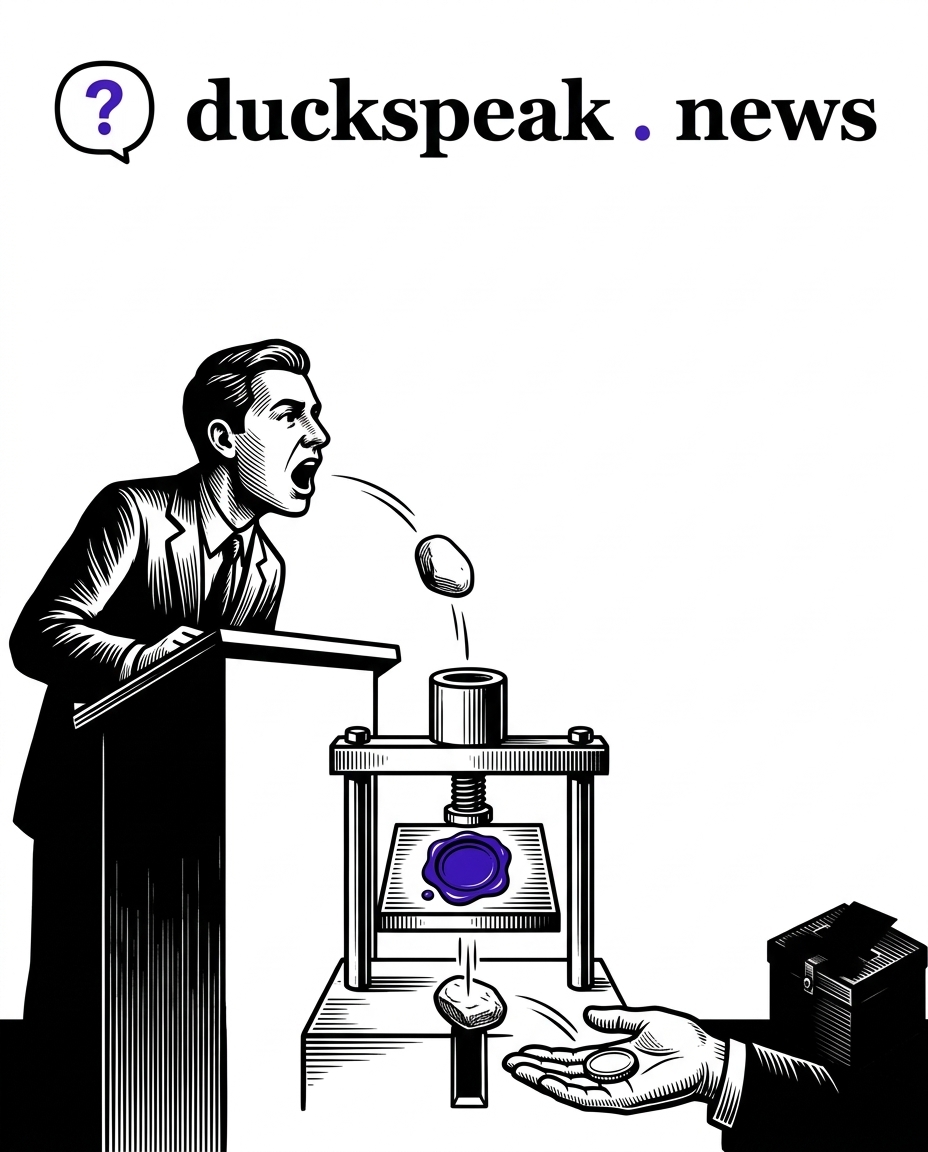
Here is how a phrase becomes a fact. On Tuesday, according to The Independent, a prime minister stood at the despatch box and called Brexit a “wrong turn” [1]. The paper then reports “new polling from YouGov” in which “55 per cent of British people agree with the prime minister that Brexit was a wrong turn” [1], and caps it with the headline: “Majority of Britons agree with Burnham that Brexit was ‘wrong turn’ for UK” [1]. The phrase left the despatch box as rhetoric and returned as arithmetic, and at no point on the journey did anyone ask whether a turn is a unit of measurement.
The binary that ate four decades
Start with the grammar, because the grammar is the politics. Burnham’s speech, as quoted, runs: “Political power was centralised, economic power privatised. The country deindustrialised. Austerity followed” [1]. Power was centralised, by whom? The country deindustrialised, as though by weather. Austerity followed, the way night follows day. This is Orwell’s oldest complaint about political prose, from “Politics and the English Language”: the passive construction and the agentless verb let responsibility evaporate. A speech whose stated theme is restoring “the agency to act” [1] to hollowed-out councils is delivered almost entirely in sentences where nobody does anything; things are done to the country, and things simply happen to it.
The “wrong turn” metaphor finishes the job. A turn implies a road, a driver and a destination; it converts an argument about who did what to whom into a steering decision with two possible answers. The poll, as reported, adopts the binary wholesale, and the tell is “right turn”: nobody in British politics campaigns for right turns as such. The category exists because a binary needs an antonym. Note also the verbs the paper chooses. Labour voters “believed it to be a wrong turn”; Reform voters “claimed it was a right turn” [1]. Belief on one side, assertion on the other. Two verbs is thin evidence, and it may be a sub-editor reaching for variation, but it is in the text and it points the same way as everything else in the piece.
One caveat the article makes unavoidable: it never prints the poll’s question. YouGov’s wording, sample size and field dates are all absent [1]. So there are two possibilities and the reader cannot tell which holds. Either the pollster asked in Burnham’s vocabulary, in which case the instrument is the metaphor; or the pollster asked something else and the paper translated the result into Burnham’s vocabulary, in which case the translation is the metaphor. The article’s own phrasing, “agree with the prime minister that Brexit was a wrong turn” [1], hints at the first, but that is inference, not evidence. Either way the boundary between the politician’s voice and the public’s verdict has been dissolved.
Numbers with no floor
The article’s evidentiary centrepiece arrives in one sentence: “just days after The Independent revealed the £11.7bn a year loss in exports Brexit has caused for British business as well as a survey showing 98.2 per cent of businesses want the UK to rejoin the single market” [1]. Two figures, zero provenance. The £11.7bn is attributed to the outlet itself; the newspaper is its own source, and even the causal verb, “has caused”, is stated as settled fact with no hedging. The 98.2 per cent is attributed to nothing at all: no polling company, no sample size, no field dates, no question, no definition of “businesses”. A figure carried to one decimal place advertises precision, and precision without methodology is theatre. Were the respondents a business lobby’s members, this newspaper’s readers, a trade body’s mailing list? The article does not say, so the reader cannot check. What a reader would actually need are the institutions that track this for a living: the Office for National Statistics publishes the UK trade series, and the Office for Budget Responsibility publishes its own estimates of Brexit’s economic effects. A £11.7bn claim that never meets either is a number floating free of anything it could be checked against.
The brochure between the paragraphs
Then the piece stops pretending to be only news. Mid-article: “We’re campaigning to rebuild Britain’s future in Europe” [1]. Then a benefits list: “What you will get by joining our campaign Europe: The Way Back” [1]. Then the price: “There are even more benefits if you subscribe for just £1 for seven months” [1]. Then the flattery: “Join thought-provoking conversations, follow other Independent readers and see their replies” [1].
This is the Huxley half of the diagnosis. Orwell’s propaganda demands belief; Huxley’s conditioning offers belonging, and belonging is the product on offer here. The presumed reader already believes Brexit was a disaster; the article’s job is to confirm it, then convert the confirmation into a transaction. The only external voice quoted is Naomi Smith of Best for Britain, introduced with another agentless passive: “The Makerfield MP’s comments were welcomed by pro-EU campaigners” [1]. Welcomed by whom? By the campaign the article then quotes, and then invites you to join. No dissenting voice appears anywhere in the piece. That is not a conspiracy; it is composition. An article that quotes only the side it campaigns for, while campaigning, is a brochure.
Smith’s line is well made and worth reading as a specimen: “far from taking back control, it shrank our economy, left us poorer, weaker, less safe and more divided” [1]. It takes the Leave campaign’s slogan and inverts it clause by clause. But slogan answering slogan is jingle warfare. Orwell’s name for the perfected form was duckspeak: orthodoxy quacked out with no engagement of the higher brain. “Take back control” and “poorer, weaker, less safe” are the same machine running in opposite directions, and neither is a claim you could take to the ONS trade data.
What the article assumes you already know
The omissions are load-bearing. First, how did we get here? The opening sentence introduces “the former mayor of Greater Manchester” addressing the Commons “for the first time as prime minister” [1], and never explains how, when or by what route he took office. A reader arriving cold learns that a mayor is now prime minister, and nothing else. Second, the poll’s field dates: without them we cannot know whether YouGov measured reaction to the speech or pre-existing sentiment relabelled as agreement with it. Third, “the managed decline of Liverpool” [1]. Burnham says the country “even talked of” it; the phrase has a specific documentary origin, a 1982 memo by Geoffrey Howe, then chancellor, which the article never supplies. Unattributed, it works as incantation: an evil-sounding phrase said by no one in particular. Fourth, the people the metaphor cannot hold. On Brexit, 13 per cent did not know; on Thatcher, 23 per cent [1]. A steering wheel has no position for “unsure of the destination”, so the don’t-knows are recorded and then dropped; the headline has room only for the 55.
The loop, closed
Trace the full circuit. Burnham chooses a metaphor. The poll, as reported, grades the nation on it. The paper reports the grade as agreement with Burnham. The campaign threaded through the story offers you a way to purchase the conclusion for £1. Each step presents the phrase as more solid than the last: choice, then measurement, then fact, then membership. Nothing in the chain is arithmetically false; 55 is a majority. The work is done by the shrinking of the question until only two answers fit, which is the Newspeak method exactly: not lying about the world, but narrowing the language until the world cannot be described any other way.
Honest coverage of the same events would carry the poll’s actual question and dates, the name and method behind the 98.2 per cent, the £11.7bn set against ONS trade data and OBR estimates, one voice that is not Best for Britain, and one sentence explaining how the man at the despatch box became prime minister. None of it is exotic. All of it is absent.