

The fullest statement of how Andy Burnham’s proposed NHS-style social care service would be funded, as it appears across this week’s coverage, is this: “everyone contributes, everyone is covered but not precisely necessarily in the same way that we currently pay for the NHS” [1]. Read it twice. It promises universality twice, hedges its only substantive clause twice (“not precisely necessarily”), and names no mechanism at all. It is a sentence shaped exactly like an answer, with the answer removed. The BBC printed it in full. None of the three outlets examined here parsed it.
The number that wasn’t there
The only concrete figure in circulation across all three pieces is £18bn a year. The BBC introduces it in the passive voice: Burnham “was told it had been estimated” that a free at the point of use system “could cost taxpayers £18bn a year” [1]. Who estimated it? The copy doesn’t say. It may have a named author somewhere in the fuller exchange; in the published text it has none, and that uncertainty is worth flagging rather than smoothing over. Burnham’s reply, “It’s not that high” [1][2], is the entire costing conversation on the record. The Guardian repeats the exchange (“he rejected suggestions it could cost £18bn a year” [2]) without noticing that a rejected number leaves a hole where a number should be. Not one of the three pieces supplies an alternative figure, an independent costing, or even a range. The reader finishes the coverage knowing only a denied estimate.
The adjective that replaced the answer
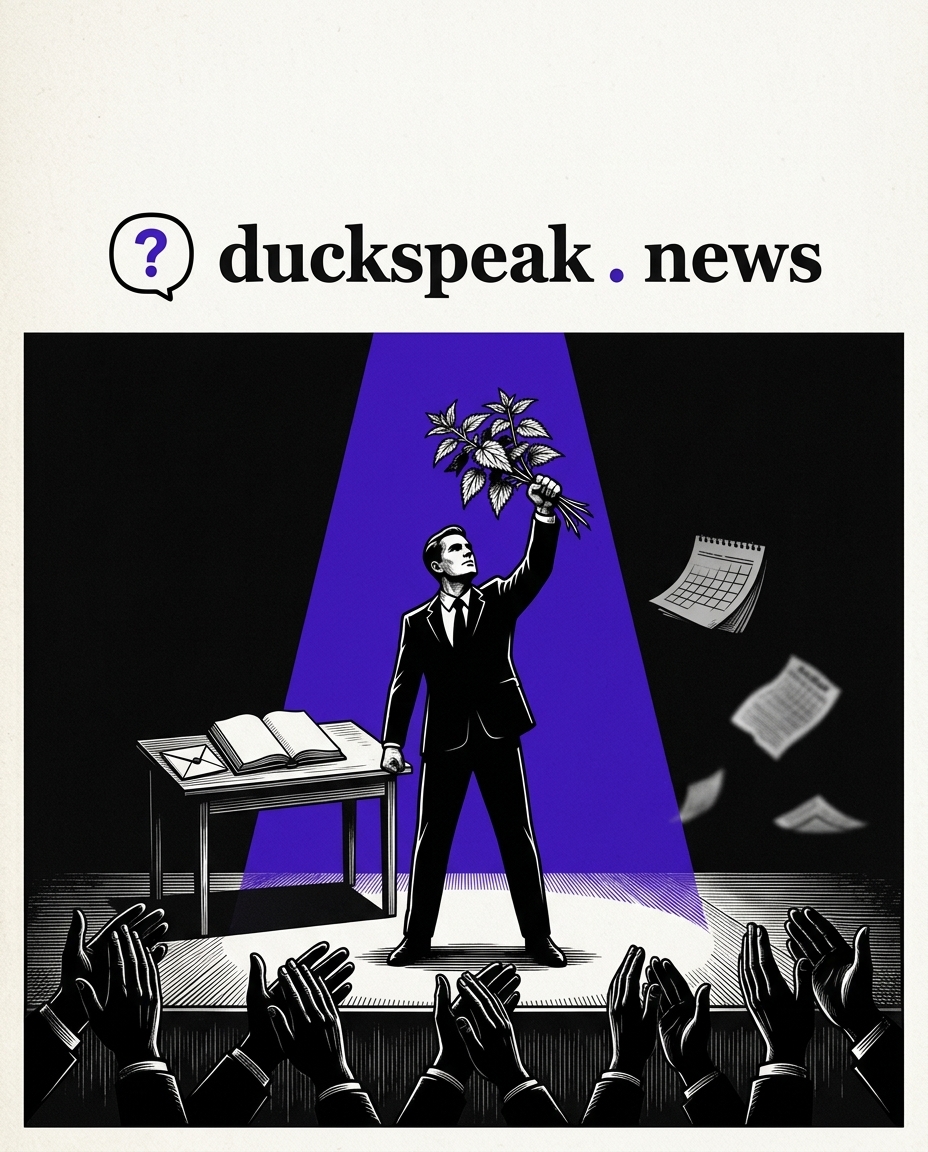
What fills the hole is character. The Guardian has the prime minister “willing to expend political capital,” pledging to “rip the plaster off,” and supplying his own eulogy: “Somebody needs to grasp the nettle. I will be the one to do that” and “I realise it might require me to spend some political capital, that it might make me unpopular with some” [2]. The paper reports that “political courage” was “a theme of the conference” [2], a sentence about mood rather than policy. The BBC quotes a Labour MP calling the plan “very bold and brave” [1]. The Independent opens by asking “A lot of style but where was the substance?” [3] and closes on “a brave but huge gamble” [3]. Three outlets, one adjective family, converging on the same transmutation: the unanswered question of how it will be paid for becomes a personal quality of the leader. You cannot audit courage. In Orwell’s vocabulary this is passive-voice politics, everyone contributes and nobody specifies; in Huxley’s it is the soothing itself, admiration distributed in place of information. The conference copy makes the Huxley side explicit: the gathering “is intended to be an upbeat affair,” designed to “restore hope” [2], and Burnham is reported not wanting to focus on a “narrative of doom” [2]. Mood management is the product; the funding plan is the mood’s pretext.
The calendar that replaced the question
Look at the schedule of accountability. The “vision” arrives on Tuesday [1]. The detail is delegated to Baroness Casey, whose review Burnham moved forward to “next summer” [1]. The “very clear plan” will be tested “at a general election” [1] that has not been called. Every moment at which the plan could acquire content is placed beyond the current news cycle. The Independent converts this deferral into its actual subject: its headline claims the announcement “guarantees Burnham cannot go early” [3], and the column is about election timing, not care. The Guardian’s own subheading asks whether Labour can “hang on to Burnham bounce” [2]. This is horse-race absorption: the material question (who pays, how much, through what instrument) is rewritten as a question about momentum and timing. The Independent, having demanded substance, then asserts with no evidence attached that “This is why the cost of UK debt has gone up even more since he became prime minister” [3]. That sentence is speculation dressed as analysis, and it should be flagged as such.
The Guardian has softer spots of its own. It reports “speculation that the Treasury could now consider £15bn acceptable” [2]; the word “speculation” is the outlet’s own, an admission printed as context, letting unsourced chatter enter the news flow carrying a number. Likewise “A series of global economic shocks, including the Iran conflict, has put the UK economy under intense inflationary pressure” [2] arrives with no attribution at all. Sentences doing the work of facts while carrying none of the obligations.
What the BBC had, and didn’t use
Fairness requires noting that the BBC’s piece carries the most substance of the three: the £23,250 savings threshold above which people in England get no council help with care costs, the different rules in Wales and Scotland, free personal care in Scotland, the 2009 “death tax” collapse of Burnham’s earlier national care service plan, and Theresa May’s 2017 “dementia tax” debacle [1]. It even carries Burnham’s sharpest substantive claim, that social care in England is “as unfair as American healthcare, where the most vulnerable in society can lose everything” [1], though no outlet interrogates the comparison. But look at what the BBC does with the two hardest facts it holds. It reports that the 2024 Labour manifesto promised no increases to national insurance, income tax or VAT [1]. It reports Burnham saying “nothing is off the table at this moment in time” on funding [1]. It never places these facts against each other to ask the obvious question: if the three largest revenue instruments are locked, what is left, and could it plausibly fund a universal service? Both facts are present; the question is absent. That is omission by adjacency, and it is the question a reader most needs asked.
What a reader would need instead
None of the three pieces names a single independent source on cost. What a reader would need is the decade of prior work the coverage skips: the commissions, caps and levies on social care that were announced, legislated and then delayed or abandoned, and the bodies that have costed this reform repeatedly, the King’s Fund and the Health Foundation among them. (This critique can only note their absence from the copy; it cannot supply their numbers here.) Meanwhile the attack lines are fully stocked: the Conservatives’ “more tax rises” [1], Reform’s “universal death tax” and “he’s coming for your home” [1]. The reader comes away equipped for the fight and unequipped for the question.
One last textual detail. The BBC reports that Burnham “wants to set out his ‘vision’ on Tuesday” [1], and its own copy puts “vision” in scare quotes, as though the word cannot be repeated bare. Even the stenographer flinches. A vision, in this coverage, is precisely the thing that pre-authorizes vagueness: it cannot be costed, cannot be wrong, and cannot be tested until after an election. Broken systems are acknowledged (“broken social care will in the end break the NHS” [1]; “the broken social care system” [2]), brave leaders are admired, and the one sentence that would have mattered, the one with a number and a mechanism in it, appears nowhere in three articles about a plan whose entire content is a number and a mechanism.