

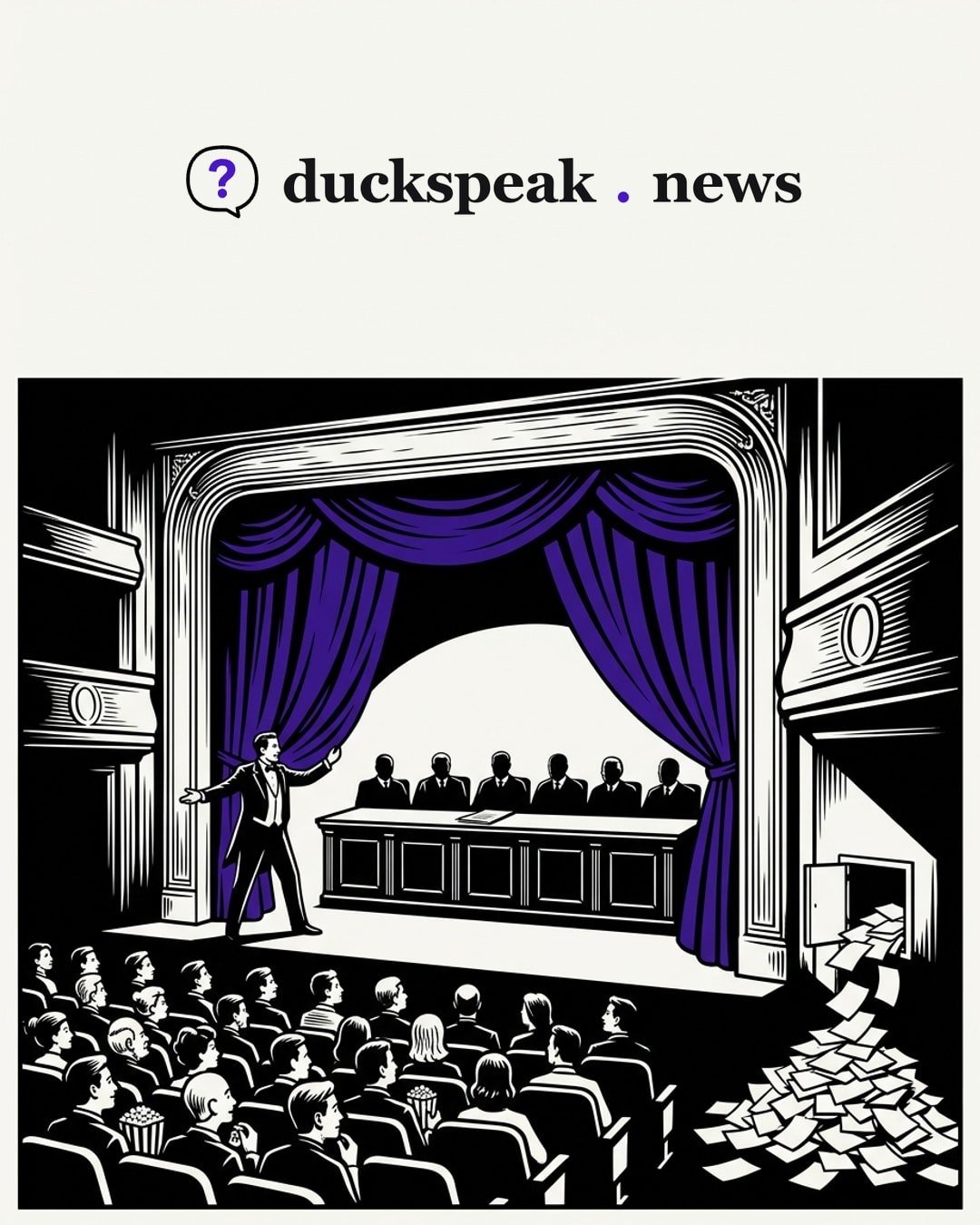
Three previews of the same Monday, and all three reach for the theater. NPR headlines a term “jam-packed with controversy” [1]; Fox says the court “kicks off” amid “fresh questions over its legitimacy” [2]; CBS reports that “waiting in the wings at the Supreme Court are several legal battles” [3]. NPR’s lede parks “election law cases” in those same wings [1]. Two outlets are two data points, not a trend, but the shared idiom is the genre showing itself. When a legal analyst quoted by Fox closes with the promise of “something for everyone” [2], the register is a fall lineup, not a docket. That is the Huxley half of the problem. The Orwell half is quieter, and it sits in the paragraphs these pieces file under backdrop.
The docket with no name
NPR’s most consequential reporting arrives early: emergency appeals have “ballooned,” fully argued cases have “dropped precipitously,” and, in Georgetown law professor Stephen Vladeck’s words, there are now “twice as many full court rulings on emergency applications as we have on the merits docket” [1]. NPR explains what that means: emergency rulings come “with little briefing, no oral arguments, and ultimately little or no explanation of the ruling” [1]. What NPR never does is use the phrase “shadow docket.” Fox uses it exactly once, quarantined inside a hedge: “its so-called ‘shadow docket’” [2]. One outlet describes the phenomenon and declines to name it; the other names it and pre-apologizes for the name. In the Orwellian sense this matters: the procedure that now produces most of the court’s rulings is the one the vocabulary refuses to stabilize. An unnamed mechanism is hard to hold accountable, and a “so-called” name arrives pre-discounted. Notice that the same hedge appears twice across these previews for different terms: NPR’s “so-called ‘third countries’” [1] and Fox’s “so-called ‘shadow docket’” [2]. The hedge is the tell; it marks the terms carrying charge the outlet will not own.
Adjectives versus arithmetic
Fox reports that “The Trump Justice Department has won over 70-percent of its emergency cases before the Supreme Court since 2025” [2]. Read the grammar: the Justice Department is the subject, and the court is scenery. The institution granting seven of ten requests vanishes from the sentence about the granting. Two paragraphs earlier, the same article forecasts “a mixed, nuanced series of rulings both for and against President Donald Trump’s ambitious agenda” [2], and shortly after concedes that “For the most part, the 6-3 conservative majority has greenlighted the administration’s power” [2]. “Mixed, nuanced” and “for the most part… greenlighted” are adjectives doing reputational work against the article’s own arithmetic. When the numbers and the adjectives disagree, the adjectives are the frame and the numbers are the fine print.
The symmetry machine
Fox repeatedly pairs asymmetric things into matched clauses. “Decisions in Trump’s second term have him and Republican lawmakers sharply criticizing their judicial losses on one hand, and Democratic leaders sounding the alarm when their side does not prevail” [2]. “Those on the right have demanded impeaching federal judges who block White House policies, while those on the left have renewed calls for drastic changes to the court’s structure” [2]. Impeaching judges over rulings and proposing term limits are not equivalent acts, but the sentence architecture makes them a balanced pair, and balance is the message. The legitimacy question is then narrated as audience research: Gallup’s record-low 33 percent approval, a Washington Post/Ipsos finding that 46 percent of Americans think the justices rule on political views [2], a chief justice “in a tough position” [2] who “continues to struggle against negative public attitudes” [2]. The problem is located in perception; the court’s conduct is a given. Approval ratings for a court are a category confusion the coverage adopts without blinking: a bench is graded like a sitcom between seasons.
The quote the frame refuses to use
The most revealing sentence in all three pieces is one Fox runs without comment: “These are not the people I interviewed to serve on the United States Supreme Court, they are merely a shell of their original selves” [2]. A president describing justices as hires who disappointed the interview. Fox frames the post as having “amped up the tensions dramatically” [2]. The same article carries Justice Kagan’s standard: “When political figures of any stripe are trying to intimidate judges and justices to do things that they like rather than the things that they don’t, that’s where we really have crossed a line” [2]. The article possesses both the criterion and the instance, and declines to run the syllogism. The word “intimidation” is present; it is simply not pointed anywhere.
Euphemism file
NPR writes that DHS may deport migrants to “so-called ‘third countries,’” then, in the next sentence, that the administration “has deported thousands of people to third world countries where they have no connections, may not speak the language, have often been jailed and allegedly subject to torture” [1]. The slide from the legal term into “third world countries” may be a typo, and this critique flags it as possibly that rather than a choice. Either way, note the verbs: “have often been jailed,” “allegedly subject to torture,” alleged by no one in particular, with the countries doing the jailing deleted from every clause.
NPR also reports the administration takes “the rare step of getting to the Supreme Court by leapfrogging over lower appellate courts that the administration views as hostile” [1]. “Leapfrogging” is a playground verb for skipping a layer of review, and “views as hostile” adopts the administration’s friend-versus-foe map of the judiciary as though it were neutral description.
CBS calls the opening climate case’s question “a technical one” [3]. The technical question is whether the deception claims, that the industry told the public “the opposite of what the company’s own scientists knew” [1], are ever heard anywhere at all. Jurisdiction is where a case goes to die politely. CBS also supplies the best single fact in the set: Alito’s recusal from this very case, alongside the detail that his 2025 financial disclosure lists stock in ConocoPhillips and Phillips 66 [3]. Neither NPR nor Fox mentions it, and Fox’s speculation about an Alito vacancy [2] never crosses with it.
Fox, meanwhile, lists “the White House ballroom and Kennedy Center construction projects” among “constitutional disputes over the power of the executive” [2], and elsewhere counts “approval for continued construction of the ballroom” as an emergency-docket win in the same breath as voter-citizenship rules [2]. A ballroom is now a recurring character in the separation of powers. The same article’s list of pending appeals includes “transgenders in the military” [2]; CBS, covering the identical policy, writes of “the policy prohibiting transgender people from the military” [3]. One phrasing makes a category; the other makes people.
What a reader would need instead
- Emergency-docket outcomes tracked as the court’s record rather than the administration’s win column. SCOTUSblog’s term statistics and Vladeck’s own chronicling of the emergency docket exist for exactly this; he is the scholar most associated with the term.
- Recusal and ethics records, compiled by watchdogs such as Fix the Court. CBS’s Alito item is the kind of fact that belongs in every term preview, not in one.
- The primary documents these previews paraphrase: the Boston district court’s ruling on third-country removals, the appeals court opinion warning of a “seismic shock through our immigration detention system” [3], the actual Colorado preschool filings.
- A genre correction. A preview that pre-scripts the verdict as “mixed, nuanced” [2] is a weather report. NPR’s Vladeck supplies the honest version: “The real story of the upcoming term hasn’t been written yet” [1].