

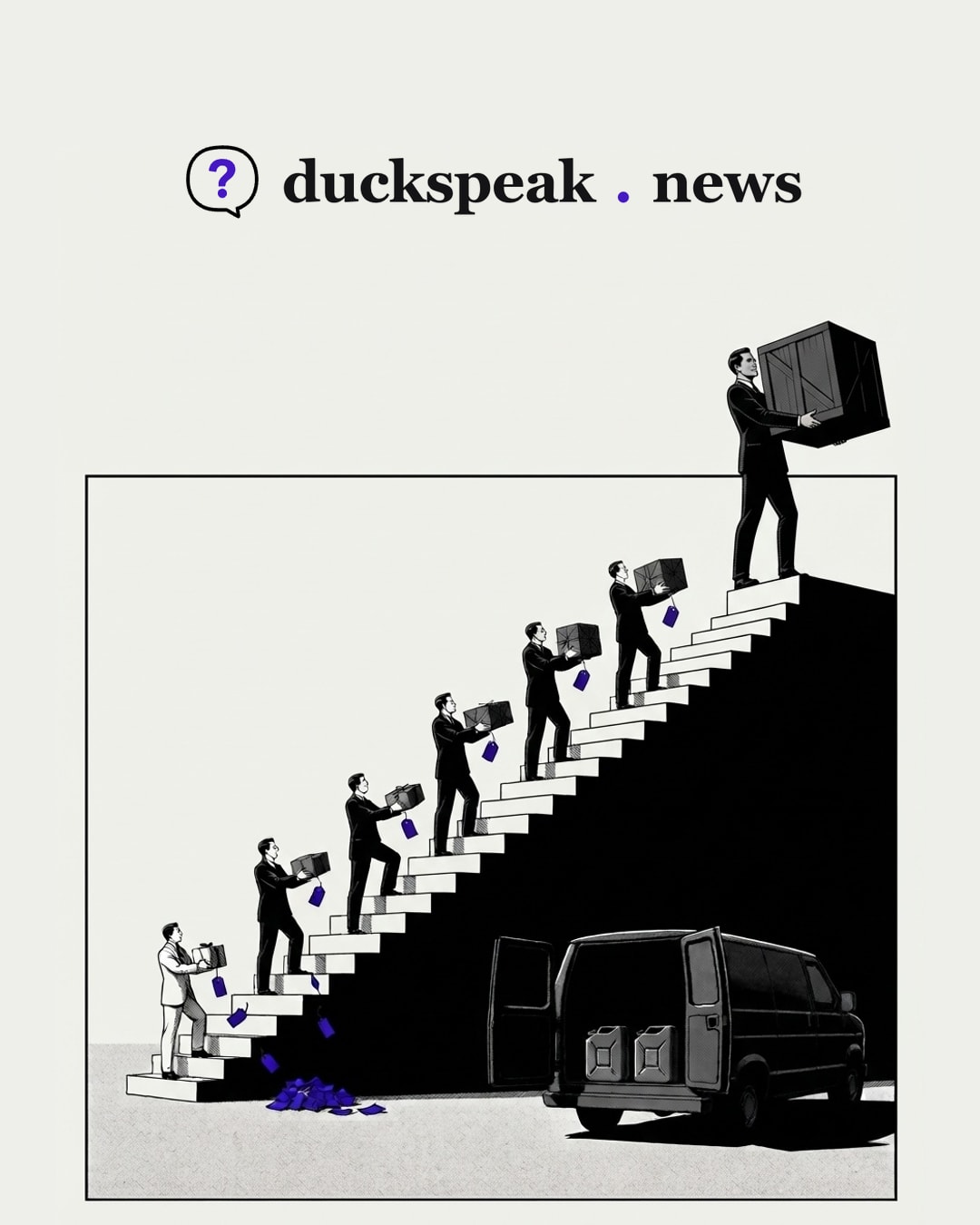
The Guardian’s headline says a man was “arrested over alleged bomb plot at RAF Fairford” [1]. In the eleventh paragraph of the same article, counter-terrorism police say what was actually found in the three vans that started all this: “a quantity of petrol, but no explosive devices” [1]. The word “alleged” hedges the plot. It does not hedge the bomb, and the bomb is the headline’s addition. No police statement quoted anywhere in this material mentions an explosive device; the only physical inventory on record is petrol.
That is the pattern across six articles from four outlets, and it runs in one direction. As the case softens, the language hardens.
The ladder of maybe
Stack the official quotes the way the outlets stack them and you get a staircase. Vicki Evans, senior national coordinator for Counter Terrorism Policing: police are looking at “all possible angles”, including “possible foreign state involvement” [1] [2] [3] [6]. US Secretary of State Marco Rubio: the incident “clearly involves the hands of a foreign actor”, country unspecified [6]. Prime Minister Andy Burnham: “strong indications” Iran played a part [1] [2] [3]. Benjamin Netanyahu: “an Iranian-sponsored attack”, flat out [1] [2].
Every rung is quoted accurately. The problem is the stacking. The police formulation is a list of open lines of inquiry, not a finding. Burnham’s is an uninspectable intensity: strong indications of what, from whom? He declined to say, citing the investigation (“I don’t say more at this point”) [6]. Yet relayed in sequence, three hedges and a foreign premier’s assertion read as converging confirmation.
The one outlet here that prints the epistemic bottom line is Fox News: “Neither investigation has publicly established that the Iranian government directed the attacks” [5]. Its experts spend the article stressing what remains unknown. Yet even Fox’s own furniture does the noun work: a crosshead announces “RUBIO CONFIRMS ‘FOREIGN ACTOR’ INVOLVED IN UK TERROR PLOT” [5], upgrading something Rubio merely said into something confirmed, inside a plot nobody has established. The Guardian, the Independent and GB News never print the caution sentence at all.
The hedge that falls out of the sentence
GB News published three pieces on this case. In one, the standing denial reads: “The Islamic Republic has categorically denied involvement in the alleged terror plot” [3]. In the other two, the identical sentence appears as “denied involvement in the terror plot” [4] [6]. The word “alleged” fell out between filings. Nothing else in the sentence changed.
This is the Newspeak move in miniature. The modifier is retractable; the noun is what memory keeps. “A suspected terrorist plot” [1] is legally safe. “The terror plot” is what readers store. GB News even hedged its own headline with scare quotes (“‘RAF Fairford terror plot’” [3]) and then dropped both the quotes and the “alleged” in the body. The adverbs stay hedged; the nouns go flat. By the time Netanyahu’s “murderous attack” arrives, relayed without challenge by GB News [4], the ground is already prepared.
The facts pointing the other way
Collect what this material actually establishes. Three vans near a base; a farmer calls it in; police were already on scene, “as it is understood one of the suspects called 999 themselves” [3] [4] [6]. That last detail is either a transcription oddity or the most exculpatory fact in the case, and all three GB News pieces carry it without spending a sentence on what it might mean. The Guardian and the Independent omit it entirely [1] [2]. The vans contained petrol and no explosives [1] [2] [3]. Six men arrested; six bailed; no charges reported in any of these articles [1] [2] [3] [4] [6]. Iran denies involvement, in one sentence, near the bottom, every time [3] [4] [5] [6].
Every one of those facts deflates the plot. Every one sits below the fold of a story whose headline inflates it. The evidence and the news value are moving in opposite directions, and the language follows the news value.
One word, dropped
GB News’s second piece is a Netanyahu statement gallery: Britain as a “rogue state appeasing an Islamist-leftist alliance” (that is the headline) [4], plus “mind-blowing hypocrisy”, “gone rogue”, and “if Britain doesn’t regain control over its borders, you will lose Britain” [4]. None of it is challenged, which is a choice. The sharper omission is smaller. The Guardian and the Independent both explain what triggered the outburst: the “sanctions” Netanyahu says were slapped on Israel “pretty much the next day” [2] were “a ban on trade with illegal Israeli settlements in the West Bank” [1] [2]. GB News retells the same sequence as a ban on “trade with Israeli settlements on the West Bank” [4]. The word “illegal” survived two outlets and died in the third. One word, and the legal status of the thing Britain sanctioned quietly changes.
Then there is the counterfactual: without Israeli intelligence, “it would probably have gone through and we don’t know how many British lives would have been lost” [3] [4]. An unknowable body count, attached to a plot whose discovered arsenal, on the police’s own statement, was petrol [1] [2] [3]. No outlet notes the mismatch. No UK confirmation of the intelligence claim appears anywhere in this material; every verb attached to it is “claimed” or “insisted” [1] [2] [3] [4]. (The coinage mutates in transit, too: “Islamist-Marxist alliance” in the Independent [2], “Islamist-leftist alliance” in GB News’s headline [4].)
The footnote that is the story
Why Fairford? The Guardian and the Independent answer in a clause near the bottom: the base “has been used in recent months by US bombers after former prime minister Keir Starmer granted Washington permission to use British bases for ‘defensive’ strikes against Tehran” [1] [2]. GB News compresses it to one line: “The US have used the base as an outpost for launching strikes on the Islamic Republic from Europe” [3]. This is not color. It is the reason a US secretary of state is commenting [6], the reason Burnham references “colleagues in the United States” [6], and the entire strategic frame without which “foreign state involvement” is a free-floating accusation. In every piece here it is a subordinate clause below the bail news. The context that would make the story comprehensible is filed as trivia.
Caveats
Two inconsistencies these articles leave unresolved. GB News reported the 1 October Westminster arrest as a “27-year-old man, a dual UK/Iranian national” [6]; its later piece on the same arrest, quoting the CTP statement, says “The 25-year-old man” [3]. Same day, same borough, same statute; one of the numbers is wrong, and nothing here says which. Second, [6] reports “a second man, 26, who is a UK national, has also been questioned under caution”; that man is absent from every subsequent article [1] [2] [3] [4]. Released, charged, or editorially evaporated? Not stated anywhere.
What a reader would need instead
- The case status in one line: six arrests, six bails, no charges reported, no explosives found [1] [2] [3].
- The police hedge taken at face value: “possible” foreign state involvement is a list of open lines of inquiry, not a finding [1] [3] [6].
- The base’s role in the US strike campaign as lead context, not a closing clause [1] [2] [3].
- The attribution chain for every escalation: “strong indications” is Burnham’s phrase, offered while declining to say more [6]; “Iranian-sponsored” is Netanyahu’s, offered while denouncing a ban on trade with illegal settlements [1] [2].
- Iran’s denial on the record, somewhere above the final paragraph [3] [4] [5] [6].
- And the sentence only Fox printed: no investigation has publicly established Iranian direction of this attack [5].
That is the minimum. Everything else here is noun work.
More on RAF Fairford on this site:
- 1 October 2026 Defensive Purposes, Such as Striking: How the Fairford Coverage Renamed a War
- 1 October 2026 Six Arrests, No Charges, and ‘the Terror Plot’
- 8 October 2026 Safe, Routine, Defensive: The Euphemism Stack at RAF Fairford
- 13 October 2026 Certainty Ratchets; the Evidence Is Still Petrol