

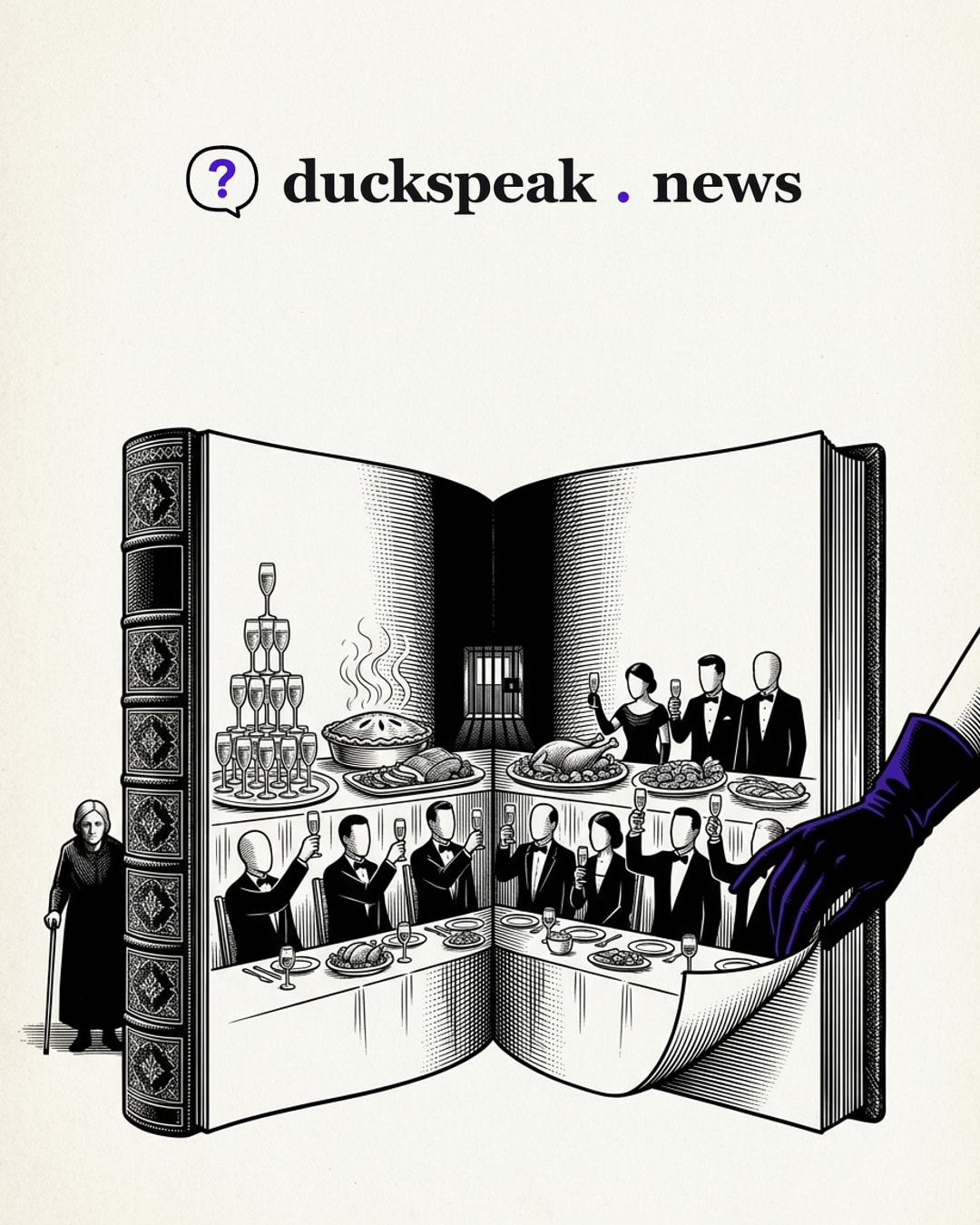
When Jeffrey Archer died at 86, the BBC’s headline made its framing decision before the first sentence: “Queen pays tribute to ‘irrepressible’ Jeffrey Archer” [1]. The quotation marks are attribution; the headline is a choice. Of every available fact about the man, the one selected to stand for his death is a royal compliment.
The Queen’s statement, quoted at length, supplies the piece’s governing metaphor. “Seldom does an author get to live a life as rich, varied and colourful as any of the characters in their books, or with as many surprising plot twists” [1]. He was, she allows, “not without flaw”, but friends will recall “an irrepressible life force through all the many differing chapters of his life” [1].
The double negative
Sit with “not without flaw” as language. The subject of that sentence was convicted of perjury and perverting the course of justice. The BBC’s fourth paragraph records the jailing, and its later text records the mechanism: a false alibi procured from a former friend, fake diary entries produced to back it up, perjury on oath at the libel trial [1]. To get from the Queen’s phrase to that record, a reader must invert the negative twice to arrive at “flawed”, and then swap the noun, because “flaw” belongs in a character sketch, not beside a four-year sentence [1].
This is euphemism by dilution rather than deletion. Orwell’s Newspeak compressed meaning until inconvenient thoughts became inexpressible; the tribute register works the other way, thinning a finding of fact into a personality trait. Nothing is hidden. Everything is diluted.
The metaphor does the work
The novel frame is not decoration; it is load-bearing. The conviction gets one sentence in the fourth paragraph, rendered as “lying and cheating” before the legal names arrive later [1], and then the piece reverts to tribute: Badenoch calls the death “devastating news” [1], followed by Major, Duncan Smith, Javid, Hunt, Cleverly, Zahawi and Brandreth [1]. The proportion feels natural only because the metaphor has already converted the material. A plot twist is something that happens to a character; perjury is something you do to a court. Once a life is a novel, fabricated evidence becomes texture.
To be fair to the BBC, the facts are stated, including the false alibi and the fake diary entries [1]. The problem is not omission. It is proportion, and the register that sets it.
The claims nobody checked
Badenoch, quoted without challenge: “He did serve his time, he made amends, and he wanted to do a lot of good in the world” [1]. The Guardian’s obituary for the same death records at least three matters that ended not in amends but in no prosecution: the Kurdish relief discrepancy, in which Archer claimed to have raised more than £57m while Kurdish disaster relief groups said £250,000 had reached groups in Iraq, a discrepancy Scotland Yard investigated without charges [2]; the Department of Trade and Industry inquiry into alleged insider dealing in Anglian Television shares, which concluded he would not be prosecuted [2]; and the accusation by Equatorial Guinea’s government that he co-financed the failed 2004 coup [2]. Those are allegations and closed inquiries, not findings of guilt, and the Guardian is careful to present them as such [2]. But “he made amends” is also a claim, and the BBC runs it with no record attached: not the two years served of a four-year sentence, not the retained peerage [2].
The same piece quotes John Major: “we have lost a man who lived one of the most remarkable lives of our age” [1]. Nowhere does the BBC mention that Major is the prime minister who made Archer a life peer in 1992 [2]. A mourner’s relationship to the deceased is context; without it, a party remembering its own reads as a nation grieving.
The eulogist’s tie goes undisclosed too. The BBC notes Archer “was a supporter of the Queen’s Reading Room charity” [1] and had appeared at her festival days before his death [1]. The statement comes from the patron of a charity he backed. That is not a conspiracy; it is a disclosure the tribute format simply never gets around to making.
The woman without a name
The libel case that produced the perjury conviction is compressed into one BBC sentence: “The Star had alleged Archer had slept with a sex worker” [1]. She has no name in the piece. The Guardian names her, Monica Coghlan, and records the £2,000 paid through an intermediary at Victoria station [2]. In the tribute version, every politician, peer and broadcaster is named; the woman at the center of the case is a noun phrase. Some lives get chapters; others get a category.
The show goes on
The Orwellian fear was the memory hole. The BBC piece demonstrates the Huxleyan variant: the uncomfortable fact is present and immersed. The perjury is stated, then surrounded by a final novel released the day after his death [1], a festival appearance, a “Watch:” link to the BBC’s own recent interview with him [1], and a royal sign-off, “Wherever the next page turns to, I trust there will be champagne and Shepherd’s Pie in abundance. Camilla R.” [1], which the BBC then footnotes by explaining that his parties were known for champagne and shepherd’s pie [1]. The crime gets a sentence; the catering gets a gloss.
The Guardian’s obituary supplies the thesis in one scene: on the morning Archer was charged with perjury, he smiled for the media and went that evening to his stage debut, because “The Archer show had to go on” [2]. The BBC’s death coverage is that show’s closing night. Whether the register reflects deliberate softening or simply the default grammar of royal-statement coverage, two articles cannot establish; what they establish is the effect, which is a convicted perjurer carried out of the news cycle on a tide of plot twists.
What a reader would need instead
The counter-register exists, in coverage of the same death. The Guardian’s obituary opens by cataloguing “allegations of lies, thefts, frauds, gussied-up CVs, expenses fiddles, charity swindles, plagiarisms, insider trading deals, funding illicit coups” [2], checks the record where it can (even the “youngest MP” claim was false; four MPs were younger, per the Crick biography it cites [2]), and still credits the roughly 300 million sales [1][2]. Even the word “irrepressible” survives there, with the hinge attached: “irrepressible, though not necessarily in a good way” [2].
Beyond that, a reader would need:
- Claims like “he made amends” [1] printed with the record attached: two years served of four, the peerage retained, and the matters Scotland Yard and the DTI examined without prosecution [2].
- Tributors’ relationships disclosed; the man who elevated Archer to the Lords [2] is not a neutral mourner.
- The woman at the center of the case named [2], not categorized.
- And a proportion rule for obituaries: when a court has found that a man fabricated evidence, that finding is not one “chapter” among many. It is the reason the life is being narrated this carefully at all.