

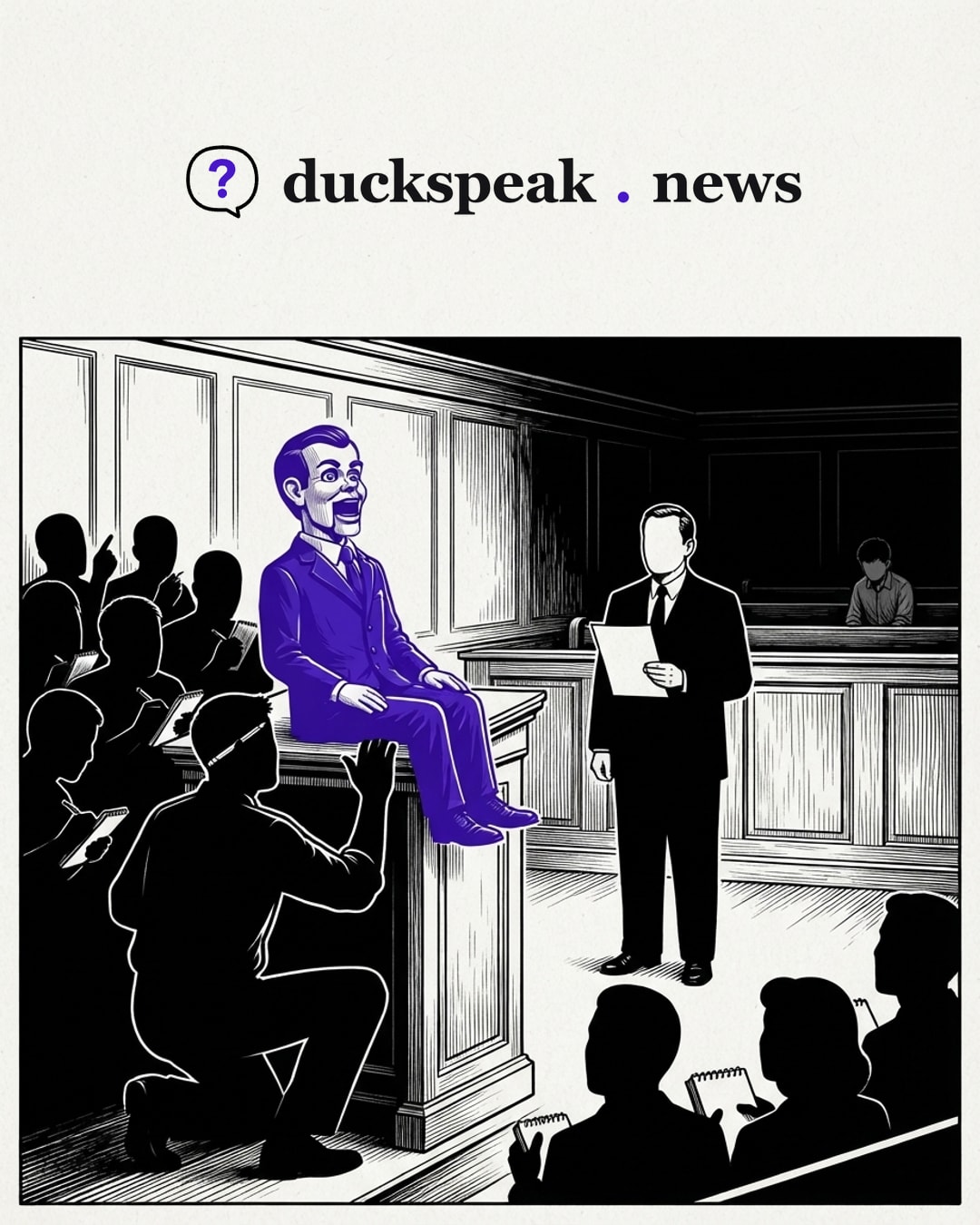
On Thursday a 24-year-old able seaman stood in the dock at Westminster Magistrates’ Court for a four-minute hearing, confirmed his details, and was remanded in custody [2]. By the time the story reached publication he had, in quotation marks, “used dark web to spy for Russia” [2]. Nobody in the story said that. The distance between those two sentences is this critique.
The punctuation that stopped quoting
The Crown Prosecution Service’s written summary, as quoted by two of the four outlets, alleges Teddy Young “engaged in activity consistent with preparing to pass protected information to a foreign power” [1][2]. Note the register: preparatory conduct, consistency, a foreign power not yet named. Now the headlines. The Guardian: “accused of spying for Russia” [4]. The BBC: “accused of preparing to spy for Russia” [1]. The Independent: charged with “spying for Russia” [3]. The Mirror: “used dark web to spy for Russia” [2], past tense, completed act. The phrase inside the Mirror’s quotation marks appears in no quoted statement in its own article, nor in any of the other three. The Independent’s body knows better, reporting a charge of spying for “a foreign power, understood to be Russia” [3]; its headline drops the hedge and keeps the spy. The bodies hedge; the headlines spend the hedge. In Orwell’s terms the quotation mark has been repurposed: it no longer means someone said this, it means we decline to stand behind this. The quotes in these headlines are not quotations; they are deniability.
One garment, four provenances
The BBC dressed him in a “grey police-issue sweatshirt” [1]. The Mirror: “grey sweatshirt and joggers” [2]. The Independent: “grey prison-issue tracksuit” [3]. The Guardian: “grey navy tracksuit” [4]. At most one provenance claim can be right, and no outlet tells you how it knows. The detail does no evidential work; its job is cinematic, putting you at the courtroom camera position. It is also a small controlled experiment in how pack texture mutates in transit. (The Guardian’s copy even garbles the basics, having Young confirm his “ate of birth” [4]; a tell about relay speed, not a substantive sin.) Huxley’s warning about detail as sensation rather than information applies: the sweatshirt is set design.
The original reporting is the least verified part
Strip out the official statements and what remains, each outlet’s own contribution, is exactly where the story inflates. The BBC, the most careful of the four, reports: “The BBC understands that the allegations against Young include translating a message into Russian and looking for a web portal that invited people to submit information to Russia” [1]. The Mirror’s version of the same allegation family: “using the dark web to try to make contact with Russian authorities” [2]. A man looking for a web portal became a man using the dark web; “translating a message” became, in the Mirror and the Guardian, “drafting a message in Russian containing classified information” [2][4]. The Guardian then supplies the defendant’s inner life, a message “that he hoped to pass on” [4]; hope is not in the CPS summary. The Mirror and Guardian both report that Young “abused his high-level security clearance” [2][4], their verb, delivered in the passive (“is alleged to have abused,” “was accused of abusing”), which attaches the outlet’s judgment to the official allegation. The Mirror’s “It is said he had drafted a message” [2] erases the sayer altogether. The pattern is consistent: the verified material is copied; the invented material is dramatized.
The timeline that does not close
Here the reader needs help and gets none. The Guardian reports Young “was first arrested in May last year. At that point he was suspended and relieved of his duties, and was on gardening leave until his latest arrest” [4]. The Mirror reports he “joined the Navy in April 2024” and that the alleged offences occurred on “his first deployment, which began on November 4 2024” [2]; the charge period runs from 26 November 2024 to 21 May 2025 [1][2][3][4]. If the suspension followed the May arrest and lasted until this week, then the warship deployment on which the alleged accessing happened sits inside the suspension. Either one account has a date wrong, or a suspended rating was deployed with high-level clearance, which would be a far bigger story than the sweatshirt. We flag this as a contradiction inside the coverage, not a claim about what happened; no outlet notices it, let alone resolves it.
Two charges, or three?
Early in its report the Mirror describes the second charge as “obtaining, accepting or retaining material benefit from a designated body” [2]. Later, the same article quotes the same charge as “obtained, copied, recorded or retained protected information, intending the conduct to benefit a foreign power” [2]. The BBC, Independent and Guardian all report the second formulation [1][3][4]. The Mirror contradicts itself within a single article and gives the reader no way to tell which is the charge. Credit where due, though: the Mirror alone quotes the charge’s full language, including the “ought reasonably to have known” standard [2], and alone reports that no plea was entered at the four-minute hearing [2]. The Guardian alone carries the judge’s actual bail reasoning [4]. The substance exists in this coverage; it is just distributed so that no reader of any single outlet gets all of it.
Duckspeak, then the till
The Royal Navy’s statement appears word for word in all four outlets: “As legal proceedings are ongoing, it would be inappropriate to comment further at this stage” [1][2][3][4]. Commander Helen Flanagan’s statement runs in three of them [1][3][4]. At a first hearing, relaying official text is defensible; Orwell named the practice of quacking official phrasing without engaging the higher brain centres “duckspeak,” and on Thursday four newsrooms quacked in unison. The trouble is the division of labor it exposes. The one official line asking for restraint survives only in the Independent’s copy of the Flanagan statement: “It is important now that any further speculation on this case is avoided” [3]. The Mirror’s headline is precisely that speculation, wrapped in punctuation that makes it officially unsayable. Then Huxley closes the loop: the Mirror’s report ends with “Choose Daily Mirror as a ‘Preferred Source’ on Google News” and a notice about cookies and personalised advertising [2]. A story about the alleged mishandling of sensitive data, monetised with a data-collection notice. The thriller is the product; the defendant is the content.
What a reader would need instead
- The full CPS written summary rather than fragments; all four quote pieces of it and none presents the whole.
- The charge sheet language, quoted most fully by the Mirror [2], and the National Security Act 2023 itself, public and readable on legislation.gov.uk, so a reader can see what “conduct in preparation for” an offence requires before deciding a man “spied.”
- The procedural facts that temper the thriller: no plea taken, a four-minute hearing [2], next appearance at the Old Bailey on 16 October [1][2][3][4], and public court listings to follow it.
- A reconciliation of the arrest, suspension and deployment timeline [2][4] before the Old Bailey hearing, from any of the four, since none has noticed the problem.
- The full Flanagan statement [3], anti-speculation line included, given the circulation the sweatshirt got.
The CPS said “preparing to pass.” Four newsrooms sold “spied.” The gap between those two sentences is where this story actually lives.