

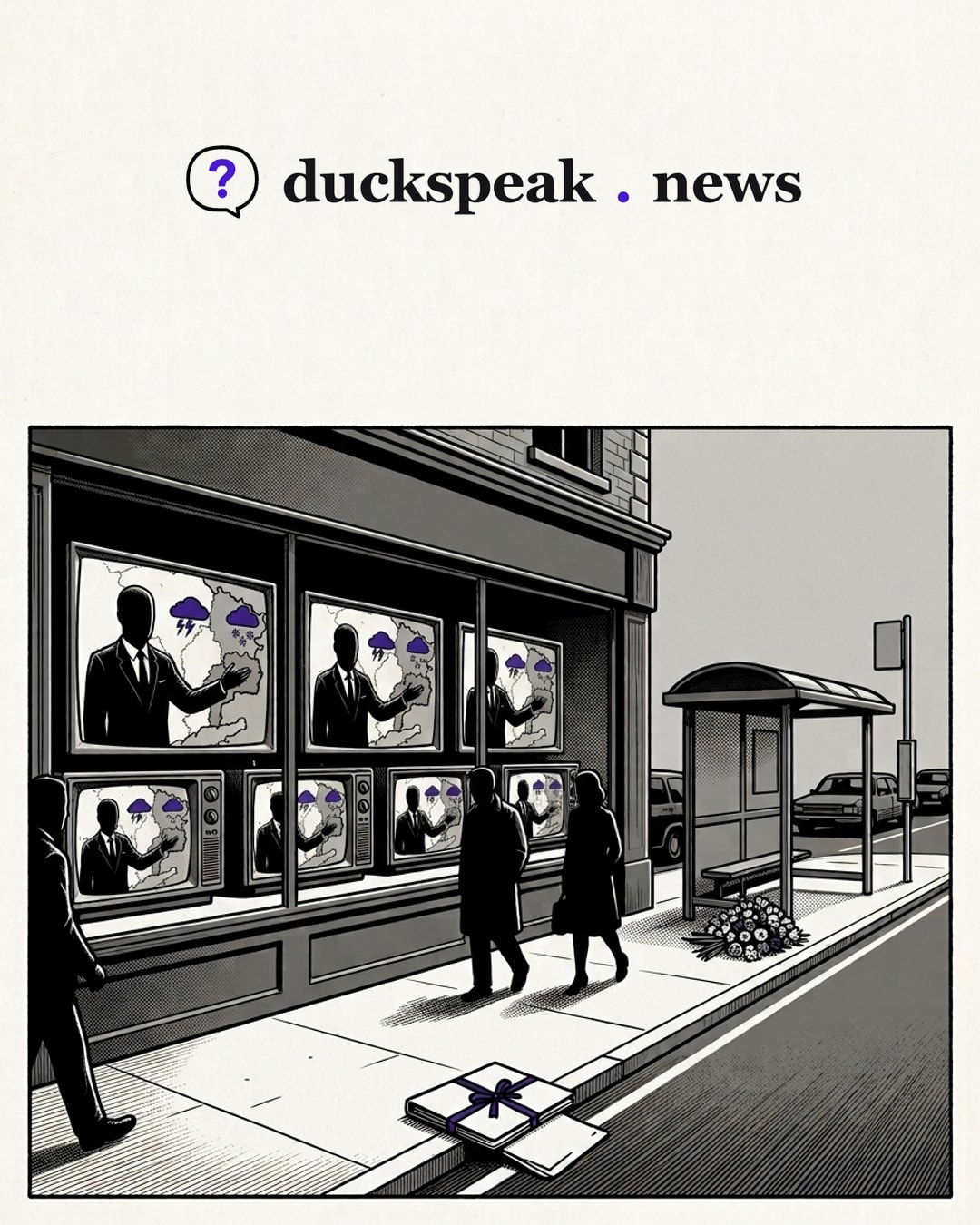
On the morning of October 8, a Russian glide bomb hit two buses on a street in Kramatorsk, killing at least 30 people and wounding 18 more [7][4]. By evening, seven outlets across three countries had filed on it. Read together, their coverage shows a story being processed into background: a massacre rendered as season, as gauge reading, as the latest link in a chain of “responses,” while the day’s legal facts fall out of the text.
One text, seven stamps
Start with the finding a repetition dashboard would flag first: NPR and The Independent published the same sentences, in the same order, on the same day. “Russia and Ukraine are locked in a long-range aerial war while their armies remain largely deadlocked on the front line, more than 4 1/2 years since Moscow’s full-scale invasion” [2][3]. Then the same DTEK paragraph on emergency power outages, lightly re-punctuated; the same sentence about specialists defusing “two more unexploded ballistic missile warheads, each weighing about half a ton”; the same line about drones striking Kyiv’s Obolonskyi and Desnianskyi districts; and the same ritual shrug on the Salavat refinery claim, “The claim could not be independently verified” [2][3].
Whether this is shared agency copy or syndication we cannot prove from the text, and we flag that as inference; what is not inference is that it is the same text. The consequence is structural. The reader who checks a second outlet receives the same sentences under a different masthead. Repetition masquerades as verification, which is the Huxleyan half of the problem: you can consume seven reports and be informed exactly once, while feeling cross-checked six times over.
The massacre as meteorology
The frame the shared text reaches for is seasonal. NPR and The Independent both call it “an intensive pre-winter wave of attacks” [2][3]. NPR’s headline pairs the bus strike with infrastructure weather: “Strike on Ukrainian public bus leaves 30 dead as blackouts worsen in Kyiv” [2]. Both outlets point readers toward “expected prolonged winter blackouts” [2][3], a phrase in which engineered deprivation is a forecast, like snow. NBC has “Moscow’s intensifying attacks grow ever more deadly” and casualties that “have surged” [4]; BBC has “a dramatic surge in Russian attacks” [7].
Weather has no agent and no docket. Yet the intent evidence sits inside the same articles. CBS carries Zelensky’s claim of documents showing Russian forces are permitted “to attack in the cities, in the villages, everywhere, roads, schools, hospitals,” in order “to pressure people to leave the capital, leave different cities. This is the goal of the operation” [1]. BBC reports Kramatorsk and Slovyansk are “part of a so-called fortress belt that Moscow is trying to seize,” and that the Kremlin aims to capture the remaining 20 percent of Donetsk [7]. The outlets have strategy on the page and season in the frame. That is the Orwellian move: “intensify,” “surge,” “escalate” are verbs that need no subject, and a massacre described only by its rate of change stops being anyone’s decision.
The euphemism at the scene
The phrase doing the heaviest lifting is administrative. Filashkin suspended public transport citing “the sharp deterioration of the security situation” [4]; NPR has “the sharp deterioration in security” [2]; RFI renders it as “la nette détérioration de la situation sécuritaire” (the sharp deterioration in the security situation) [6]. Thirty commuters killed at a morning bus stop becomes a reading on an administrative gauge. The outlets quote the phrase as explanation, never translating it back into the event it describes. This is Newspeak’s core function: a formulation built so that bodies on a road beside “the charred, twisted metal shells of destroyed vehicles” [1] never have to be connected to the policy that produced them.
The “response” that dissolves the sequence
France Info’s headline promises Zelensky’s “une réponse ferme” (a firm response) [5]. Its subheading then performs a quiet sequencing trick: “Moscou entend ‘intensifier’ ses frappes sur l’Ukraine après que Volodymyr Zelensky a dit vouloir renforcer les attaques contre les raffineries russes” (Moscow intends to “intensify” its strikes on Ukraine after Volodymyr Zelensky said he wanted to strengthen attacks against Russian refineries) [5]. We flag this as a framing observation, not a claim about editorial intent; but the word “after” does causal work while asserting nothing, inviting the reader to hear the day’s civilian deaths as a reply to a Ukrainian policy announcement. The same day’s coverage reports Ukrainian strikes on refineries in Omsk [1] and Salavat [2][3] and on a Yandex data center [2][3][7], and the loop closes: every strike is a “response” to a previous strike, and in an infinite chain of responses nobody ever acts first. The outlets’ own details break that symmetry. The Kramatorsk location was, in the city council’s words, one “where there are absolutely no military targets” [7], while the Omsk refinery, per Ukraine’s military, “was supplying fuel to Russia’s forces” [1]. The tit-for-tat ledger is a frame, not a fact. Rubio’s “impasse” [6] and Zelensky’s “diplomatic stalemate” [4] belong to the same family: a war rendered as a chess problem, though the shared boilerplate sentence does at least date the lock to “Moscow’s full-scale invasion” [2][3].
What fell out of the story
The sharpest omissions are legal. RFI alone reports that the Donetsk regional prosecutor opened a preliminary investigation for “crime de guerre,” war crime [6]. No English-language outlet in this set carries it, though The Independent quotes UK Foreign Secretary Miliband saying “when you target civilians, it is war crimes” [3]. BBC alone cites the UN figure that more civilians were killed by August this year than in all of 2025 [7]. So the accountability frame exists in the day’s material and mostly does not make the cut, while “Moscow has repeatedly denied that it deliberately targets civilians” [4] rides again as punctuation. CBS, to its credit, juxtaposes the denial with “regular attacks on residential buildings throughout the war” [1].
Two smaller drops, both telling. CBS’s headline calls the weapon a “guided missile” while its own body calls it a “guided bomb” [1]; BBC explains glide bombs are fitted with winglets so they glide toward the target rather than simply fall [7], a different class from the ballistic missiles at issue in the day’s policy talk of “anti-ballistic capabilities” and “interceptors” [2][4] and BBC’s note that “interceptor missiles are in short supply” [7]. No outlet notes the mismatch between the remedy requested and the weapon that killed the commuters; we flag that as our observation of a gap, not a claim about motives. And the Pryluky wounded count drifts between “at least 50” [1] and 54 [2][3][6], uncorrected and unexplained.
What a reader would need instead
- The UN Human Rights Monitoring Mission in Ukraine’s casualty series, the yardstick BBC cites once [7], so deaths are counted against a record rather than against a season.
- The prosecutor’s war-crimes investigation [6], carried as the story’s legal spine rather than as one French outlet’s detail; atrocity with a docket is a different genre from atrocity as weather.
- The weapon taxonomy: glide bomb versus ballistic missile, because the remedies differ, and a headline that says “missile” while its own body says “bomb” [1] is not a rounding error.
- The primary record: Zelensky’s posts [4][5], the prosecutors’ images [7], Filashkin’s transport decision [4], read directly rather than through the shared paragraph.
- A habit of noticing when “both sides” symmetry [7] and “locked in” boilerplate [2][3] are doing the framing; the invasion date sits in the same sentence for a reason.
- Credit where due: BBC is the strongest of the seven, with the UN figure, the “so-called fortress belt,” and scare quotes on “liberation” plus an explicit rebuttal [7]. The critique here is of the spread, and of what the spread repeats, not of every masthead equally.