

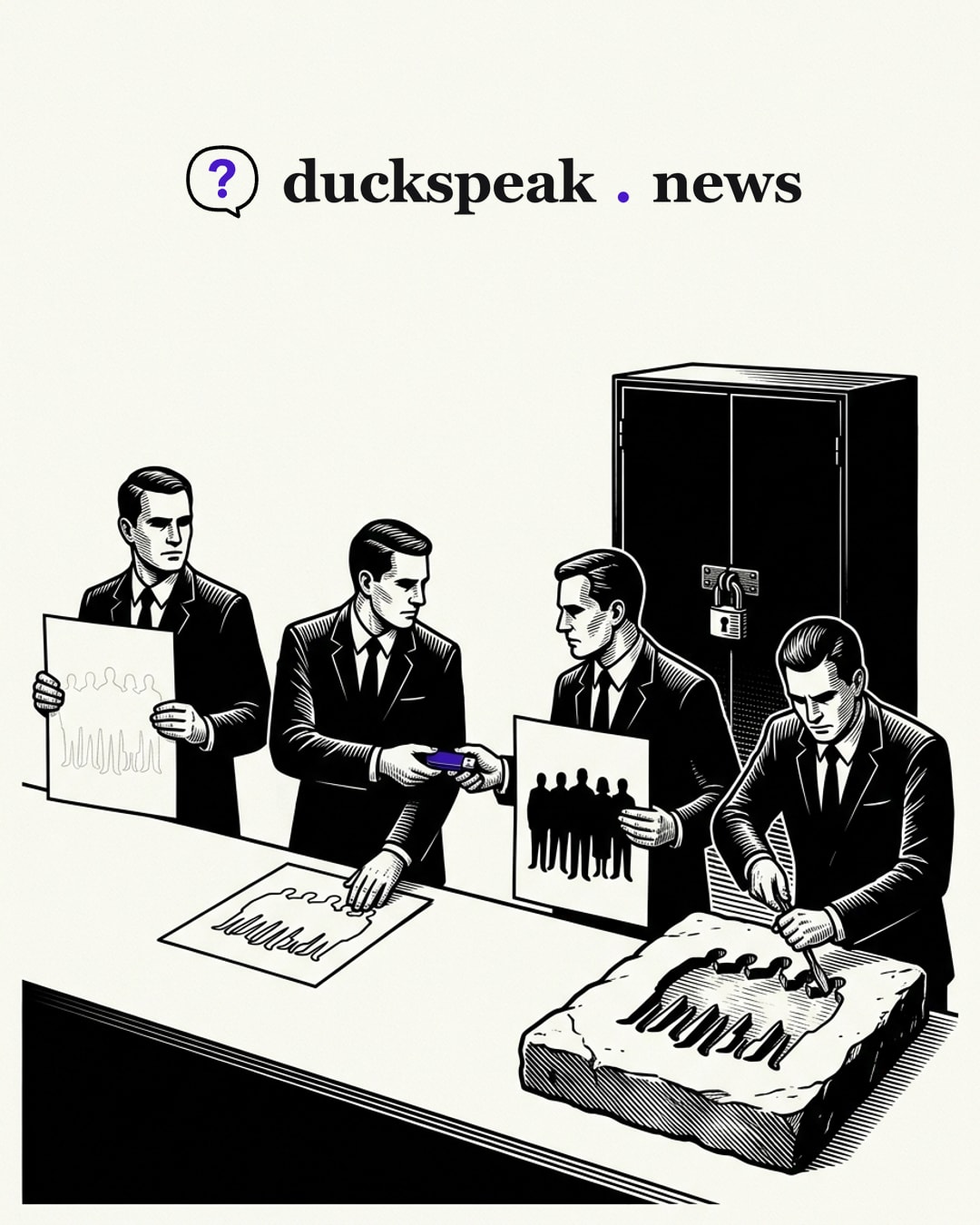
A list that hardens as it travels
The core object in this story is a password-protected thumb drive. The Justice Department says it holds names of people it “believes are likely noncitizens who were sent a vote-by-mail ballot,” in the words of the letter as quoted by NBC [2]. That is a layered hedge: believes, likely, noncitizens. Watch what happens to it.
AP says “what it says are noncitizens believed to have received mail ballots” [1]. CBS says people the government “believes may have received mail-in ballots… despite not being U.S. citizens” [3]. By the New York Post, the hedge has curdled into a number and a noun: “roughly 20,000 suspected noncitizen voters” in the headline, and “approximately 20,000 likely noncitizens who received mail-in ballots” in the text [4]. The Post attributes this to “federal officials” [4]; the other three articles that describe the list do not give a count [1][2][3]. ABC says only “thousands of names” [5]. We cannot tell from the coverage whether 20,000 is a verified DOJ figure; it is at least unconfirmed in the other coverage.
This is the Newspeak move: a probabilistic guess is compressed into a classification (“noncitizen voters”), and the classification then carries the emotional weight of a crime. Note the Post’s headline calls them “voters,” though the DOJ’s own stated aim is to determine whether they are citizens at all [3].
Verbs that do the government’s work
The Post describes the DOJ as having “fired a warning shot,” in a “blistering letter,” delivering an “even more ominous warning” in a “bitter voting showdown” [4]. This is theatre language that frames the department as a combatant and the story as a spectacle, not a legal dispute about process. It also reproduces the DOJ’s framing that California “refused” [4], when the Post itself reports the dispute began with a 48-hour review deadline, and the lawsuit followed one day after that lapsed [4]. A county clerk quoted by AP called that deadline “completely unreasonable,” saying it “would take more than 48 hours to even begin to get the full picture” [1]. The Post gives election officials no such voice; its only California response is Weber saying no evidence was provided [4].
Meanwhile, the DOJ spokesperson’s line, “This should not be controversial,” is quoted by NBC without rebuttal at that point in the text [2]. That is a pre-emptive closing of debate, and a faithful quote is not the same as a check on it.
The shifting denominators
Context about rarity is where the outlets diverge most, and the numbers do not line up:
- AP: about 90 people charged this year, 50 for alleged noncitizen voting, against “more than 227 million registered voters” in 2024 [1].
- NBC: “over 100 cases” involving noncitizen voting, against “more than 154 million people” who voted [2].
- CBS: “more than 100 people” charged with “voter fraud-related crimes,” against “about 174 million people registered” [3].
Some of these are different quantities (registered versus voted; charged this year versus since inauguration; noncitizen voting versus broader fraud), and the outlets do not always say so. A reader could reasonably wonder why the registered-voter figure is 227 million in one place and 174 million in another. We cannot resolve this from the articles alone; the Census and Election Assistance Commission figures would settle it. The point: unlabeled numerators and denominators let “rare” feel either vivid or vanishing depending on the outlet.
What the better coverage does, and what’s still missing
AP and CBS supply the most useful tests of the list’s reliability. AP notes Nevada’s claim of 1,500 noncitizens “turned out to be zero” after identification, and that DHS’s database “has been criticized as inaccurately flagging U.S. citizens” [1]. The Post includes the Nevada figure too [4]. CBS reports the DOJ “has lost 26 of those cases, and has not achieved one legal victory to date” in its voter-roll suits [3], while AP says it has “so far… lost those cases” [1]. CBS also notes the DOJ acknowledged it intends to share data with DHS for screening [3], which matters for how the list was built. AP says the clerk questioned how the federal government produced the list without access to the state’s detailed voter data [1]. None of the articles tells us the method behind the thumb-drive list. That is the central omission.
There is also a minor chronology wobble worth flagging: AP says the letter was sent Tuesday [1]; CBS dates it Oct. 13 [3]; NBC gives a noon Thursday deadline [2]; ABC and the Post report a Friday letter and a Thursday lawsuit [4][5]. These may be separate letters, but the outlets do not always make that clear.
Several sources also carry a second story: officials and a Brennan Center expert say the moves look like “groundwork for post-election challenges” [2][5]. That is attributed opinion, and it is presented as such. ABC’s “personal fixation” [5] and the Post’s “crusade” [4] are the outlets’ own characterizations, pointing in opposite rhetorical directions; both are editorializing in a news voice.
The Orwell and Huxley angle
Orwell: “likely noncitizen” is a category engineered so that a list can substitute for a finding. Once “suspected” becomes a noun, the burden shifts to the state to disprove it in 48 hours. Huxley: the dazzle of escalation (warning shots, jail posts, lawsuits within a day) crowds out the dull question of how the list was made.
What a reader would need instead
- The method and source of the thumb-drive list, and any error rate for the DHS database cited by AP [1].
- Whether 20,000 is an official DOJ figure or the Post’s rendering [4].
- Consistent, labeled denominators (registered, voted, charged, convicted).
- Court filings, not letters relayed by news outlets, as the basis of the story.
- Election officials’ views in every account, as AP and ABC provide [1][5], not just in some.