

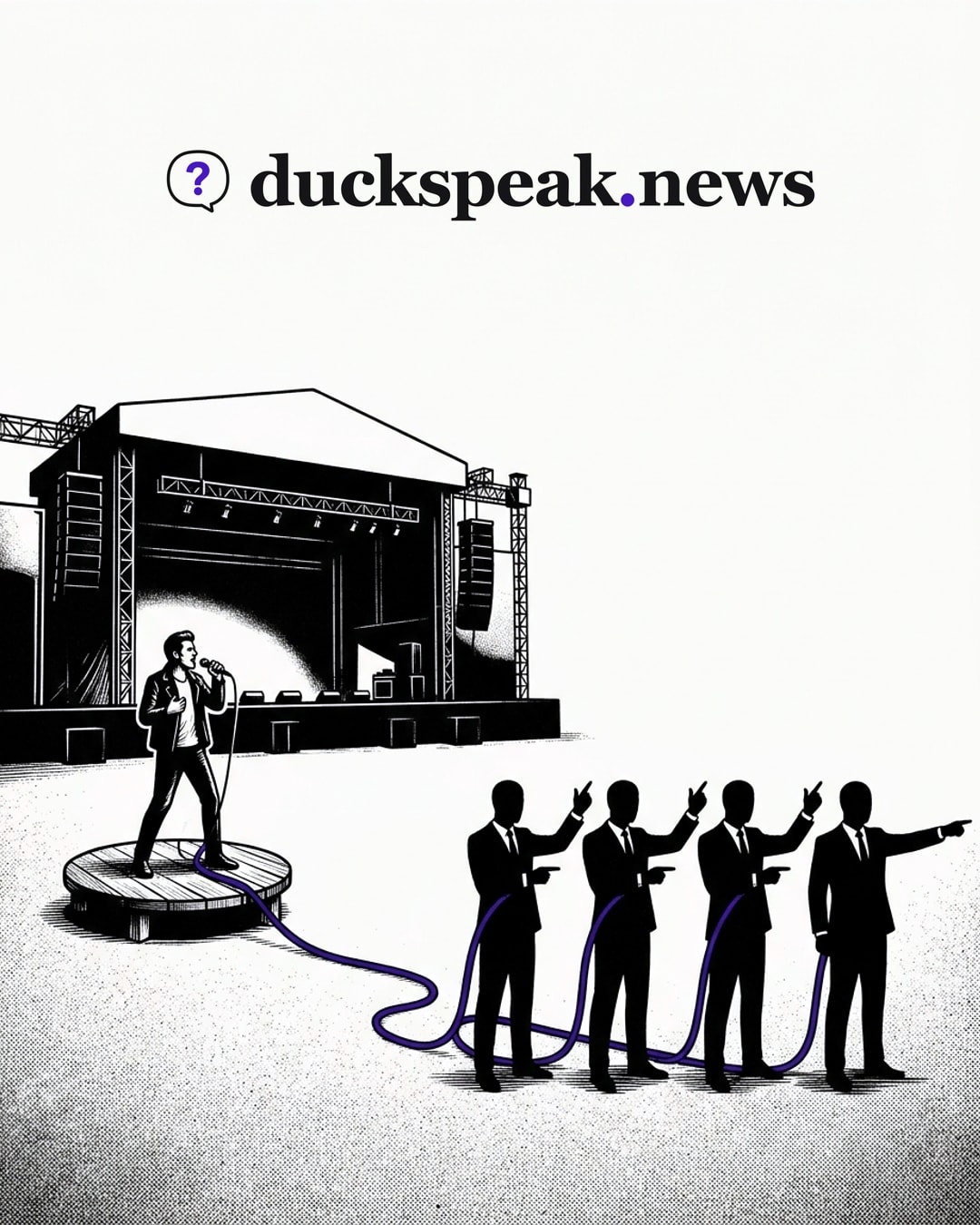
Every account of this Dublin concert has to answer one small question before it can describe the show: why was Macklemore on his own stage? The four outlets answer it in four different grammars. Two of them never say who did the removing, one names a culprit in its own voice, and one imports an accusation from a third newspaper.
A removal with no remover
France Info’s short report says the rapper “avait été écarté des dates américaines d’Ed Sheeran”Agentless passiveThe agentless passive is a sentence built so the action happens with no one doing it. (had been dropped from Ed Sheeran’s American dates) [1]. The headline’s “éviction” (eviction) and the lead’s “évincé” (evicted) work the same way [1]. Someone acted, but the sentence is built so that nobody did. The next paragraph reports that Sheeran said the decision came “pas de lui mais des organisateurs” (not from him but from the organisers) [1]. The organisers are never named, and neither are venues, owners or any other party.
The agentless passive is a sentence built so the action happens with no one doing it.
The reader is left with an event that simply happened to Macklemore. The article also supplies its own reason: he was removed “pour des commentaires de soutien aux Palestiniens” (for comments in support of Palestinians) [1]. That is the outlet’s gloss, not a quoted explanation from anyone who took the decision. Variety’s account is different. It says the promoter claimed it had been “notified by venues” that “they will not allow a concert to take place with Macklemore on the lineup” [4].
The chain, when you assemble it
Put the four sources together and a chain appears. According to Variety, Messina Touring Group says venues refused [4]. GB News says Sheeran attributes the decision to Messina, not himself [3]. Macklemore says Robert Kraft pushed him out [4], or in GB News’s wording that stadium owners coordinated [3]. Each party points one step along the chain, and no single outlet lays it out whole. A reader of France Info alone sees none of it. Responsibility ends up spread so thinly that it can’t be located.
The sources also disagree on small points. Variety calls Kraft the owner of Gillette Stadium [4], the Guardian the owner of the New England Patriots [2], and GB News a “billionaire venue owner” [3]. None of them says whether Kraft has responded to the claim that he pushed for the removal. GB News does report that Kraft “alleged the rapper had engaged in hate speech and antisemitic rhetoric” [3], but gives no date, no quote and no venue for it. Variety does not mention it. So we can’t tell from these texts whether it is a reply, a pretext or both.
The outlet that picks the culprit
The Guardian settles the question in its own voice: the night was “perhaps not what Robert Kraft, the billionaire owner of the New England Patriots, had in mind when he led efforts to pressurise Sheeran to remove MacklemoreUnsourced motive attributionUnsourced motive attribution is a news text stating what an institution or government 'wants', 'fears' or 'seeks' as plain fact, with no official, document or source behind the intention, so the reporter's hypothesis reads as a finding.” [2]. Two things happen in that clause. First, an intention is assigned (“had in mind”) with no source. Second, “led efforts to pressurise” is stated as established fact. Variety and GB News both present the same claim as Macklemore’s: he “claimed” it [4], he “accused” [3]. Elsewhere the review also says Sheeran’s tour “limped on amid much opprobrium” [2], again without a source for how it was received.
The Guardian may well have grounds for its confidence. The review does not show them, and a reader who has seen the other accounts will notice that a contested allegation has moved from the rapper’s mouth into the paper’s narration.
The review that grades the cause
Reviews are expected to give verdicts, and this one does: the show is “a triumph” in its headline [2]. The closing line goes further, saying the night “feels like a worthwhile triumphVerdict adjectivesVerdict adjectives (credible, serious, responsible) deliver a political conclusion while presenting themselves as neutral description.” [2]. “Triumph” can be about performance. “Worthwhile” is a judgment about what the evening was for, and it reads as neutral description of a concert. The piece also tells us nobody was “rocking up in order to grab brownie points or reflected glory” [2], which is a claim about the motives of every guest, again with no source. A reader is invited to treat the cause and the quality of the show as one measurement.
Variety’s headline does a gentler version of this. It says Macklemore “Calls for Unity” [4]. That is the speaker’s self-description (“Not against anybody, not divisive” [4]), adopted as the outlet’s summary of a speech that also promises to “fight for collective liberation until our last breath” [4].
The outlet that adds a suspect
GB News ends with a different thread. Dozens of peers have urged the Home Secretary to “ban” Macklemore from entering the UK, it says, citing the Telegraph, over a recipient group’s “record of glorifying terrorism and of intimidating elected representatives” [3]. The quotation comes second-hand, and the article does not say whether any of it has been checked. Nor does it say what the group would receive from the tour. The page also carries a teaser about “pro-Palestine artists profiting from Ed Sheeran tour fallout” [3]. That sits oddly beside the article’s own statement that all proceeds are going to aid organisations [3], and beside Variety’s report that Macklemore donated his $1 million salary from Sheeran’s tour [4]. The teaser is not the article, but readers see the two together.
What a reader would need instead
5 checks to run on the next story like this one.
-
The removal, with names. The reader needs the removal described once, with names. Who told whom, and when?
-
The primary documents. Messina’s statement, the venues it refers to, Sheeran’s own statement and Kraft’s reply are all primary documents that these articles paraphrase and do not link.
Gap in the coverage
-
An owner for every claim. Every claim of pressure should carry its owner, whether Macklemore, the promoter or the paper.
-
Music or message. A review’s praise should say whether it is judging the music or the message.
-
Evidence behind the ban call. A call for a ban should come with the evidence for the accusation, not just the peers’ words.
Gap in the coverage
The four texts agree on the basics: the date, the guests, the sell-out. They disagree on how the removal happened and who is accountable, and that is the question the concert’s own backstory turns on.