

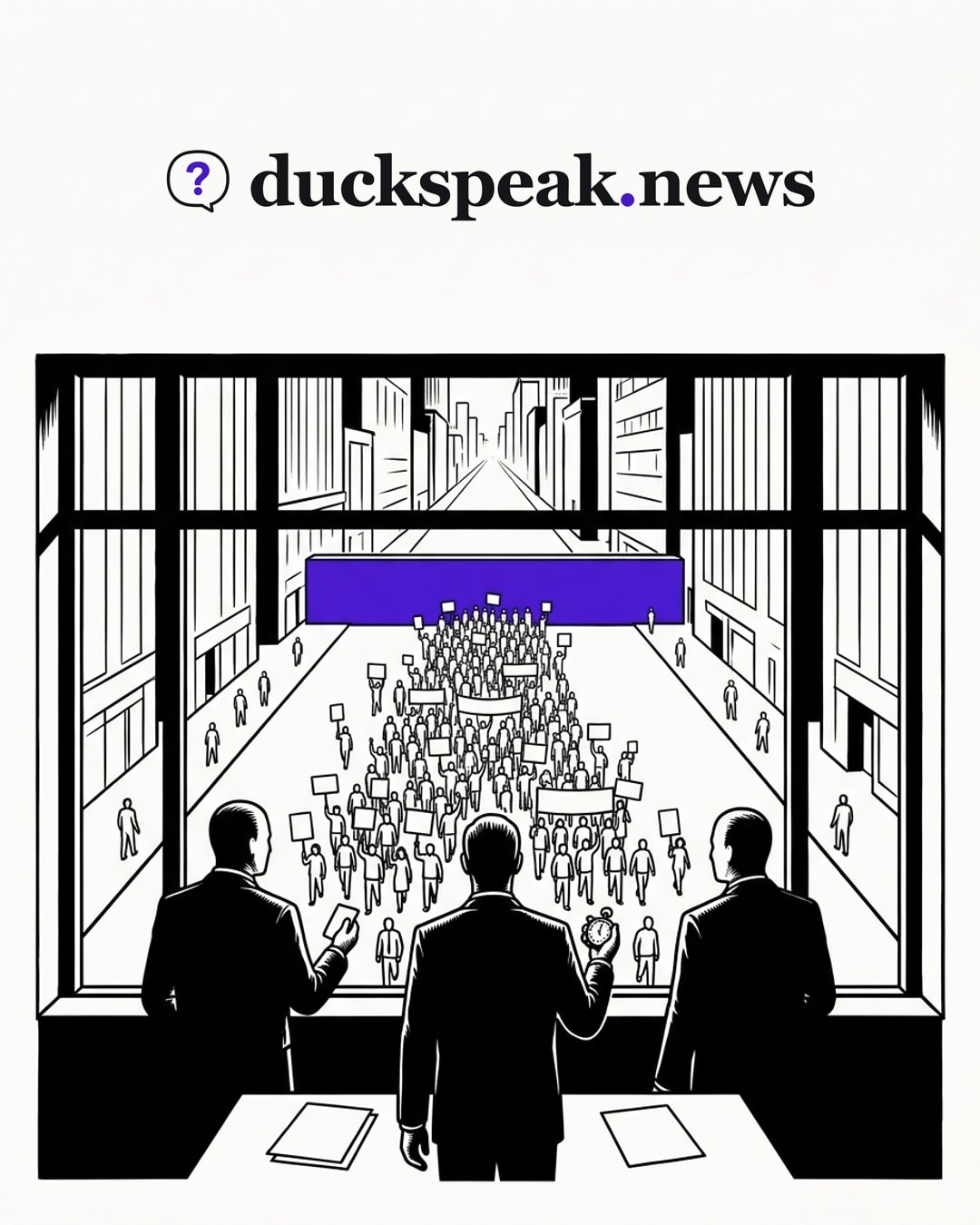
A social crisis told as a survival forecast
France Info’s headline asks the question that shapes the whole article: does the Lecornu government have “encore des marges de manœuvre pour répondre à la crise sociale ?” (any room left to manoeuvre in responding to the social crisis?) [2]. The rest of the piece stays with the executive’s point of view. For the government, the day looks “à haut risque”Horse-race framingHorse-race framing reports a policy fight as a contest, with battles, winners, flinches and bounces, so the reader learns who is ahead and never what the deal, the budget or the plan actually contains. (high-risk) [2], and a subheading asks whether to “Faire un geste ‘pour survivre’ ?” (Make a gesture “to survive”?) [2]. An adviser talks of offering the unions “un trophée, une victoire politique” (a trophy, a political victory) [2]. This horse-race framing tells the reader who might fall, and when. It says almost nothing about what the demands listed in the first paragraph would cost (higher wages, higher pensions, a higher public-sector pay index) or who would pay for them. Every figure in the article serves the government’s constraints: 43 billion in savings, a deficit at 5%, slowing growth [2]. The only figure attached to a demand is the possible “coup de pouce” (boost) to the minimum wage, “environ 22 euros net par mois” (about 22 euros net per month) [2], and it comes from a measure the government is considering, not from a union demand.
The voices follow the same slope. The article quotes “un ministre” (a minister), “un député macroniste” (a Macronist MP), “un autre député du bloc central” (another MP from the centrist bloc), “l’entourage d’Emmanuel Macron” (Emmanuel Macron’s entourage), “un conseiller de l’exécutif” (an adviser to the executive), “un conseiller du pouvoir” (an adviser to those in power), “une source au fait des tractations” (a source familiar with the negotiations) and “un élu macroniste” (a Macronist elected official) [2]. Eight voices of power speak without a name; no trade unionist speaks. The opposition gets names (Eric Coquerel, Fabien Roussel, Matthias Renault) [2], but nobody from the union front calling the strike is quoted, in an article that asks how to “répondre” (respond) to it.
“Grogne”, “colère”, “pression de la rue” (grumbling, anger, pressure from the street)
The same article names the protest as a mood that needs to come down: “la persistance de la grogne sociale” (the persistence of social grumbling), “La colère ne retombe toujours pas” (The anger still isn’t subsiding), “faire retomber la pression de la rue” (to ease the pressure from the street) [2]. A Macronist official concludes: “Rien ne la calmera” (Nothing will calm it) [2]. A list of demands can be negotiated; grumbling is something you calm down or wait out. This vocabulary has no glossary entry of its own, but it is easy to spot: an emotion word takes the place of a demand that could be costed. RFI also writes that “la grogne n’a fait que grandir” (the grumbling has only grown) [5], but it immediately lists what the grumbling is about: wages, the minimum wage, public services, tax justice, the freedom to demonstrate [5]. At RFI, then, the word does not replace the content.
Beauvau’s tally, with no second source
France Info’s report after the day [4] fairly gives both counts in its headline. Its second half, however, relies on the interior ministry alone, under a subheading that reads “Des tensions signalées”Agentless passiveThe agentless passive is a sentence built so the action happens with no one doing it. (Tensions reported) [4]. Reported by whom? By Beauvau (the interior ministry) and no one else, but the agentless passive turns one party’s statement into an observation. The reader learns of “448 interpellations” (448 arrests) and “53 membres des forces de l’ordre blessés” (53 members of the security forces injured) [4], and nothing about injured demonstrators: no figure, and no sentence saying the figure is missing. Yet RFI shows that another source existed that same day: “Des journalistes de l’AFP ont constaté de leur côté des tirs de gaz lacrymogènes, des charges et des coups de matraque, ainsi que la prise en charge de plusieurs blessures à la tête par des street medic” (AFP journalists, for their part, saw tear gas fired, charges and baton blows, and street medics treating several head injuries) [5].
The agentless passive is a sentence built so the action happens with no one doing it.
RFI has agentless sentences of its own, though. “Au total, 70 000 policiers et gendarmes ont été mobilisés” (In total, 70,000 police officers and gendarmes were deployed) [5]: the article does not say who decided this. Boulevard Voltaire is the “seul passage autorisé aux manifestants” (only route authorised for demonstrators) [5], after “la justice a finalement rejeté le recours de l’intersyndicale contre l’interdiction” (the courts finally rejected the union front’s appeal against the ban) [5]: we know who ruled, not who banned. Earlier, shopkeepers are “échaudés par les violences du 17 octobre” (wary after the violence of 17 October) [5], with no word on whose violence it was, although elsewhere the article speaks of “violences policières” (police violence) [5]. So the same word covers both property damage and baton blows, and the sentence leaves the reader to pick.
City centres “interdits” (banned), with no one doing the banning
The ministry accuses groups of trying “de pénétrer dans les périmètres interditsPresuppositionPresupposition embeds a huge, unstated fact as an assumed background detail instead of reporting it, so the question of how we got here becomes structurally impossible to ask. et notamment dans les centres-villes” (to get into the banned zones, especially the city centres) [4]. France Info quotes the sentence with no context, so the bans look like a settled fact, when they were the contested decision of the week. This is a presupposition: the reader of [4] cannot ask who closed the centres, or whether that was legitimate, because the question does not exist in the text.
France-Soir shows what this backdrop hides. In Toulouse, the prefect, Fabrice Rigoulet-Roze, issued an order barring the march from the city centre; the prefecture had warned “que la manifestation serait interdite tout court si ce tracé était refusé” (that the demonstration would be banned outright if this route were refused); his chief of staff told the judge about “le risque de voir des éléments anarchistes et d’ultragauche s’infiltrer” (the risk of anarchist and far-left elements infiltrating) [3]. Every verb has an author. The Guardian reports that Sophie Binet criticised “decisions by authorities in cities such as Rennes, Toulouse and Lyon to push demonstrations out of city centres” [6]. In [4], Toulouse exists only as the scene of “des incidents extrêmement violents” (extremely violent incidents) [4], a ministry phrase that nothing in the article spells out. None of the sources says whether these incidents had anything to do with the contested route. France-Soir dwells on the question (“Reste à savoir comment les forces de l’ordre accueilleront […] un cortège déclaré en bonne et due forme mais engagé sur un itinéraire désormais proscrit” (It remains to be seen how the security forces will greet […] a march properly declared but set on a route that is now prohibited) [3]); France Info never asks it.
Where the coverage holds back is with the hard words, which stay inside quotation marks on both sides: “l’autoritarisme” (authoritarianism) is attributed to the trade unionist Cédric Caubère [3], “authoritarian shift” to the Ligue des droits de l’homme [6], and “militants radicaux et d’ultra-gauche” (radical and far-left activists) to the ministry [4]. On this point the newsrooms take up neither camp’s language. Still, The Guardian’s headline, “France braces for day of strike action” [6], treats the strike like a storm on the forecast.
What a reader would need instead
4 checks to run on the next story like this one.
-
In an article about the government’s “réponse” (response), the named voices of the people it is responding to: the union front, with the estimated cost of its demands set next to the 43 billion in savings [2].
-
For each closed city centre, who made the decision, and the order itself. Prefectoral orders are published in each prefecture’s recueil des actes administratifs (register of administrative acts); France-Soir shows that the prefect can be named [3].
-
An injury count that doesn’t stop at the security forces, or at least a sentence saying that no one publishes one. The Défenseur des droits (France’s rights ombudsman) takes complaints about the conduct of the security forces, and the AFP observations cited by RFI [5] show that witnesses existed.
Gap in the coverage
-
Recent data on union membership among young people, which is central to the debate on “convergence” between the movements. The only official rate cited, 2.7% among the under-30s, dates from 2019 [1].
Gap in the coverage