

A war that acts on its own
Burnham’s answer, quoted almost word for word by three of the four outlets, treats the two wars differently. One is “the conflict in Ukraine started by Russia” [3]. The other is just “the conflict in the Middle East” [3]. The coverage keeps that split. PBS, carrying AP copy, says Ukraine faces “a war that Russia started with its full-scale invasion in 2022” [2], and the Mirror calls it a “barbaric invasion” [4]. So the Ukraine war has a starter, a date and a method.
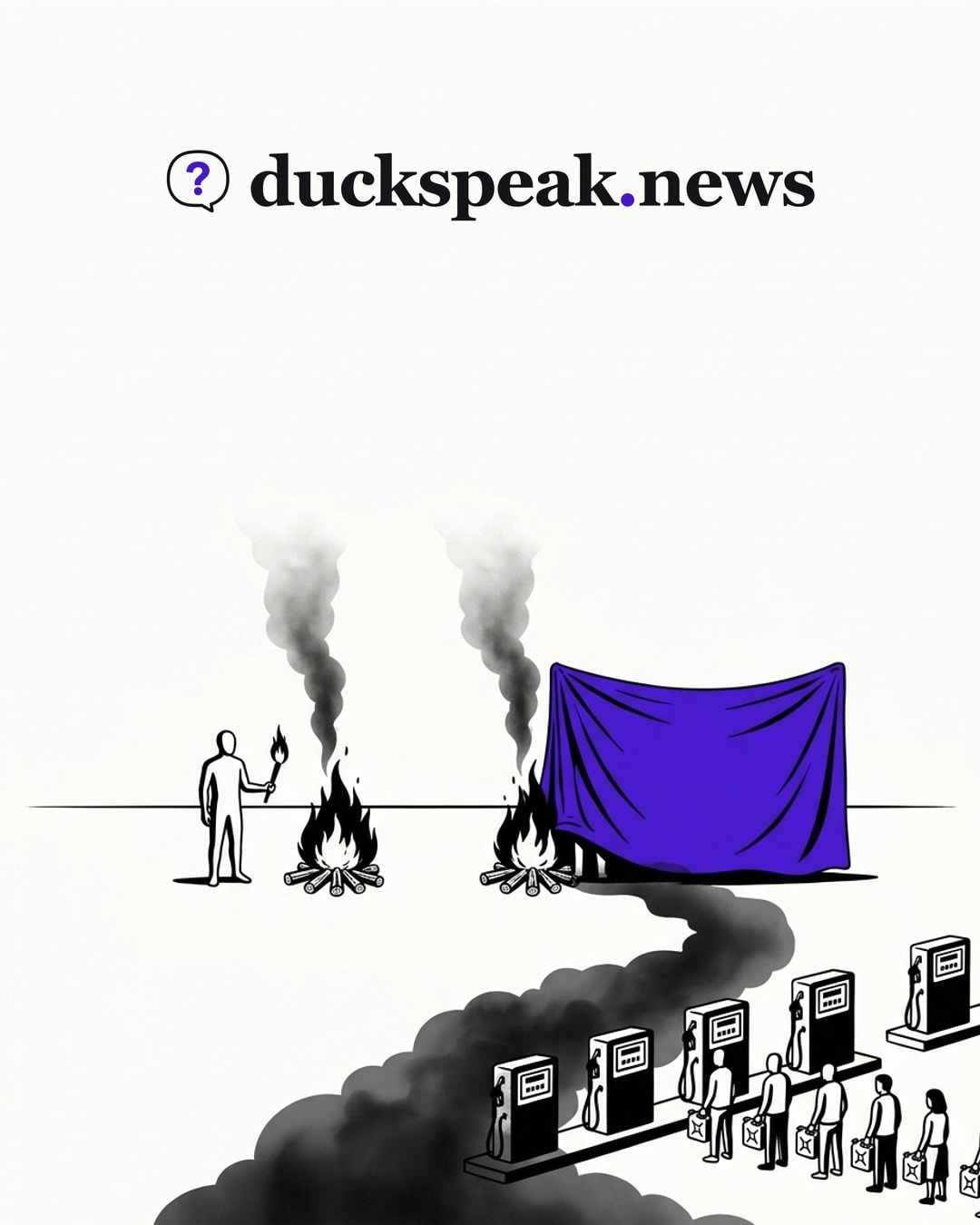
The Iran war is written as an earlier event that now does things to people. PBS refers to “the Iran war, which has sent fuel prices soaringPresuppositionPresupposition embeds a huge, unstated fact as an assumed background detail instead of reporting it, so the question of how we got here becomes structurally impossible to ask.” [2]. The Mirror has “the Iran war that has rocked economies around the world” [4]. The Independent writes that “The unpopular war in Iran has caused gas prices in the US and globally to skyrocket” [3]. The BBC talks about “the consequences of a foreign war the type of which he had originally promised to avoid” [1]. This is presupposition. The reader gets the war’s effects at the pump but nothing on how it started, who decided it, when, or under what authority. The only hint of agency is in the Independent, which says in passing that Trump “has no regrets over launching the conflict” [3]. None of the four articles says when the war began or what its goals are. Russia’s war has a starter; the Iran war, in all four texts, mostly has consequences. When you read “the war has caused” or “has sent prices soaring”, look for the sentence that says who did the sending.
The Miliband quote in the BBC piece sounds the same way: “The Strait of Hormuz being not exactly closed, but not properly open” [1]. The BBC lets it stand without asking who is keeping it half-shut.
Polite words, promised outcomes
The government quotes themselves share a pattern. Burnham says “we’ve made movesCommitment-free statementA commitment-free statement is an institutional quote that concedes a problem in feeling-language while specifying no agent, no deadline, and no way to check later whether it happened.” on the cost of living and that “I hope the world has a moment to do that” [3]. Miliband calls a diplomatic way out “one of the things that we’re working on” [1]. These are commitment-free statements. They admit the problem is serious but give no named step, no partner and no date anyone could check later. A reader is left believing something is underway without any way to find out what.
The outlets handle the dodge differently. The BBC notes that when asked whether a humiliated Trump might become more belligerent, Miliband “didn’t offer a direct answer to my question” [1]. The Independent puts the same kind of question to Burnham (“whether he thought they would make Mr Trump more unpredictable”) and then prints his cost-of-living reply in full without saying it doesn’t answer what was asked [3].
Turning a hedge into a verdict
The Independent’s standfirst describes Burnham’s mild sentence, “That’s what the voters, in my view, are saying in the United States,” as “a damning indictmentAdjective inflationAdjective inflation is a dramatic modifier ('fiery denial,' 'bombshell') bolted onto a flat, uncontested sentence to make it read as a conflict story. of the humiliatingVerdict adjectivesVerdict adjectives (credible, serious, responsible) deliver a political conclusion while presenting themselves as neutral description. results” [3], and the body repeats it as “a damning indictment of a humiliating set of results” [3]. That is adjective inflation. Nothing in the words quoted indicts Trump; Burnham talks about voters wanting “the world coming together” [3]. A careful remark by a prime minister who is still, as the BBC puts it, “in the foothills of establishing a relationship with the president” [1] gets recast as an attack. “Humiliating” does a second job: it is one of the verdict adjectives, a judgment on the results in the outlet’s own voice, which no one in the article is quoted as saying. When an adjective grades the news, ask who is speaking. The diplomatic stakes the BBC describes vanish. The same article says Trump “was left to hide out in his private residence” [3] and cites “fears Mr Trump may escalate the war” [3], with no source for either the hiding or the fears.
Adjective inflation is a dramatic modifier ('fiery denial,' 'bombshell') bolted onto a flat, uncontested sentence to make it read as a conflict story.Verdict adjectives (credible, serious, responsible) deliver a political conclusion while presenting themselves as neutral description.
Headlines that settle what the body leaves open
The Mirror’s headline says Burnham is “feeling ‘confident’ about populist declineModal deletionModal deletion is dropping a hedge word like 'could' from a headline, turning a hypothesis the article's own body still calls conditional into a present-tense fact.” [4]. Its first paragraph is more careful: Burnham “has suggested Donald Trump’s crushing midterms defeat could signal a decline in right-wing populism” [4]. That is modal deletion: the “could” disappears between body and headline. The quote the word “confident” comes from doesn’t describe a feeling. It’s an instruction to his own side: “we’ve got to be confident in the moment that we’re in” [4]. A reader skimming the headline comes away believing the prime minister predicted populism’s decline, which he did not.
The BBC headline makes a similar jump in the other direction: “The US elections will change TrumpHeadline asserts, body hedgesThe mother pattern behind scare quotes, modal deletion, and the commitment-free statement: a headline states a claim as settled fact while the article underneath it quietly hedges, denies, or contradicts it.” [1]. The analysis underneath ends on two open questions, whether defeat “make[s] it more likely that President Trump gets angrier abroad” or whether allies will “try to challenge and restrain a weakened president” [1]. It even says the voters’ verdict was only “seemingly” a punishment for the war [1]. When the headline’s firm claim is firmer than what the body supports, that’s headline asserts, body hedges. Mason’s body text is honest about uncertainty; the headline is not.
What the wider roundup shows
The PBS/AP piece goes furthest toward answering the question the British articles raise. Laurel Rapp of Chatham House says Congress will find it easier to constrain Trump at home than abroad, because “Trump retains a lot of latitude” over foreign policy tools [2]. That is what “will the defeat change Trump” actually depends on, and in the UK pieces it only appears as an unsourced “fear”.
What a reader would need instead
5 checks to run on the next story like this one.
-
The war’s origin, stated plainly: who began the US conflict with Iran, when, and by what decision, with the same precision these outlets use for Russia’s 2022 invasion.
-
The source of the “widely seen” claim: the BBC says the Iran war is “widely seen” within government as the biggest single driver of the cost of living [1]. The ONS publishes the inflation breakdown and Ofgem sets the energy price cap, so the share caused by fuel could be checked rather than assumed.
Gap in the coverage
-
Shipping figures: for Hormuz, the volume actually passing through, which the International Energy Agency tracks, instead of “not exactly closed”.
Gap in the coverage
-
Something checkable from London: what “moves” the government has made, and what Burnham will put forward at the G20, so a reader could tell later whether any of it happened.
-
Congress’s real powers: whether the new Congress can restrict war powers or overturn sanctions waivers like the one PBS reports [2], instead of guessing at Trump’s temper.
Gap in the coverage