

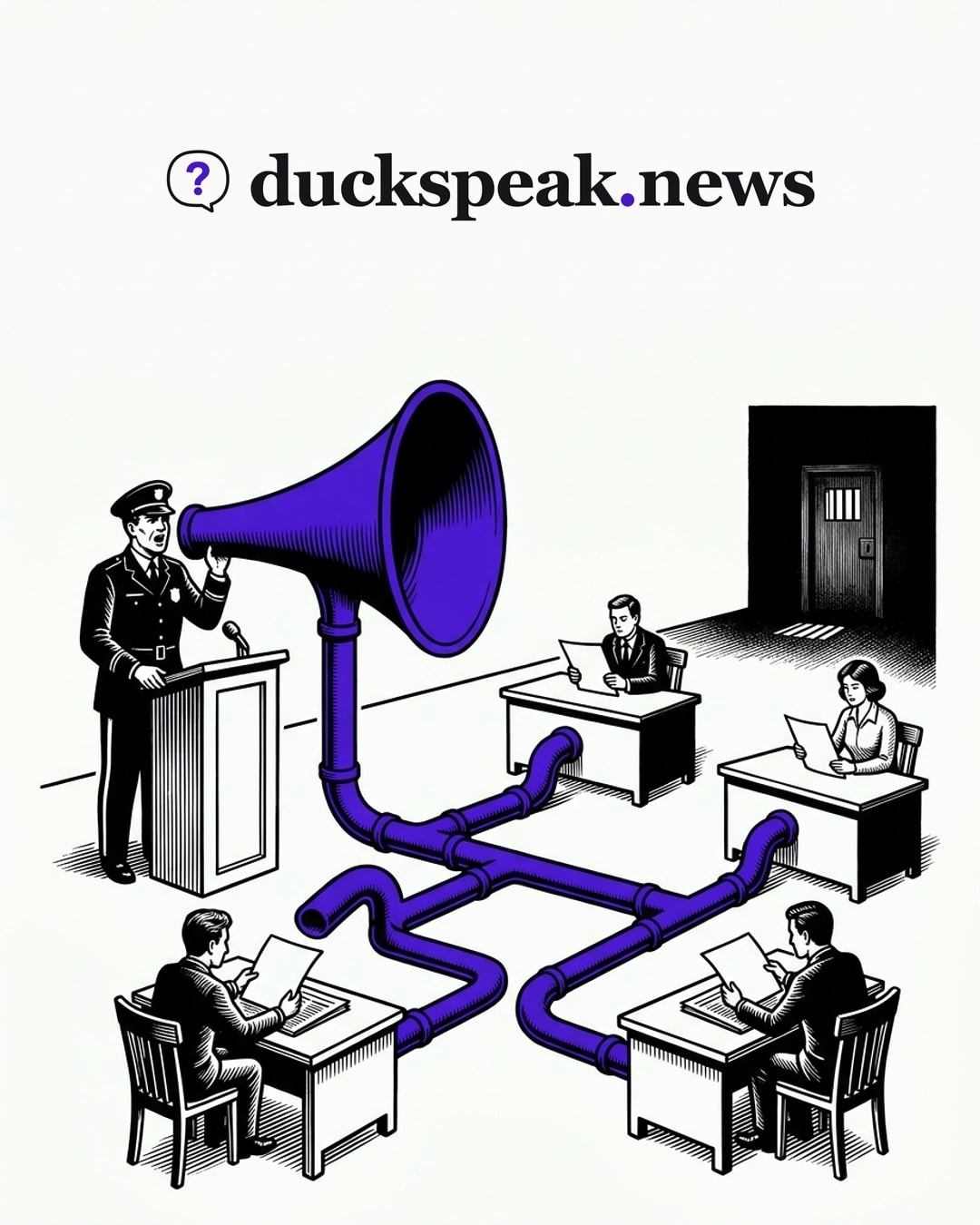
The barest version of this story is also the most careful one. BBC News reports that “the force said the allegations related to Russia” and that “the FBI said the arrest involves allegations of espionage” [1]. Every claim has a speaker. Most of the rest of the coverage keeps the speakers but lets them take over the story. Readers end up hearing a great deal about how well the agencies worked together and very little about what a 41-year-old man in a London police cell is suspected of doing.
The statement is the story
The Mirror, The Independent and, a day earlier, GB News build their articles from the same block of official quotes, in the same order. Deputy Assistant Commissioner Vicki Evans says the work “demonstrates the strength of our UK and US law enforcement and national security partnershipsChurnalismChurnalism is a press release, wire feed, or one outlet's unsourced reporting republished under several bylines and read by the public as independent confirmation.” [2]. The identical sentence appears in The Independent [3] and in GB News [6]. Brigadier General Sean Stinchon adds that the case “demonstrates the strength of our partnerships and the resolve of the counterintelligence community” [2], which The Independent repeats on both days [3][4]. Kash Patel thanks five agencies “for their outstanding work” [3].
This is churnalism in its plainest form. Three outlets carrying one text look like three confirmations, but they all point back to a single source: the agencies’ own account of the agencies. The French coverage worked the same way. RFI and France 24 ran the same AFP wire copy almost word for word [9][10], although RFI at least labels it “avec AFP” [9]. To spot this, set two articles side by side and see whether any sentence of the outlet’s own reporting sits between the quotes. In the Mirror’s article [2], after the opening paragraphs, almost none does.
The quoted material is not empty, but it is lopsided. Each statement spends several sentences on partnership, professionalism and teamwork. On the substance, the only firm details are the two sections of the Act, the country, the soldier’s age and two searches in Gloucestershire.
A number nobody checks
Patel’s statement includes a figure: “167 counterintelligence and espionage arrests from this FBI over the last 21 months – a 53 per cent increase” [3]. GB News prints it whole [6]. The Mirror paraphrases it and quietly drops the percentage [2]. None of them asks the obvious questions. An increase on which earlier period? How many of the 167 arrests involved service members? How many led to convictions? The number does work for the FBI director, presenting this arrest as part of a record, and it reaches readers without anyone testing it. GB News is the only outlet to place Patel politically, calling him “the senior Trump administration figure” [6].
Patel’s other sentence, that the FBI “has no tolerance for anyone who breaks their oath” [3], is worded as a general rule. Printed straight after news of a specific arrest, it reads as a description of this man, and no outlet points out that he has not been charged.
From “a member” to a name
On 10 November the soldier was “not named” [8]. By 12 November, ABC News had a name, a rank and a career, all resting on “a source familiar with the investigation” and on “a LinkedIn account matching his name” [5]. The ABC headline reads “US soldier accused of spying for RussiaHeadline asserts, body hedgesThe mother pattern behind scare quotes, modal deletion, and the commitment-free statement: a headline states a claim as settled fact while the article underneath it quietly hedges, denies, or contradicts it. identified” [5]. The body is more cautious: “It remains unclear exactly what Tyner is accused of doing,” and he is only “expected to be formally charged” [5]. This is a case of headline asserts, body hedges. Readers who stop at the headline come away with a settled charge, plus a name attached to it, when the article itself says neither the charge nor the conduct is yet known. In fairness, ABC is also the only outlet to say it “has not been able to reach Tyner” and that “it is unclear if he has retained a lawyer” [5], which is the closest any article comes to treating him as someone with a side of the story.
ABC then gives background: espionage convicts “have often been junior or mid-level service members, according to Army dataProof by invocationProof by invocation cites a report, a study or unnamed experts as having shown something, without giving a single figure, name or finding from them, so the reader can only take the conclusion on trust., with financial gain a common motive” [5]. That is proof by invocation. There is no number, no period and no report title, so “often” and “common” have to be taken on trust. The paragraph exists to suggest that this senior-officer case is unusual and therefore more serious. That may well be true, but readers are given nothing they could check.
The Independent’s update says “it has been reported that the soldier was based at Imjin Barracks” [4] without saying who reported it. On 10 November NBC had sourced that detail to “three people familiar with the matter” and a NATO official’s statement [7]. Two days on, the sourcing had been dropped.
Small errors that travel with speed
Copy written this fast picks up mistakes. The Independent’s first story says the man was held under “sections one and two” of the Act, then describes the contents of sections 1 and 3 [3]. Its own follow-up corrects this to “sections 1 and 3” [4]. GB News has him arrested “on Thursday” [6], although every other account says Tuesday, and misspells the general as “Strinchon” [6]. ABC calls the NATO unit the “Allied Rapid Response Corps” [5], while NBC and The Independent call it the Allied Rapid Reaction Corps [7][4]. None of these errors changes the story. They do show how little checking the reprinted material received.
What the first day added, and what was dropped
On 10 November NBC set the arrest in a wider frame: “The arrest comes at a time of heightened tensions around the threat from hostile statesGuilt by juxtapositionGuilt by juxtaposition places separate cases or facts side by side so the reader infers a link, a pattern or a cause the article never states, and so never has to prove.,” followed by paragraphs on Iran-linked arson attacks and US tankers leaving RAF Mildenhall [7]. That is guilt by juxtaposition. A Russia espionage arrest sits next to Iranian proxy attacks, so readers infer a single campaign that the police never described. PBS used the same police line in the opposite direction, reading “not linked” as ruling out any connection to the suspected Iran plot at RAF Fairford [8]. The current coverage keeps the bare “not linked” sentence [2][3] and drops the wider frame altogether. It also drops the one sign of an institution declining to talk: the Pentagon « a renvoyé les questions sur cette affaire vers l’armée de Terre, qui n’avait pas répondu dans l’immédiat » (referred questions on the case to the Army, which had not immediately responded) [9]. No later article says whether the Army ever replied.
What a reader would need instead
5 checks to run on the next story like this one.
-
What the law requires. Sections 1 and 3 of the National Security Act 2023 cover obtaining or disclosing protected information and assisting a foreign intelligence service [4]. The coverage never explains what police would have to show under each, or what penalties they carry.
Gap in the coverage
-
How custody works. The Independent reports a warrant of further detention until 17 November [4]. Readers would need to know the legal maximum detention without charge under this Act, and that in England the Crown Prosecution Service, not a “source familiar”, decides whether charges follow.
Gap in the coverage
-
A test of the FBI’s figure. The baseline behind “a 53 per cent increase” [3], and how many of the 167 arrests became prosecutions, should come from the FBI or Justice Department’s own published records.
Gap in the coverage
-
The data behind “Army data.” The US defence establishment does publish research on espionage cases. Its PERSEREC personnel-security research centre has studied them for decades. Citing a specific report with its numbers would let readers judge how unusual a senior officer really is.
-
A question to the US Army. The Pentagon passed the question to the Army [9], and no outlet reports an answer. Readers should be told whether the Army has said anything about the soldier’s role or access, and whether he has legal representation.
Gap in the coverage