

A promise that goes unchecked
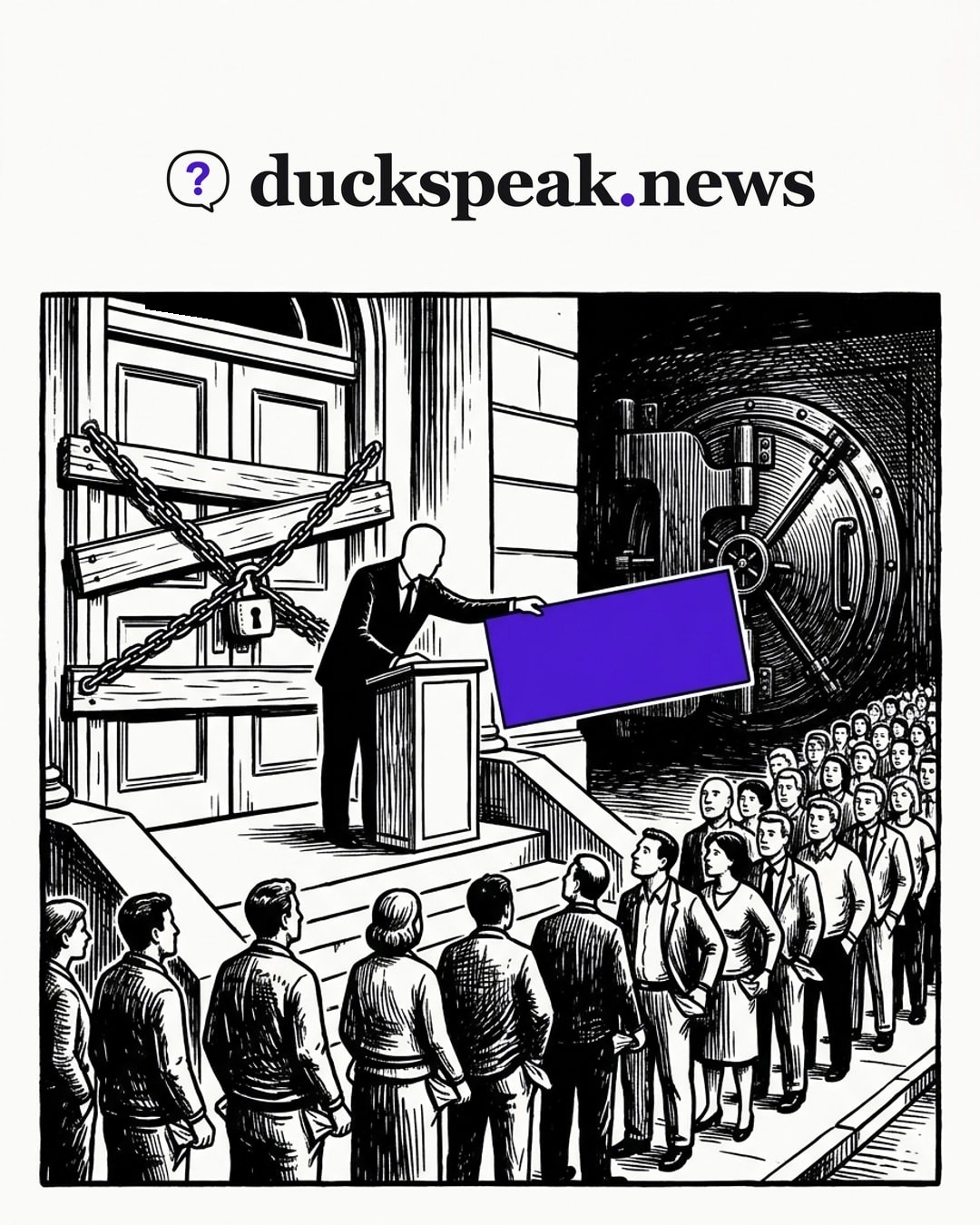
Pedro Alliana’s first promise as president runs in two outlets as he spoke it. The BBC quotes him saying that compatriots in difficulty “will be fully compensatedCommitment-free statementA commitment-free statement is an institutional quote that concedes a problem in feeling-language while specifying no agent, no deadline, and no way to check later whether it happened.” [1]. France Info has the same line: « les compatriotes qui traversent une situation très difficile à cause du chaos financier seront pleinement indemnisés » (compatriots going through a very difficult situation because of the financial chaos will be fully compensated) [5]. Neither outlet says by whom, from what fund, by when, or up to what amount. This is a commitment-free statement. Readers come away believing the losses will be covered, but they have no figure they could hold the new government to later.
PBS is the only outlet that sets the promise against something checkable. The Central Bank, it reports, says “1.2 million Ueno customers had received partial or full reimbursement of their insured deposits under Paraguayan law” [4]. “Insured” and “partial” are the important words here. A deposit guarantee has a ceiling, so “fully compensated” for everyone would mean paying out more than that guarantee covers. None of the five articles gives the ceiling, and none says whether Alliana’s promise goes beyond it. A promise with no amount, no date and no mechanism is the easiest sentence in a crisis to print.
Peña’s own farewell words work the same way, and this time they come without the comment NPR offered the day before. NPR quotes “I want to apologize to the Paraguayan people if I have failed you” [3]. The “if” again turns the apology into a hypothesis. When this site looked at the 6 November coverage, NPR at least noted that Peña stopped short of accepting responsibility; that note is gone now. PBS runs “My responsibility is to put the country above my personal fate” [4], which uses the word responsibility while accepting none. The BBC gives “it was never my intention to betray the trust you placed in me” [1], which denies intent rather than any act.
Money that moves itself
There is no agreement on who seized or suspended the bank. The Guardian writes that Ueno “was suspended this week after irregularitiesAgentless passiveThe agentless passive is a sentence built so the action happens with no one doing it.” [2]. The sentence has no actor, and the irregularities are never named. NPR and the BBC do name the actor, the central bank [3] [1], and NPR gives the stated reason: a solvency ratio that “no longer met legal standards” [3]. So the information was available.
The agentless passive is a sentence built so the action happens with no one doing it.
The public money gets the same treatment. The Guardian reports that “An estimated $800m to $860m in state and pension funds were invested in Ueno” [2]. That is the agentless passive, and it takes away the question that matters most to the striking teachers PBS mentions [4]: which official signed off on putting pension money into this bank? The paragraph before it gives the agency to the bank, which “managed to bring public pension funds controlled by Peña’s administration into its portfolio” [2]. The analyst quoted next gives it to the funds themselves, which “went to deposit their money in the bank” [2]. PBS comes closest to naming someone: lawmakers “accused Peña of using his political influence to steer” the money [4]. But that is an accusation, and none of the outlets names the fund managers who actually moved the deposits.
To its credit, the Guardian fills a gap from the earlier coverage: “Peña appointed Carlos Carvallo Spalding, a former CEO of Ueno, head of the country’s central bank” [2]. PBS mentions Carvallo only as “former Central Bank chief” [4]. It never says he used to run Ueno or who put him in the job. The BBC, NPR and France Info leave him out entirely.
Three verdicts for one vote
What did the Senate actually find? According to the BBC, Peña was found guilty of “dereliction of duty” [1]. NPR has “malfeasance in office” [3], and PBS has “poor performance” [4]. France Info quotes « mauvais exercice de ses fonctions » (poor exercise of his duties) [5]. These all appear to be translations of one Spanish charge, but none of the outlets prints the original wording. In English they mean different things: “malfeasance” means wrongdoing, “dereliction” means neglect, and “poor performance” sounds like an HR review. A reader of one outlet would not know whether the Senate found corruption or incompetence. Senator Filizzola’s words shift in the same way: “the biggest corruption scandal in our democratic history” in the BBC [1], “one of the biggest corruption scandals since the return of democracy” in the Guardian [2].
Motives and analysts nobody names
The Guardian says in its own voice that Peña tried to resign “in an attempt to retain the special jurisdictionUnsourced motive attributionUnsourced motive attribution is a news text stating what an institution or government 'wants', 'fears' or 'seeks' as plain fact, with no official, document or source behind the intention, so the reporter's hypothesis reads as a finding.” afforded to former presidents [2]. That may well be true, and PBS attributes a similar reading to opposition lawmakers [4]. But the Guardian states it as unsourced motive attribution: a claim about what Peña intended, offered as a finding, with no source behind it. The BBC goes the other way: “Analysts sayProof by invocationProof by invocation cites a report, a study or unnamed experts as having shown something, without giving a single figure, name or finding from them, so the reader can only take the conclusion on trust. Peña is likely to now be prosecuted” [1]. No analyst is named and no reasoning is given. That is proof by invocation, and it adds little, since in the same article a named prosecutor has already set out the charges [1].
Unsourced motive attribution is a news text stating what an institution or government 'wants', 'fears' or 'seeks' as plain fact, with no official, document or source behind the intention, so the reporter's hypothesis reads as a finding.Proof by invocation cites a report, a study or unnamed experts as having shown something, without giving a single figure, name or finding from them, so the reader can only take the conclusion on trust.
How many people, and who counted them
The figures don’t agree either. The Guardian’s headline says the crisis “leaves 60% of countryHeadline asserts, body hedgesThe mother pattern behind scare quotes, modal deletion, and the commitment-free statement: a headline states a claim as settled fact while the article underneath it quietly hedges, denies, or contradicts it. unable to access accounts” [2], while its own body says “about 60% of the country’s adult population” [2]. The headline is broader than the body underneath it, which is headline asserts, body hedges. The BBC says “more than half of Paraguay’s population” [1]. Yet PBS gives “nearly 3 million customers” in a “country of 6 million people” [4], which works out to just under half. Only France Info points out where the number comes from: « le nombre de clients que revendiquait Ueno » (the number of customers Ueno claimed) [5]. The BBC also writes that three million depositors “remain unable” to access their savings [1], which is hard to square with the 1.2 million reimbursements PBS reports [4]. The outlets don’t reconcile these figures, so the reader has to.
NPR also reads in places like the bank’s own brochure. It cites Ueno’s claim that a million people opened their first account, then describes its “generousVerdict adjectivesVerdict adjectives (credible, serious, responsible) deliver a political conclusion while presenting themselves as neutral description. cash back offers on groceries” [3]. These verdict adjectives are favourable judgments in NPR’s own voice. The Guardian describes the same model as returns “far above those offered by the rest of the market” [2], which is how risk sounds. NPR also calls Ueno “U.S.-owned” [3] and never explains it. No other outlet says this, and the reader can’t tell what it’s based on.
What a reader would need instead
5 checks to run on the next story like this one.
-
The ceiling of Paraguay’s deposit guarantee, the size of the fund behind it, and whether Alliana’s “fully compensated” goes beyond it. The Central Bank publishes the reimbursement figures PBS quotes [4].
-
The Senate’s verdict in its original Spanish wording, and the specific charges voted on, which NPR says are on the Senate’s website [3].
Gap in the coverage
-
Which pension and state bodies placed the $800m to $860m [2], and which officials signed off.
-
The irregularities behind the suspension, from the central bank’s own resolution, rather than “after irregularities”.
-
A source for Ueno’s customer count and for NPR’s claim that the bank was “U.S.-owned”.
Gap in the coverage