

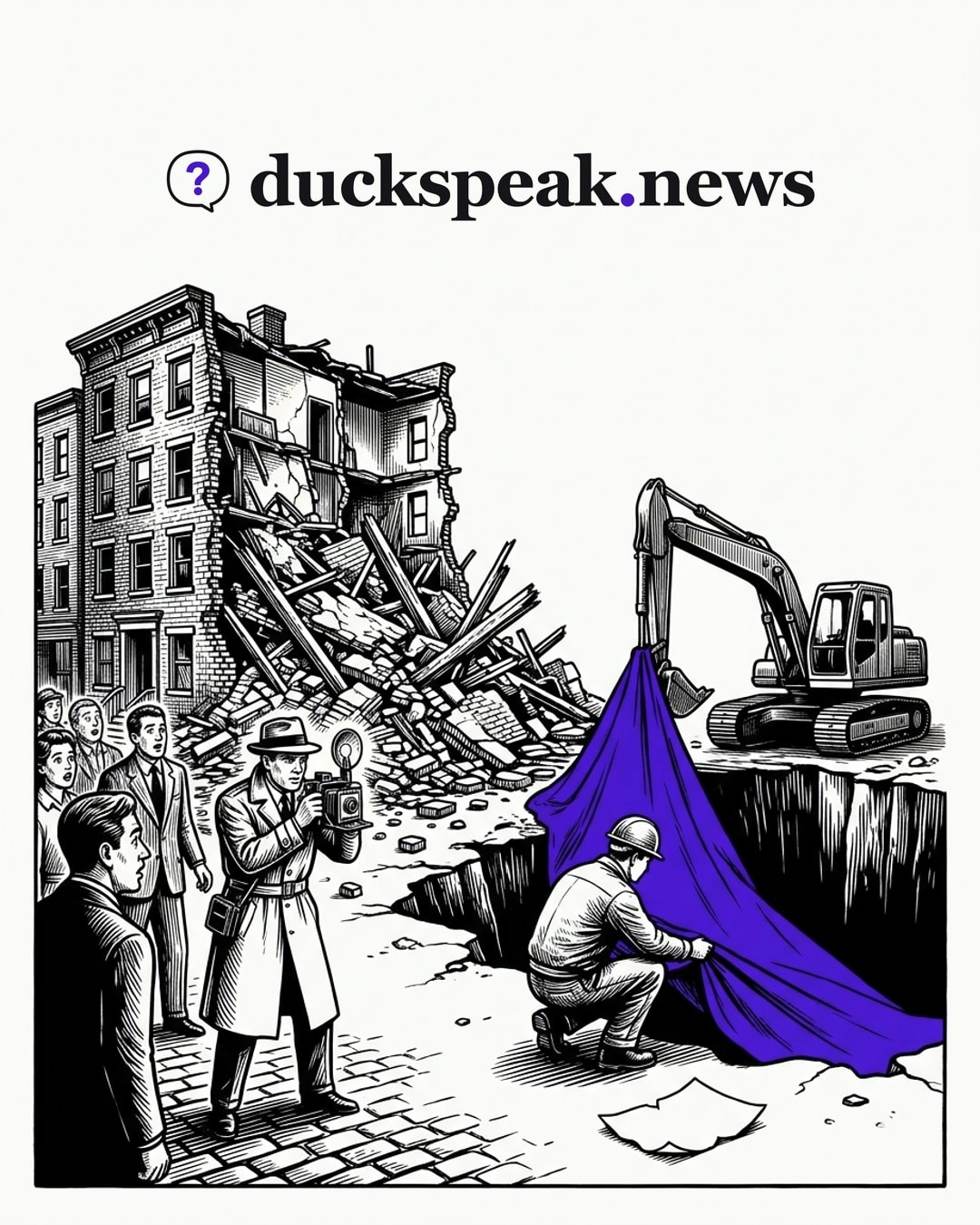
A building that “just fell”
BBC News headlines its piece with a resident’s question: “How does a building just fall?” [1]. It’s a fair thing for a grieving neighbour to ask. As a headline it frames the event as a mystery, even though the article’s own body gives part of the answer: the 1930s building “collapsed into a neighbouring construction site, where crews were working” [1]. The BBC narration also calls the event “the accident” twice and “the incident” once [1]. That’s a choice of noun. “Accident” settles the question of fault on the same day the mayor promised an investigation. By Friday, AP was reporting that prosecutors were among the officials looking into it [6].
NPR’s short report never mentions the construction site. The building “collapses”, and people are hurt “in the building collapse” [4]; the excavation doesn’t appear at all. France Info’s headline uses the same intransitive verb, “Un immeuble s’effondre” (A building collapses) [7]. The excavation does appear in the body: “des ouvriers creusaient au moment de l’écroulement” (workers were digging at the time of the collapse) [7].
The context comes after the video
The best-documented causal context sits deep in the copy. Fox News opens with a home video of walls giving way and Gothamist’s account of a 9-year-old and a gallon of milk. Only after that does a paragraph begin “Meanwhile, the owner of the neighboring property is facing scrutiny”Buried ledeA buried lede is the fact that should have organized the whole story, relegated instead to the final sentence or hidden inside someone else's quote. over past violations, “including a contractor’s decision to ignore a city stop-work order” [5]. This is the buried lede: the one fact that could explain the deaths arrives as a “meanwhile”, an aside to the footage. Fox also places the ignored order “in March” [5], while AP says the order was issued in March and the violation was found in April [6]. The two accounts don’t line up, and neither outlet explains the gap.
The AP report carried by PBS has the most material: a named contractor, Mordechai “Marty” Waisbrod; a notice to the city that the excavation “would include rock blasting”; and permit plans “to dig below 15 feet” [6]. All of it comes near the end, after the survivors’ accounts. The section that holds it is headed “Official says prior problems that halted construction were fixed” [6], so the official’s reassurance frames the record before the reader gets to it. NBC places its sentence about the excavation site, the one fact that ties the collapse to its likely setting, in the second half of the article, the same buried lede on a smaller scale [2].
Work that “was allowed”
Once the excavation does appear, the grammar takes the people out of it. NBC describes the site as one “where single-floor building had been cleared”Agentless passiveThe agentless passive is a sentence built so the action happens with no one doing it. [2]. AP writes that “Work was allowed to continue after the problems were corrected” [6]. This is the agentless passive. The reader learns that permission was given, but not who gave it, who corrected the problems, or who checked the corrections. In that sentence the Department of Buildings is both the regulator and the source quoted, and the verb keeps its own role out of view. To spot the move, ask of any “was allowed” who did the allowing.
The agentless passive is a sentence built so the action happens with no one doing it.
Promises with no date attached
Officials are quoted at length, and the outlets don’t ask them for anything specific. Mamdani pledges a “comprehensive and thorough” investigation [1]. NBC prints “We will find out what happened and we will share that information with New Yorkers”Commitment-free statementA commitment-free statement is an institutional quote that concedes a problem in feeling-language while specifying no agent, no deadline, and no way to check later whether it happened. [2]. AP quotes Tigani: “We’re looking at the entire history” [6]. The mayor also says it is “always an outrage” when New Yorkers die “as a result of all of this” [6]. These are commitment-free statements: the grief is real, but nothing in them can be checked later. There’s no timeline, no named office reporting back, and no say on whether the inspection results at “100” sites [1][2], later “more than 160” [6], will be published. The rising count could be read as decisive action, but no outlet asks what the sweeps have found so far.
A word in quotes, a fire in the background
GB News’ headline says the collapse left New Yorkers “‘trapped’”Scare quotesScare quotes are quotation marks placed around a word an outlet won't stand behind, so it can print the word anyway. under rubble [3]. These scare quotes have no speaker: nobody in the article is quoted saying “trapped”, and the body states it plainly, “One person was still trapped under the rubble” [3]. The quotation marks put distance between the outlet and a fact the outlet itself reports, which leaves the reader wondering whether “trapped” is somehow in doubt.
GB News then ends with a fire: the collapse “comes just one week after”Guilt by juxtapositionGuilt by juxtaposition places separate cases or facts side by side so the reader infers a link, a pattern or a cause the article never states, and so never has to prove. six people died in a Sunset Park blaze [3]. No link between the two is stated or sourced. Read together, they invite guilt by juxtaposition, a sense of a city where things go wrong, with no argument behind it. AP’s closing line does something similar, calling the collapse “the second high-profile structural problem” in five months alongside a buckled Manhattan skyscraper [6]. A tally like that implies a pattern the article never examines.
GB News also quotes State Representative Rodneyse Bichotte Hermelyn saying the site’s owners “were waiting for a permit to build affordable housing” and that the building had “probably” been “neglected” [3]. Tigani, quoted by Fox, says the developers had an approved three-storey plan and were seeking nine storeys [5], which France Info repeats [7]. No outlet puts these two accounts side by side, and the reader can’t tell which is right.
RTÉ, to its credit, puts the construction site in its first sentence [8].
What a reader would need instead
6 checks to run on the next story like this one.
-
The excavation in the lead. Rock blasting, digging below 15 feet and the stop-work history [6][5] belong at the top, not after the video and the vigils.
-
Who let the work resume. Name the office and the inspector who decided the overhead-protection problems “were corrected” [6], and say whether anyone checked the effects of the excavation on the neighbouring wall.
-
A timetable and a promise to publish. Ask the mayor and the Department of Buildings when findings and the results of the sweeps at more than 160 sites [6] will be made public.
-
Words the outlet stands behind. If people were trapped, as GB News’ own body says [3], print the word without quotation marks.
-
Evidence before a pattern. Link the collapse to the Sunset Park fire or the Pfizer tower [3][6] only if there is a shared cause, and show it.
-
One account of the permits and the dates. Settle whether the stop-work order was ignored in March or April [5][6], and whether the planned building was nine storeys or affordable housing [3][5].
Gap in the coverage
Several neighbours told AP that the construction vibrations had cracked their walls [6]. If a building did “just fall” [1], the reader still needs to know who was digging next to it, and who signed off on the work.