

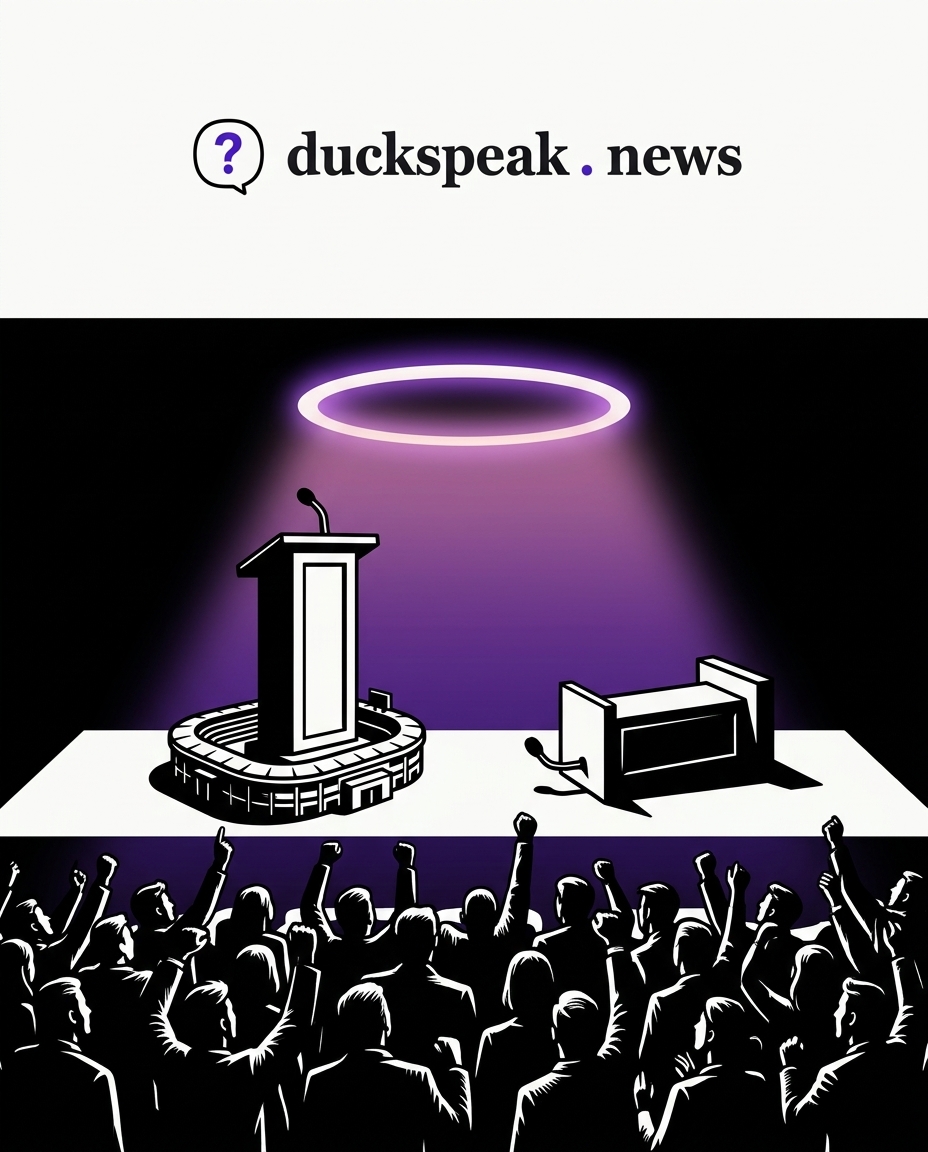
Ed Sheeran finally said something about Gaza on Saturday, and both outlets covering the Philadelphia show opened with the same disclaimer: he “wants his music and shows to be about unity and humanity, not politics” [1][2]. NPR and CBS News then spent the rest of their articles documenting a week of politics: a billionaire urging a rapper’s removal, openers withdrawing in solidarity, police deploying to monitor protests, a civil-rights organization demanding answers. The lid sits on top of the pile.
An earlier piece on this site, “Nobody Dropped Macklemore,” dissected the headline grammar of the removal itself: the passive verb, the “after” clause, the agent deleted from the sentence. This coverage is the next chapter, and the mechanism has evolved. The story is no longer agentless. It is symmetrical.
An ultimatum is not an argument
NPR quotes Sheeran: “this has put me in the middle of an important and passionate argument about freedom of speech and the most complex political issue on the planet” [1]. An argument has two sides, and NPR builds the article to match, a refunded fan who protested against an attending fan who objected to politics at shows [1]. What the same articles document is a chain, not an argument. The removal “came at the urging of New England Patriots owner Robert Kraft,” whose company owns a stadium where the tour was scheduled to play [1][2]. Sheeran says the tour promoter was ultimately responsible [1]; CBS names the promoter, Messina Touring Group [2]. The openers withdrew [1][2]. Kraft’s stated standard, per CBS, is that the comments “went too far” [2], with no definition of too far given or sought. An ultimatum is not an argument. One side of it owns the stadium.
The complexity clause does separate work. “The most complex political issue on the planet” [1] makes any position presumptuous, and both outlets transcribe it without comment. The question actually before the public, who removed Macklemore and why, is not complex, and both outlets report it as unanswered: CAIR Philadelphia has sent an open letter asking who made the decision [2], the Eagles “have not returned a request for comment” [2], and “Sheeran’s representatives have not responded to multiple requests for comment” [1][2]. The one question with a paper trail is the one the complexity clause excuses everyone from pursuing.
Unity is the residue
Both outlets print the songs being about “love, hope, and unity” [1] and the shows being about “unity and humanity” [1][2], without noting what the unified show is: the one that proceeded after the opener was dropped and his replacements backed out. NPR’s headline calls it a “solo concert” [1], accurate, since he has performed much of the tour solo [1][2], and also convenient, since the empty slots read as a format rather than a removal. Unity, in this usage, is the name for the crowd that remains after the removal.
Sheeran told the crowd that “everyone is welcome” and that fans “can have opposing points of view while still singing his songs” [1]. The welcome extends to views held by ticket-holders; the view that got a performer dropped from the tour is not in the sentence, and NPR never places the two facts in the same room.
The valve, voiced by a fan and a cop
NPR’s balance machine produces Diane Savitz, 53: “Everyone has their right to freedom of speech, but not every platform is the place for it” [1]. Concession, then gate. NPR transcribes it without asking the question its own article answers: who decides what a platform is for? In its own reporting, the removal followed the urging of a man whose company owns one of the platforms [1].
CBS supplies the state’s version of the move, from Police Commissioner Kevin Bethel, who will allow protesters their “First Amendment right as long as they don’t engage in illegal and inappropriate behavior” [2]. “Inappropriate” is not a legal category; it is a platform-owner’s category, borrowed by a police commissioner. A fan and a cop perform the identical maneuver, affirm the right in the abstract and gate it in the instance, and neither outlet notices the echo, because the echo is the house style. CBS then frames the protest as logistics: officers “deployed at the concert to monitor protests” [2], fans taking public transit “because of the expected protests” [2], and “a small group of about 50” demonstrators [2] warranting “additional assets in the stadium area” [2]. Fifty people, “assets.” The protest is weather; the deployment is commute advice.
To its credit, NPR prints the counter-sentence. Hillary Steinberg, who refunded her tickets, says “all art is political, and all music is political” [1]. It is the sharpest sentence in either article, and it runs once, in a fan’s mouth, unexamined.
What fell out of the quote
What Sheeran said, per CBS: “What happened in Israel and at the Nova Music Festival on Oct. 7th was horrific and compounded centuries of Jewish pain. What is happening in Gaza is a catastrophic and an unjustifiable and disproportionate,” followed by “the systemic injustice we’re seeing unfold in the West Bank cannot be overlooked” [2]. NPR’s rendering: he said the Oct. 7 attacks were horrific and what is happening in Gaza “catastrophic and unjustifiable” [1].
The paraphrasable softness survives the edit; the quotable hardness falls out of it. What falls out specifically is “disproportionate,” the one word in the statement with a legal meaning, the proportionality standard of the laws of war, and the entire West Bank sentence. A reader of NPR alone never learns either was said. This could be innocent compression; one sentence is a small sample, and intent cannot be read from a trim. But the pattern of what drops is one-directional, and it drops in the outlet’s calmer rendering of the artist. CBS’s own transcription is garbled, “a catastrophic and an unjustifiable and disproportionate” [2], missing its noun.
The money paragraphs
Both outlets carry a near-identical donation paragraph: Macklemore is giving $1 million and challenged Kraft to match; “a spokesperson for Kraft has said the billionaire and Sheeran have each agreed to donate $2 million but have not specified where the money will be directed” [1][2]. Three facts, none examined. The destination is unspecified, and neither outlet asks; two million dollars each, directed nowhere in particular, becomes the story’s resolution, the question of who gets to perform dissolving into philanthropy arithmetic. The sourcing is singular: the man whose urging began the removal is, through his spokesperson, the sole on-record source for the size of Sheeran’s donation, in articles noting that Sheeran’s own representatives “have not responded to multiple requests for comment” [1][2]. And the symmetry is manufactured: Kraft and Macklemore, matched in donation headlines, the ultimatum rewritten as a check-writing contest. This is the Huxley layer, a blacklist drowned in adjacent arithmetic until it reads as a telethon.
Both outlets also run the same Pollstar paragraph, the tour the highest-grossing in the world, “with an average box office gross of over $7 million per city” [1][2]. Dressed as celebrity finance trivia, it is the most political paragraph in either piece: it is why the ultimatum worked, and why “he would never willingly let down his fans or abandon the touring crew” [1] reads as it does. Neither outlet lets the gross collide with the claims of non-responsibility. NPR comes closest, then evaporates the attribution: “experts say an artist of Sheeran’s magnitude generally has the final say about what happens concerning the shows” [1]. Which experts, how many, on the record? The sentence does not say. The single gesture at accountability in either piece is attributed to no one and followed by nothing.
NPR then closes with boilerplate: “NPR does not offer or accept money for coverage or interviews” [1]. The disclaimer is standard practice; the juxtaposition is still the story’s last word. The one money question answered is the one nobody asked.
What a reader would need instead
The central question is now formally on record as asked. CAIR Philadelphia’s open letter to “the Philadelphia Eagles, the stadium operator and the city” asks “who made the decision to remove Macklemore” and raises “whether Macklemore’s support for Palestinian rights played a role in his removal” [2]. The Eagles have not answered [2]. Sheeran’s representatives have not answered [1][2]. The question is documented as open in both pieces and pursued in neither.
The artist, meanwhile, has named the mechanism himself: “I am deeply worried about the idea that venues pre-approve content performance” [2]; “This happens in so many places that I perform around the world, but it should never happen in the free world” [1]. Sheeran is worried about venues preapproving content in the same week he performed without the opener those venues objected to. Neither outlet places those two facts in the same sentence. A reader would need to know that the performer’s complaint and the promoter’s decision are the same mechanism, and that the institution already asking the right question is a civil-rights organization, not the newsrooms covering it.
The prior chapter’s verdict was that the passive voice is the sound a decision makes when no one wants to be its subject. This chapter’s is simpler: the “argument” is the shape a decision takes when two newsrooms need it to have two sides. Sheeran supplied the vocabulary, “passionate argument,” “unity,” “not politics,” and both outlets transcribed it as the frame rather than as one party’s account. That is duckspeak: not coordination, reflex. The words were lying there, and everyone reached for them.