

A verdict in the headline, a passive in the body
The outlets agree on the outline. Novaya Gazeta says it is closing, and it blames the state. AFP’s headline says the paper “shuts under Kremlin pressure” [1], NBC says “under state pressure” [2] and the BBC says “under pressure from authorities” [4]. RFI and France Info both write « sous la pression des autorités » (under pressure from the authorities) [5][6]. Only the Los Angeles Times keeps the claim as the paper’s own (“blaming pressure from authorities” [3]), and the Guardian builds its headline on Sokolov’s quote [7]. The record behind the firmer headlines is real: a revoked licence, a blocked website, a journalist under house arrest, searches of the office. Nobody here is misleading readers about the general direction of events.
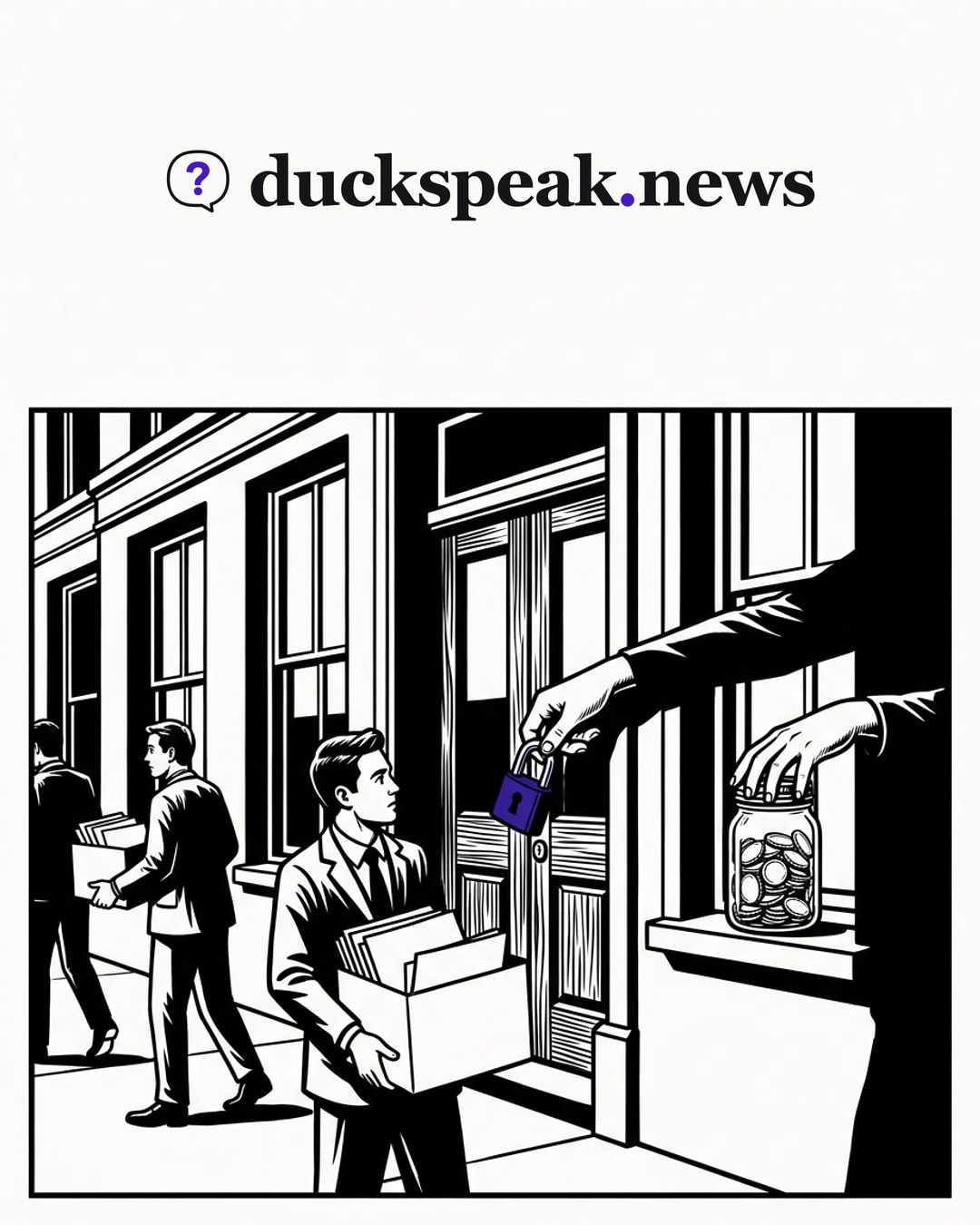
The coverage itself explains that two specific acts ended the paper: an eviction and the loss of donations. As the BBC puts it, “That leaves no way to fund the publication” [4]. At exactly that point, the grammar stops naming anyone. In the BBC, the donation system “was disabled”Agentless passiveThe agentless passive is a sentence built so the action happens with no one doing it. [4]. In the Guardian, the donation platforms “have been shut down” [7]. RFI and France Info use the same French sentence: the system « « a été bloqué » » (has been blocked) [6][5]. NBC’s opening has the paper’s “financial support and premises “have been taken away”” [2]. This agentless passive leaves the reader unable to tell whether a regulator, a bank, a payment processor or a court cut off the money. The closure is the news, and its proximate cause has no subject. The Los Angeles Times alone gives one: “authorities also shut the donation system” [3]. Even there, the article never says which authority, or by what order.
The agentless passive is a sentence built so the action happens with no one doing it.
The eviction gets the same treatment. The BBC says the paper “has received an eviction order” [4] and does not say from whom. NBC says the office is one “from which it is now being evicted” [2], the same construction again. Only the Guardian names an actor, “the newspaper’s landlords” [7], and it never says who the landlords are or whether they answer to anyone in government. So the headlines link “Kremlin pressure” to the final blows, but none of the articles shows that link. They pass on the paper’s statement that “The Russian authorities and the Russian security services have forced our editorial team to cease operations” [3]. That may well be the full truth. It is still the paper’s account, reported without checking. The test for next time: when a story’s decisive action sits in the passive, ask who the subject of the sentence would be, and whether the article ever tells you.
A tense that runs ahead
France Info’s standfirst says the paper “a été expulsé de son siège historique de MoscouHeadline asserts, body hedgesThe mother pattern behind scare quotes, modal deletion, and the commitment-free statement: a headline states a claim as settled fact while the article underneath it quietly hedges, denies, or contradicts it.” (has been evicted from its historic Moscow headquarters) [5]. Further down, the same article says it “va être expulsé de son siège historique de Moscou le 9 novembre” (is to be evicted from its historic Moscow headquarters on 9 November) [5]. This is headline asserts, body hedges: the standfirst reports as done what the body still describes as scheduled. A reader who skims the top comes away thinking the doors are already shut. Comparing the tense of the standfirst with the dates in the body is enough to catch it.
“Arrested”, again
On Sokolov’s October questioning, the verbs still disagree. The BBC says he was “taken in for police questioning” [4], and France Info says he “avait été interrogé par les autorités russes” (had been questioned by the Russian authorities) [5]. RFI writes “Le 15 octobre, le rédacteur en chef Sergueï Sokolov est arrêté” (On 15 October, editor-in-chief Sergei Sokolov is arrested) [6] and gives no procedural status. An earlier piece on this site looked at the same split between “arrested” and “questioned” in coverage of that episode. Here RFI keeps the hardest word without explaining it. The outlets cannot agree on the timing of the search of his home either: “last month” in the Guardian [7], “this month” in NBC [2].
Intent stated, not sourced
The BBC describes the wartime laws in its own voice: “new laws “were adopted” in Russia” (again with no lawmaker named), then ““Their aim”Unsourced motive attributionUnsourced motive attribution is a news text stating what an institution or government 'wants', 'fears' or 'seeks' as plain fact, with no official, document or source behind the intention, so the reporter's hypothesis reads as a finding.: to punish dissent and silence criticism of the war and of those in power” [4]. This unsourced motive attribution reads as a finding, but no document, official or analyst stands behind it. The material to show effects instead of asserting intent is available: NBC cites the “long jail terms for ‘discrediting’ the Russian army” [2], and the Guardian describes the stars Sokolov printed in place of the word “war” [7]. A sentence that tells you what a law is for, without saying who says so, is asking you to trust the writer.
The “foreign agent” label is glossed the same way. AFP calls it “a label reminiscent of Soviet-era repression used to stifle dissent” [1]. France Info says “une étiquette utilisée pour étouffer toute voix dissidente” (a label used to stifle any dissenting voice) [5], which is almost the same wording. The BBC calls it “a label often used by the Russian authorities to punish critics” [4]. Only the Los Angeles Times describes what the label does, saying it “implies additional government scrutiny” [3]. None of the articles says what the law actually requires of those it designates.
Words for the war
The Guardian explains that Sokolov had to write “***” because Russian law requires the term “special military operation” [7]. Next to that, the Los Angeles Times writes in its own voice about “the start of the conflict in Ukraine” and the Kremlin’s “military action in Ukraine” [3], even though it also says Putin “sent troops into Ukraine” [3]. A paper that faced prison for the word “war” is being covered by an outlet under no such law that chose softer words anyway. The BBC goes the other way and stacks two distancing devices: “what the Kremlin calls the so-called ‘special military operation’” [4].
What a reader would need instead
5 checks to run on the next story like this one.
-
Who disabled the donation system: which platform or bank, and under which order or authority.
-
Who owns the Moscow building, and whether the eviction rests on a court ruling, a contract or a state request.
-
Sokolov’s exact procedural status after 15 October, stated the same way across outlets.
Gap in the coverage
-
What the “foreign agent” designation legally requires, with any account of its purpose attributed to a named source.
-
Continued tracking: Reporters Without Borders, quoted by AFP, documents the “judicial harassment” of the paper’s journalists [1], and NBC notes that Novaya Gazeta Europe “will continue to operate” [2].
Gap in the coverage