

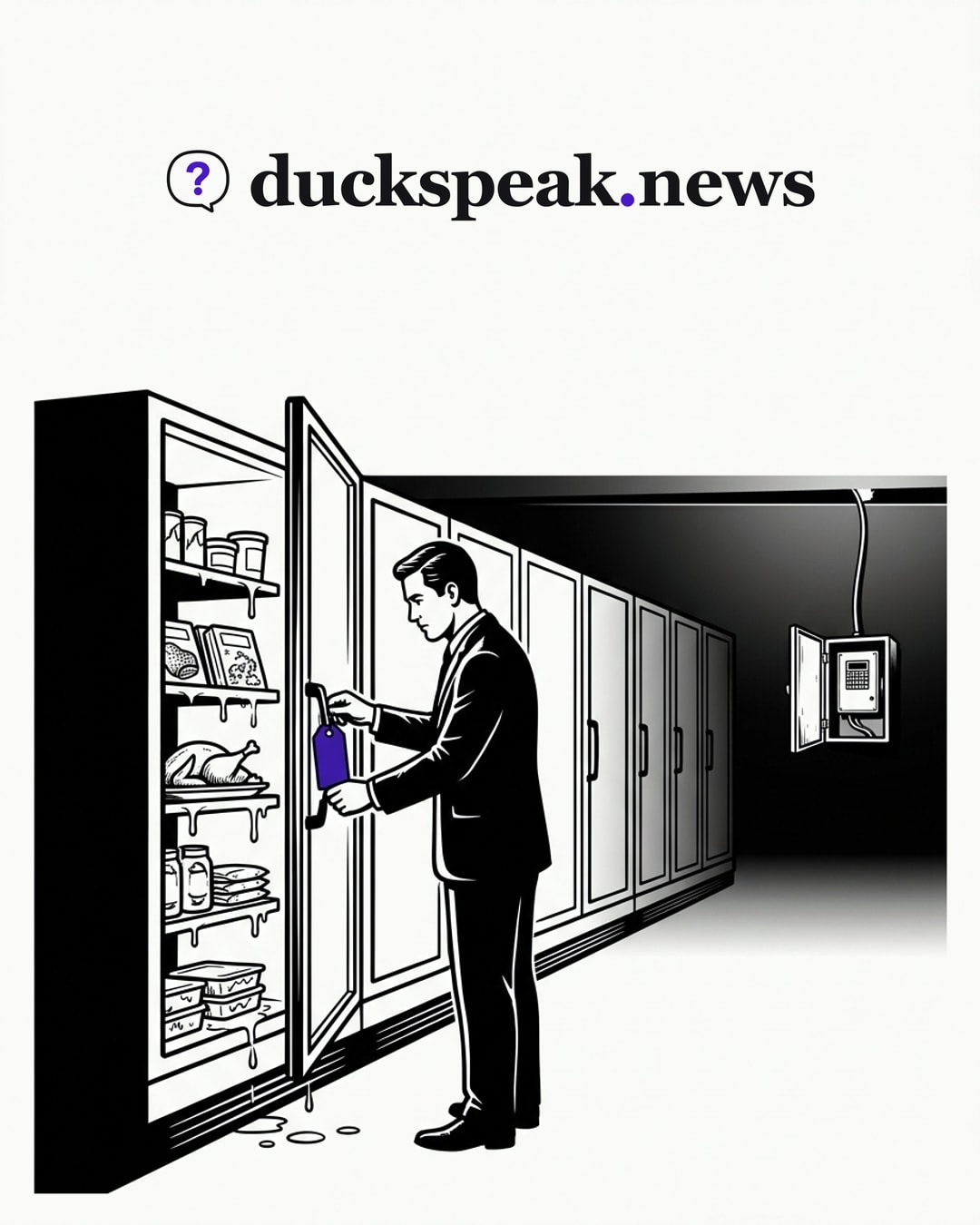
Three weeks after hundreds of French supermarkets lost control of their cold rooms, a second wave hit stores across Europe. An earlier piece on this site looked at how French coverage of the first attack leaned on the word « inédit » (unprecedented), which made a documented vulnerability sound unforeseeable. This time the attack can’t be called new, so the vocabulary changes. Coverage of the second wave talks about faults and small numbers, and the details that point to known, unfixed exposure come last.
Attacks that read like breakdowns
ABC News opens by saying grocery stores are “dealing with incidentsEuphemism launderingEuphemism laundering is official or institutional vocabulary repeated across coverage until it stops sounding like a chosen frame and starts sounding like plain description. affecting refrigerator and freezer systems” [4], then adds in its own voice that refrigeration systems “have been malfunctioning Monday” [4]. The AP copy run by PBS has stores “hit Monday by problems with freezers and fridges” [1]. RFI lists chains that “ont elles aussi subi des problèmes techniques” (also suffered technical problems) [5]. NBC’s narration says “The incidents caused temperature spikes” [6].
“Incident” is the companies’ word: Delhaize’s “IT incident” [1][4][6] and Musgrave’s “cyber incident” [3][6]. In the narration it no longer reads as a word someone chose. “Malfunctioning” goes further than any company did. A malfunction is a property of a machine. Someone setting freezers to 50 degrees is an act. Yet the same ABC article reports that “Temperature settings were increased” [4]. When a story says “problem” or “incident” in its own voice, ask whether the facts underneath describe a fault or an intrusion.
Limited according to whom
The chains measure the damage as a share of their stores. Carrefour Belgium says the attack “only had an extremely limited impact” [1][6], or “très peu d’impact” (very little impact) [2]. Coop says the situation is “contained and under control” [3][4]. France Info’s standfirst goes a step further: the impact “est jugéAgentless passiveThe agentless passive is a sentence built so the action happens with no one doing it. “mesuré” à ce stade” (is judged “measured” at this stage) [2], and later “La situation est jugée quasi normale” (the situation is judged nearly normal) [2].
The agentless passive is a sentence built so the action happens with no one doing it.
The reader is never told who did the judging. The verb takes a corporate assessment and makes it sound like a general verdict. Meanwhile the BBC reports that “Millions of euros worth of food has had to be thrown away, according to local media reports” [3], and that one Delhaize branch in Hoeilaart lost €100,000 of produce, a figure its manager said left out closure losses [3]. RFI’s own lead mentions « la perte de tonnes de marchandises » (the loss of tonnes of goods) [5]. “Fifteen of 700 stores” is one measure. A shop throwing out everything in its freezers is another. Only the BBC puts the two side by side.
The chains also mark distance from the stores that were hit. ICA’s affected stores were “operating outside ICA’s central network” [3][4] and used “an external supplier” [6]. Colruyt’s were « des indépendants qui ont leur propre fournisseur » (independents with their own supplier) [2]. Each outlet passes this on without asking how these stores came to be exposed, or how many other stores are set up the same way.
A war in the next sentence
NBC writes that “Authorities have not indicated who could have been behind the incidents. There were no claims of responsibility” [6]. The next sentence reads: “The issues come as the continent confronts broader security fears stemming from Russia’s war in UkraineGuilt by juxtapositionGuilt by juxtaposition places separate cases or facts side by side so the reader infers a link, a pattern or a cause the article never states, and so never has to prove.” [6]. The article admits it has no attribution, then puts a suspect beside that admission without naming one, and no source is given for the link. A reader leaves with a culprit the reporting never supports. RFI gives similar room to shoppers wondering « si ce n’est pas un pays de l’Est » (whether it isn’t an Eastern country) [5]. That is a fair vox pop, but it is the only explanation of motive anyone in the article offers. Next time, check whether the sentence after “no one has claimed it” quietly suggests who did.
The headlines carry some of the same certainty. PBS says “apparent” [1] and the BBC says “suspected” [3]. NBC’s headline says supermarkets were “hit by new fridge cyberattacksHeadline asserts, body hedgesThe mother pattern behind scare quotes, modal deletion, and the commitment-free statement: a headline states a claim as settled fact while the article underneath it quietly hedges, denies, or contradicts it.” [6], while its first sentence calls them “apparent cyberattacks” [6]. Most attributions here come from the companies themselves, so the attack itself is not in serious doubt. The headline still states as settled what the article keeps qualified.
Concern without commitments
EU agriculture commissioner Christophe Hansen calls the attacks « une tentative délibérée de perturber notre chaîne d’approvisionnement alimentaire », then adds « un avertissement que nous devons prendre au sérieuxCommitment-free statementA commitment-free statement is an institutional quote that concedes a problem in feeling-language while specifying no agent, no deadline, and no way to check later whether it happened. » (a deliberate attempt to disrupt our food supply chain; a warning we must take seriously) [5]. It calls the attack deliberate without saying on what evidence. It also never says who must take the warning seriously, how, or by when. NBC paraphrases the Commission’s line that the attack “highlights how digital threats can increasingly affect citizens’ everyday lives” [6], which is just as uncheckable. Neither outlet asks a follow-up question.
What the last paragraphs say
The facts that would change how the story reads sit at the end. The AP copy closes on one line: “The cyberattacks in France appeared to target old systems.Buried ledeA buried lede is the fact that should have organized the whole story, relegated instead to the final sentence or hidden inside someone else's quote.” [1]. If the systems were old, the question is who kept them running after the French attack. NBC gives its last quotation to Sweden’s cybersecurity chief, who says the agency had “identified that we have quite a lot of exposed operational technology devices in Sweden that we have been clear about the necessity to update or patch” [6]. A national agency was already warning about the exposure, and that becomes a closing aside. ABC’s final paragraph reports that US military commissaries “experienced similar cyberattacks in August, according to Reuters” [4]. That is two months before France, which undercuts every outlet’s account of Europe being hit by a sequel to October.
Some details appear in only one article. Sabcobel’s CEO says the fix needed “physical modifications, not just software updates,” and that “Most of our customers switched” to secure connections after France [3]. Coop says the attack came “ahead of a planned system upgrade” prompted by the French case [4]. Only NBC repeats that French police said the October attack caused “fires” [6]. The coverage also contradicts itself on basic facts. Coop has six affected stores [1][6] or seven [3][4]. Danfoss is a “Danish manufacturer” [3] and a « fabricant danois » [2], but a “Dutch refrigeration company” [4]. The coverage doesn’t say which figures are right.
What a reader would need instead
5 checks to run on the next story like this one.
-
A plain statement of what was compromised: which controller models, and whether they are the obsolete Danfoss units identified in France. Kitman Coldtech says the Estonian units were older Danfoss models with the same « signature » [5].
-
Answers from the national agencies already involved: Sweden’s cybersecurity center, Belgium’s CCB, which points to a security alert issued two weeks earlier [2], and France’s ANSSI. Readers need to know how many exposed devices those agencies had flagged, and how many remained online.
Gap in the coverage
-
Loss figures stated in money and tonnes, not as shares of store networks.
Gap in the coverage
-
The August US commissary incidents [4] placed in the timeline, with the Pentagon’s findings once available.
-
Attribution only when an authority makes one, and no context sentence doing that job in its place.